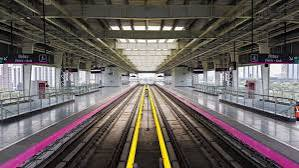
Siemens has delivered an integrated signalling, electrification and communications package for India’s Pune Metro Line 3, a 23-kilometre elevated railway linking the Hinjewadi technology district with Shivajinagar. The corridor was inaugurated on 3 November 2026, with regular passenger services scheduled to begin on 4 November. Siemens’ work includes communications-based train control, a 750V DC third-rail power system, telecommunications, depot equipment and system integration, supported by a ten-year maintenance commitment for signalling and electrification.
The development has been implemented through a public-private partnership involving Tata Group company TRIL Urban Transport and Siemens Project Ventures. Pune IT City Metro Rail Limited was established as the project vehicle under India’s New Metro Rail Policy, while the Pune Metropolitan Region Development Authority awarded the concession. The arrangement combines capital participation and railway systems delivery within a long-term infrastructure project. Siemens Limited has described its role as part of a consortium with Siemens AG and its partners rather than as the sole constructor of the entire corridor.
The 23-kilometre elevated corridor has 23 stations, a depot and a fleet of 22 trains, according to Siemens Mobility. It connects the Hinjewadi employment district with Shivajinagar and other interchange opportunities in Pune. The project is expected to shorten journeys between the corridor’s endpoints by about 50%, a forecast that will depend on the eventual stopping pattern, service frequency and passenger access to stations. The complete railway includes both the civil structures and the electrical, signalling and communication equipment required to run trains on them.
Train movements are managed by Siemens’ Trainguard MT communications-based train control system. CBTC exchanges information between trains and fixed control infrastructure so that movement authorities, train location and separation can be managed with greater precision than a timetable alone provides. The system is designed to support supervision and automatic train operation, but achievable service frequency also depends on station dwell times, operating rules, train availability and the performance of the entire railway. The interfaces between onboard and trackside equipment are therefore central to reliable daily operation.
The initial operating design is Grade of Automation 2, or GoA2, which allows semi-automatic train operation while retaining an onboard operational role for staff. Siemens has also provided for a potential upgrade to GoA4, the grade associated with unattended train operation. That higher grade would require further engineering and operating arrangements before use. The distinction is especially important on a new corridor, where the installed signalling capability, the available rolling stock and the operator’s approved procedures must work together in the initial service configuration.
Power is supplied through a 750V DC third-rail electrification system. A conductor rail provides traction current to suitably equipped rolling stock, while the wider electrical installation must manage substations, protection, distribution and the interaction between power supply and train movement. Siemens says the arrangement gives the corridor an effective electricity supply with a relatively limited visual footprint. The release does not specify substation quantities, power ratings or the final configuration of protection equipment, so those details should not be inferred from the route length.
Alongside the train control equipment, Siemens lists a communications backbone, TETRA train radio, telephones, CCTV, access control and a digital station manager. Those systems carry different operational functions across trains, platforms, the depot and control facilities. Reliable communications provide coordination between personnel and systems, while surveillance and access control support station operation and incident management. Integration is necessary because a failure or loss of information in one subsystem can affect the operator’s ability to supervise the railway as a whole.
Depot workshop equipment forms another part of the delivery, supporting inspection and maintenance of the 22-train fleet. Rolling stock, traction power, communications and signalling must be tested as interacting systems rather than merely as independent purchases. The turnkey package includes systems integration and project management, with Siemens Limited working alongside Siemens AG and project partners. Bringing these elements into the same operating configuration is particularly important when the line is entering its first regular passenger timetable.
A ten-year full-service maintenance agreement covers the signalling and electrification systems after delivery. Planned inspections, component replacement, software maintenance and fault response will have to be coordinated with passenger operation, although the exact contractual performance measures have not been disclosed. Long-term responsibility for these systems brings the equipment supplier into the operational period, when reliability is assessed through the performance of the installed railway rather than through acceptance testing alone.
The passenger opening is being phased. Indian reporting identifies 4 November as the scheduled start of public services at 17 stations following the 3 November inauguration; the remaining six stations are expected to open later, with the staged programme extending into early 2027. Some initially accessible stations will also have limited staircase or escalator arrangements until works are completed. Those arrangements distinguish the completed railway systems delivery from the progressive opening of all passenger facilities along the corridor.
Passenger running across the initial stations will be followed by completion of the remaining station facilities and continued operation of the integrated signalling and power systems. The corridor was developed through a public-private partnership, and Siemens’ maintenance role continues beyond inauguration into a decade of signalling and electrification support. Its future GoA4 upgrade option remains separate from the GoA2 operating configuration being introduced with the new line.