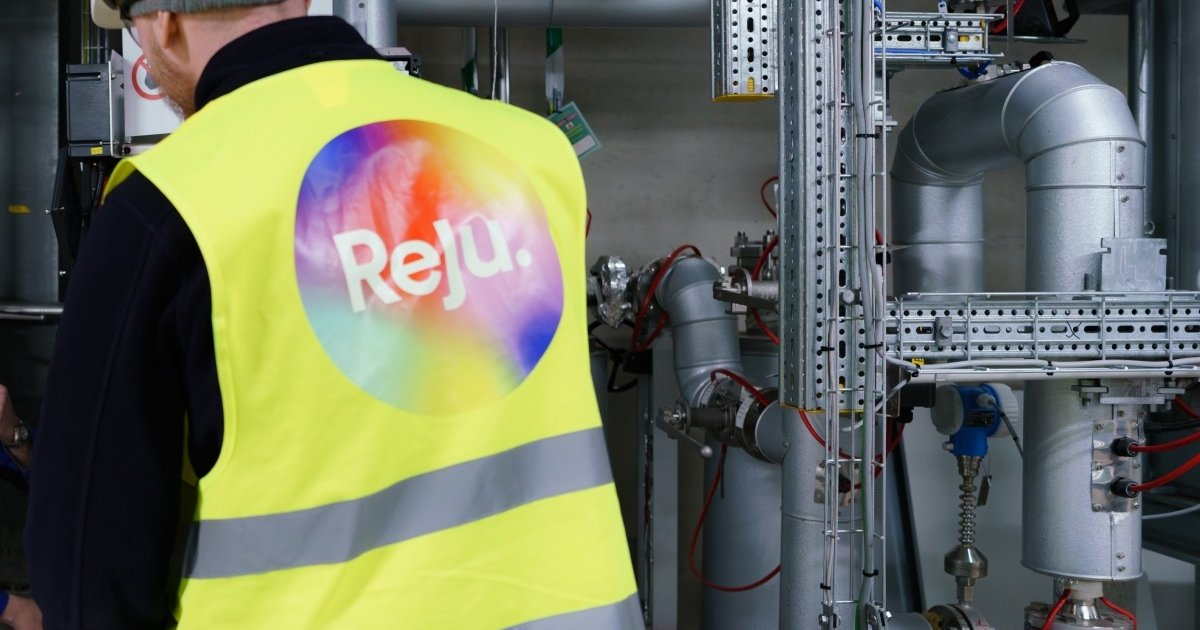
Reju is working with six textile mills in Europe and the Americas to develop fabrics using regenerated polyester, connecting its planned chemical regeneration facilities with the businesses that knit, weave, dye and finish textiles. The partnerships cover distinct production methods, including circular knitting, seamless construction, technical weaving and specialised finishing, with the work organised around development projects for future material supply.
A. Sampaio, RDD Textiles, Tintex Textiles, FOV Fabrics, Utenos Trikotazas and Swisstex Direct make up the group. Five have European production operations, while Swisstex Direct operates in Los Angeles and El Salvador. Reju says each workstream is linked to specific development activity and demand identified through agreements with brands. The mills offer different process capabilities, allowing the company to assess how regenerated polyester can be used across textile constructions rather than relying on a single fabric specification.
Three Portuguese businesses contribute complementary capabilities: A. Sampaio makes circular knitted fabrics, RDD Textiles works with seamless and circular knit structures and recycled-content traceability, and Tintex combines jersey production with dyeing and finishing. Sweden’s FOV Fabrics contributes technical woven materials, while Utenos Trikotazas brings vertically integrated knitting and garment production in the Baltic region. Swisstex Direct extends the network to the Americas through knitting, dyeing and finishing operations.
Regenerated polymer must pass through several production stages before it becomes a finished textile. Polyester must be converted into a form suitable for downstream manufacturing, with consistency in the feed material influencing subsequent spinning, fabric formation and finishing. Knitted structures are shaped by yarn properties and loop formation, whereas woven fabrics rely on different construction and performance requirements. Dyeing and finishing impose further demands on dimensional stability, surface appearance, colour consistency and the intended use of the fabric.
Reju is developing a chemical regeneration route for polyester contained in post-consumer textile waste. Its announced process converts recovered textile material into regenerated bis(2-hydroxyethyl) terephthalate, or rBHET, which is then repolymerised into PET for subsequent textile applications. That differs in process terms from simply grinding a used garment into fibre: the recovery and polymer-making stages are designed to produce new polyester feedstock. No quantified performance results for the individual six-mill fabric trials have been disclosed.
Before discarded polyester can be regenerated, collection and sorting operations have to separate suitable material from mixed-fibre garments, finishes and non-textile accessories. Feed preparation influences both process stability and the eventual composition of the regenerated polymer. Reju has developed upstream recovery and preprocessing relationships alongside its chemical process, and the six mills now extend the industrial chain into fabric construction and finishing. Each stage has different quality and traceability requirements.
A yarn that processes reliably into a knitted jersey may behave differently in a densely woven technical fabric, where yarn tension, dimensional stability and mechanical properties have different limits. Trials across the mills allow the partners to adjust manufacturing specifications, examine fabric formation and assess finishing compatibility. Consistent results between batches will be particularly important when supply moves from trials towards larger volumes; Reju has not published numerical yields or material test results for these six projects.
Patrik Frisk, chief executive of Reju, said: “Every selected mill with whom we are working adds to our circular textile system.” The company, owned by Technip Energies, uses regeneration technology originating with IBM Research. Its Regeneration Hub Zero pilot facility opened in Frankfurt in 2024, providing a development base for the proposed transition towards industrial-scale processing.
Reju has selected Chemelot Industrial Park in the Netherlands for a proposed industrial-scale hub and secured €135m of Dutch government support under the NIKI programme in April 2026. It has also selected locations at Rochester in New York state and Lacq in France for potential hubs. Site selection and funding support are not equivalent to completed construction or unrestricted production approval; Reju has previously stated that final investment decisions are required for industrial projects.
At Chemelot, the company has described an ambition to produce 50,000 tonnes of rBHET annually once the proposed facility is operating. That figure is a project objective, not the output of the current six-mill collaboration. Moving polymer from pilot or first industrial production through certified, repeatable textile conversion will require evidence about quality, traceability and compatibility across the separate stages of the chain. A network of mills gives Reju routes through which to test those requirements ahead of broader manufacturing deployment.
The six mill partnerships establish routes to test regenerated polyester across different textile machinery and product specifications, while Reju’s proposed hubs will determine the supply available for those conversions. No production quantities or purchase volumes have been reported for the six workstreams. The next measurable steps are successful fabric qualification, repeatable manufacturing runs and progress towards commercial operations at the planned regeneration sites.