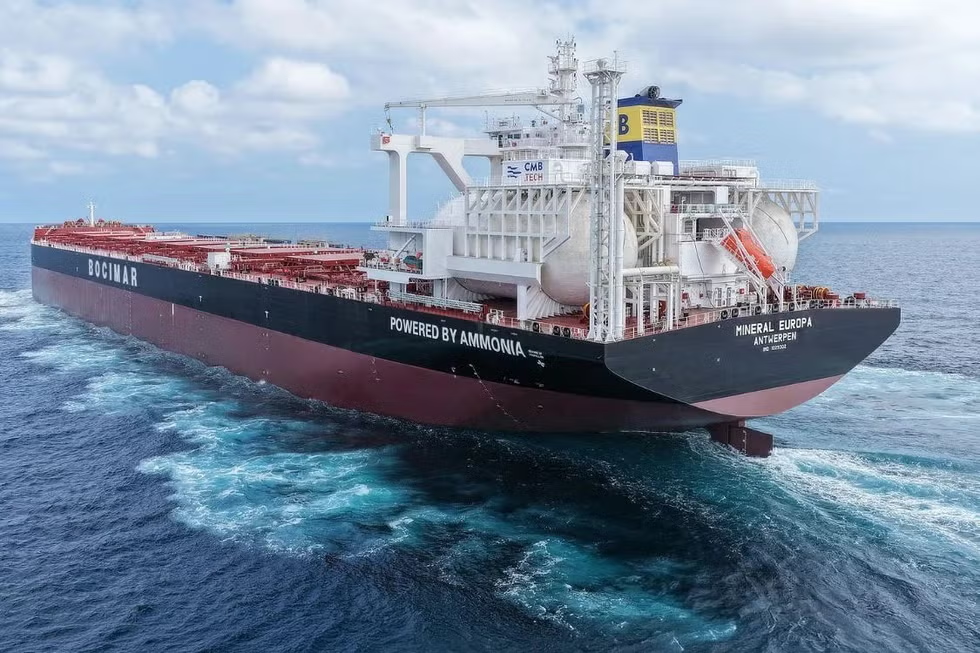
CMB.TECH announced on 9 October 2026 that Mineral Europa, a 210,000-deadweight-tonne bulk carrier capable of operating on ammonia, had begun its maiden voyage to Australia. The Belgian group describes the vessel as the world’s first ammonia-powered dry bulk carrier and the start of a larger order programme.
The company says 21 ammonia-powered ships are scheduled for delivery by 2029, comprising 18 bulk carriers, a container ship and two chemical tankers. These are planned deliveries, not vessels all confirmed in service. Their practical impact will depend on construction, commissioning and fuel availability.
Ammonia contains no carbon, so burning it does not release carbon dioxide directly from the fuel molecule. That narrow point must be separated from emissions generated while producing and transporting ammonia, and from other pollutants that an engine and its after-treatment systems may produce.
Dual-fuel marine propulsion introduces engineering challenges around storage, handling and combustion characteristics. Ammonia is toxic and requires appropriate detection, containment and safety arrangements. The installation and operation of such equipment therefore demand crew training and specific technical safeguards.
Large bulk carriers operate over long distances and require reliable bunkering arrangements. A vessel capable of using ammonia may still depend on the availability, price and specification of suitable fuel at the ports it serves. A maiden voyage does not itself demonstrate a mature worldwide supply network.
The environmental benefit also depends on how the fuel is made. Ammonia produced from hydrogen derived using fossil fuels without effective emissions control can have a different lifecycle footprint from ammonia made using low-carbon electricity and appropriately sourced feedstocks.
The reported milestone is the vessel beginning its maiden voyage. The announcement does not, by itself, establish verified voyage efficiency, fuel consumption or lifecycle emissions reductions. Comparing ammonia with conventional marine fuels would require operational data and an agreed accounting boundary, including the production and delivery of the fuel.
The shipping industry also needs consistent procedures for fuel quality, delivery, onboard storage and emergency response. Port infrastructure and regulations will influence how readily more ammonia-capable vessels can join existing freight routes. These are operational constraints separate from shipyard construction.
Mineral Europa represents a substantial physical engineering milestone because it has moved beyond a concept study into an operating vessel. However, the company’s description of a new propulsion era is promotional interpretation, not an independently measured sector-wide transition.
CMB.TECH has not supplied a full lifecycle emissions assessment for this voyage or verified figures for the share of propulsion energy supplied by ammonia. It would therefore be inaccurate to report the trip as entirely emissions-free without further operating evidence.
Shipbuilders, engine developers, classification societies and vessel operators all have roles in demonstrating safety and performance. The commissioning of a first vessel can provide practical information about maintenance, fuel transfer and operator procedures that is difficult to establish from simulations alone.
The confirmed milestone is Mineral Europa starting its maiden voyage. Subsequent reporting should examine fuel actually used, operating performance, verified emissions and the delivery of the remaining vessels before drawing conclusions about the scale of ammonia propulsion.
Because vessels may be described as ammonia-capable or ammonia-powered, fuel-use reporting deserves particular attention. The descriptions are not interchangeable evidence of what was burned during any given leg of a voyage.
Life-cycle analysis would have to account for ammonia synthesis, the source of hydrogen, transport and the energy used onboard. The absence of carbon in ammonia molecules is important, but not sufficient to determine the climate impact of an entire voyage. The relevant boundaries need to be stated.
Safety assurance is similarly broader than the fuel tank or engine. Crew procedures, ventilation, monitoring and incident response matter wherever the chemical is transferred or stored. A working vessel can generate operational evidence for these systems, but individual incidents and reliability will only become apparent over time.
Commercial operators will assess the new fuel against cost, energy density, vessel range and bunkering availability. These factors can influence how often the ammonia-capable engine is used in practice. A propulsion system that works technically is not necessarily the cheapest choice on every route.
The planned 21-vessel programme creates an opportunity for repeatable engineering lessons if additional ships enter service. The announced timetable is ambitious, but should be tracked through delivery records and operational outcomes rather than treated as a completed fleet.