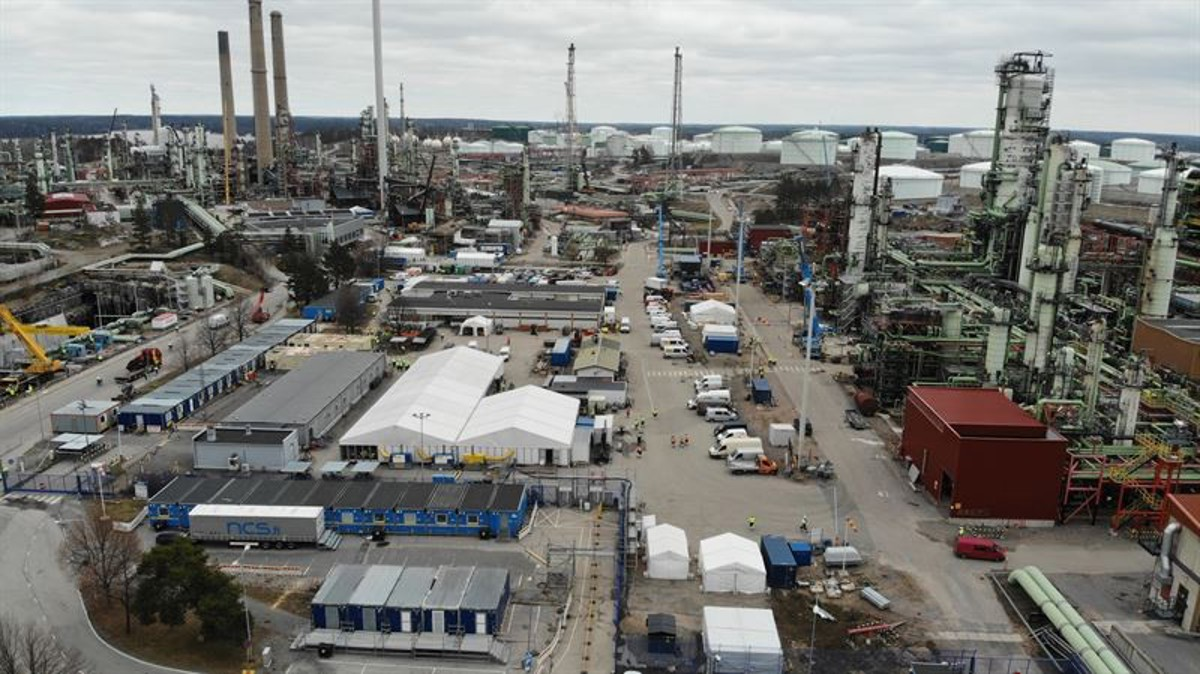
VAROPreem is adding renewable feedstock co-processing at its Cressier refinery in Switzerland, with the site expected to handle around 40,000 tonnes of renewable material annually from 2027. The company estimates that production associated with the programme could reduce carbon dioxide emissions by about 90,000 tonnes a year, although that figure remains a forecast until the modified refinery is operating at the planned volume.
Cressier is Switzerland’s only conventional fuel refinery, with capacity of around 70,000 barrels a day and a role supplying roughly 30% of the national fuel market. The co-processing project therefore modifies an existing strategic energy asset rather than creating a separate renewable-fuels plant, allowing renewable material to enter part of the same manufacturing and logistics system that continues to handle conventional feedstock.
VAROPreem launched the Cressier programme in 2025 with the intention of replacing part of the refinery’s crude input with advanced renewable feedstock; the latest update adds a clearer operating date and an annual volume. Co-processing is attractive because existing equipment can continue to be used where its metallurgy, catalysts and operating conditions are suitable, reducing the need to duplicate every refinery process solely for renewable material.
That flexibility does not make the feedstocks equivalent. Renewable raw materials can differ in composition, impurities and processing behaviour from conventional refinery feeds, so the proportion introduced into an existing unit has to remain within the conditions for which the process can operate safely and produce specification-compliant fuels. VAROPreem has not published the detailed feedstock mix, unit configuration or expected yields for Cressier, leaving those engineering parameters outside the evidence available for the current project.
The planned 40,000 tonnes a year is significant enough to create a recurring renewable stream through the refinery while remaining modest beside its total conventional throughput. That allows the company to accumulate operating experience without making Cressier dependent on renewable feedstock availability from the outset, an important consideration because reliable sourcing can become as large a constraint as the physical processing equipment.
VAROPreem operates across sourcing, manufacturing, trading and logistics, which gives the group a direct interest in securing material as well as converting it. Renewable feedstock markets are influenced by competing demand from fuels, chemicals and other sectors, while eligibility under regulatory schemes can affect which materials have sufficient value to process. The refinery therefore has to combine technical capability with a supply chain capable of delivering suitable feedstock at the planned rate.
Cressier’s existing storage and distribution infrastructure remains useful after the process change because both raw materials and finished fuels must move through an established national system. The company says the refinery will retain its energy-security role while adding renewable production, meaning the project has to be introduced without undermining the availability and reliability expected from Switzerland’s only conventional refinery.
The wider group already has experience of renewable processing through the former Preem operation, including co-processing and subsequent renewable capacity investments in Sweden. Cressier consequently adds another refinery to an existing industrial capability rather than asking VAROPreem to learn the process from scratch, although local feedstock, equipment and operating conditions still have to be validated for the Swiss site.
The combined VAROPreem business now operates seven manufacturing hubs and has access to more than 120 terminals, giving the Cressier programme a broader supply and distribution network than the refinery possessed as a standalone project. Scale at group level can support feedstock procurement and product placement, but it does not remove the requirement for individual refinery units to run reliably when renewable material is introduced.
Start-up in 2027 will provide the first useful comparison with the company’s projections. Reaching 40,000 tonnes of renewable feedstock while maintaining conventional production and refinery reliability would demonstrate that Cressier can absorb a recurring co-processing stream; until then, the 90,000-tonne emissions reduction remains an expected consequence of a manufacturing change whose operating performance has yet to be measured.