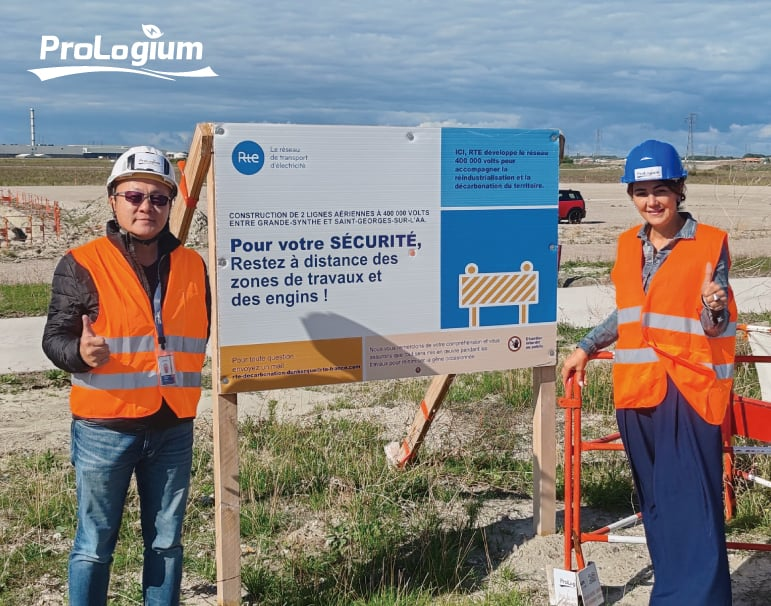
ProLogium has moved its Dunkirk battery gigafactory further into site execution, with electrical infrastructure, grid connection, access, and platform works progressing ahead of planned construction site energisation in early October.
The development follows the start of phase one construction earlier this year and moves the project beyond preparatory activity into coordinated work across several contractors. ProLogium is also continuing engineering, French and European supplier qualification, technology localisation, and workforce development alongside the physical build.
A consortium of Sogea Caroni, Exyte, and Lucas & Gaillard Architectes is responsible for site access preparation, fencing, and platform works. Ardelec Energie is installing electrical infrastructure, while Enedis is carrying out the grid connection. Contractors are now operating under a common health, safety, and environmental framework following an on-site coordination meeting in September.
The immediate electrical milestone is power for the construction site rather than production equipment. It is nevertheless a necessary step before later building services, controlled environments, and manufacturing systems can be installed and commissioned.
The Dunkirk development will be ProLogium’s second gigafactory and its first large manufacturing base in Europe. The company specifies an initial annual production capacity of 4GWh, with an ultimate design capacity of up to 44GWh. Its current project update says mass production is scheduled to begin by the end of 2028.
Battery factories make unusually heavy demands on infrastructure that would be secondary in less sensitive manufacturing operations. Cell production requires close control of moisture, contamination, temperature, material flows, and electrical conditions. Dry rooms, cleanrooms, ventilation, power distribution, and process utilities consequently form part of the manufacturing system rather than simply the building around it.
ProLogium says the Dunkirk facility will include a purpose designed cleanroom and dry room solution and is targeting BREEAM certification. The company intends the site to manufacture its fourth generation inorganic lithium ceramic battery technology, building on its existing manufacturing operation in Taoyuan, Taiwan.
Moving that technology into a much larger European plant creates a second industrial challenge alongside construction: localisation. ProLogium is qualifying suppliers in France and elsewhere in Europe while engineering and technology transfer continue. The objective is to establish more of the production ecosystem close to the plant rather than relying entirely on a supply base developed around its existing Asian operations.
That work covers more than raw materials. Battery manufacturing depends on specialist tooling, process equipment, control systems, inspection, maintenance capability, and tightly managed material specifications. A supplier that can deliver a component is not necessarily ready to deliver it repeatedly at the quality and volume required by a gigafactory.
The company is also developing a regional skills pipeline through partnerships with schools, universities, and training centres in Hauts-de-France. Battery projects across Europe have increased demand for technicians, process specialists, maintenance engineers, and automation expertise, meaning recruitment and training have to develop well before production lines reach commissioning.
Dunkirk has attracted several battery and electrification investments because of its port, industrial land, transport connections, and access to electricity. Those location advantages can reduce some infrastructure constraints but do not remove the execution risks associated with a new large scale battery process.
European gigafactory programmes have shown that announced capacity and delivered capacity can diverge sharply. Financing, equipment lead times, changes in electric vehicle demand, qualification delays, and the difficulty of stabilising new cell processes have all affected projects across the sector. Against that background, physical progress on utilities and buildings provides a more useful indication of delivery than long term capacity targets alone.
ProLogium also has to transfer a chemistry and production approach that differs from the dominant liquid electrolyte lithium-ion processes already manufactured at high volume. Its industrial challenge is therefore not simply to install more of an established line design, but to establish repeatable yield, throughput, quality, and maintenance performance as the process moves to European scale.
The current infrastructure programme does not demonstrate those production metrics, but it moves the project towards the stage at which they can be tested. Grid connection, controlled environments, qualified suppliers, and trained personnel all have to be in place before equipment commissioning can turn a factory building into a functioning production system.
Construction site energisation is the next near-term milestone. Beyond that, progress through the main building, clean and dry environments, equipment installation, and commissioning will provide increasingly useful evidence of whether ProLogium can convert its 44GWh long term ambition into operating manufacturing capacity.