
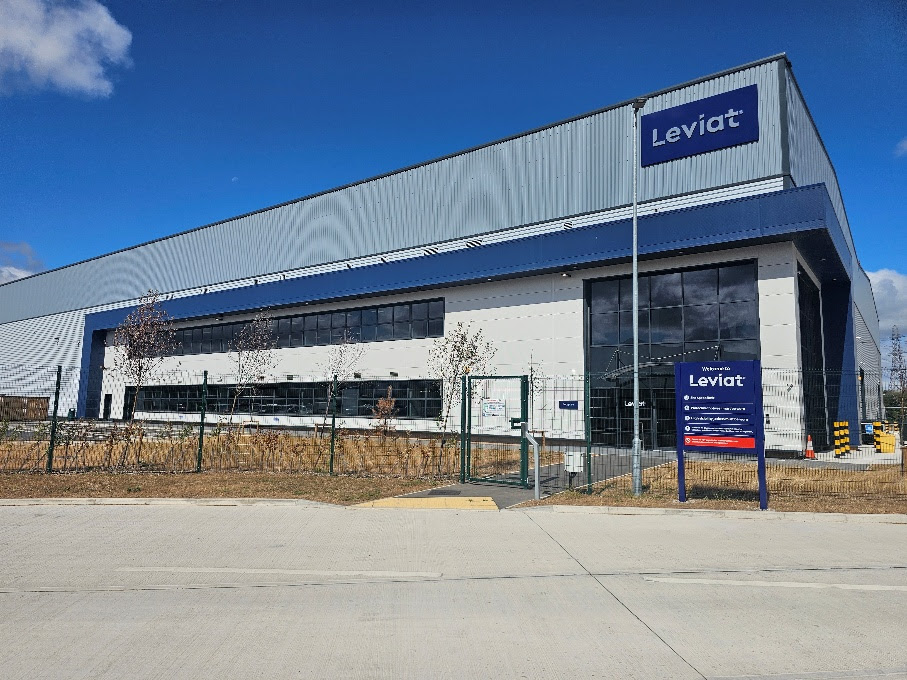
Leviat has opened a 104,000 sq ft manufacturing and distribution hub at The Airfields in Deeside, consolidating production and logistics for several of its structural connection, repair and fixing product ranges on one North Wales site.
The multi-million-pound facility is Leviat’s first purpose-built manufacturing site in Wales and becomes the sole production location for the full Helifix range. It will also manufacture selected Ancon products, primarily for the high-rise residential sector, while serving as the UK despatch hub for Halfen products after warehousing activity transferred from Dunstable.
The combination brings manufacturing, finished-goods storage and outbound distribution together around the same operation. Leviat says the layout is intended to improve internal efficiency, shorten the path between production and despatch and strengthen supply resilience as demand grows across the three product families.
The Deeside site extends more than 40 years of manufacturing activity in North Wales, with the company tracing its regional production base to a Flint factory opened in 1984. Leviat has described the new hub as the next stage in its UK manufacturing strategy rather than a simple relocation, with additional automation and process investment planned as capacity develops.
Rune Magnusson, managing director of Leviat UK and Ireland, said: “Bringing Helifix, Ancon and Halfen operations closer together under one roof means we can respond faster, manufacture more efficiently, and continue to invest in the technology and people that underpin the quality our customers expect.”
Helifix products are used in structural repair, reinforcement and masonry applications, while Ancon supplies engineered connection and reinforcement systems used across concrete and masonry construction. Halfen adds another range of anchoring, fixing and support products to the distribution operation. The ranges are different, but they share customers, logistics requirements and a dependence on consistent manufacturing quality.
That creates an operational case for consolidation. Separate production and warehouse locations generate transport between sites, duplicate stock positions and additional planning interfaces. A common hub can reduce those movements and make production status, finished stock and despatch requirements easier to coordinate, particularly where projects require mixed orders drawn from several product families.
Construction products also face uneven demand. Large projects can create concentrated requirements for specific fixings or connection systems, while site programmes change and delivery dates move. The Deeside facility will need enough manufacturing flexibility and warehouse discipline to absorb that variability without simply transferring delays from production into despatch.
Leviat has already invested in flexible wall-tie manufacturing technology, and the purpose-built layout gives the company more scope to arrange future equipment around material flow rather than fitting automation into inherited factory constraints. Space for additional technology is valuable only if work-in-progress, operators, maintenance access and outbound logistics are designed around the same production model.
The consolidation also gives the business a clearer base for digital production and warehouse systems. Linking manufacturing schedules with stock and transport data can reduce situations in which one area optimises its own performance while creating problems elsewhere. A faster production line, for example, achieves little if finished goods cannot be stored, picked and despatched at a matching rate.
Supply resilience is another stated objective. Bringing several activities together does create concentration risk if one site is disrupted, but it can also reduce dependence on inter-site transfers and give production teams greater visibility over available stock and urgent customer requirements. The balance will depend on business-continuity planning and the extent to which other Leviat operations can support Deeside during an interruption.
The site’s location within The Airfields industrial development gives Leviat a modern manufacturing footprint with direct road access and room for further expansion. Its current UK contact network still includes operations in Sheffield, Luton and other locations, so Deeside becomes a larger node within a broader national structure rather than the company’s only British site.
The product mix also connects the factory closely to construction project delivery. Structural repair, reinforcement and anchoring components can be low in value relative to an entire building but critical to sequencing on site. A delayed specialist component can hold up a larger package of work, making lead-time consistency an important part of the supplier’s value proposition.
Bringing production and distribution together should give Leviat more control over that lead time, although the gains will depend on planning discipline as much as on the building itself. The facility has to convert additional space into shorter queues, more predictable output and better coordination between manufacturing and logistics if the investment is to deliver the claimed efficiency improvement.
Leviat says further capacity and capability investment is planned at Deeside as the business rebalances its UK operations. The opening establishes the physical platform: Helifix production, selected Ancon manufacturing and Halfen despatch now share the same 104,000 sq ft hub. The next phase will determine how much automation and process integration can be built on top of that consolidation.
