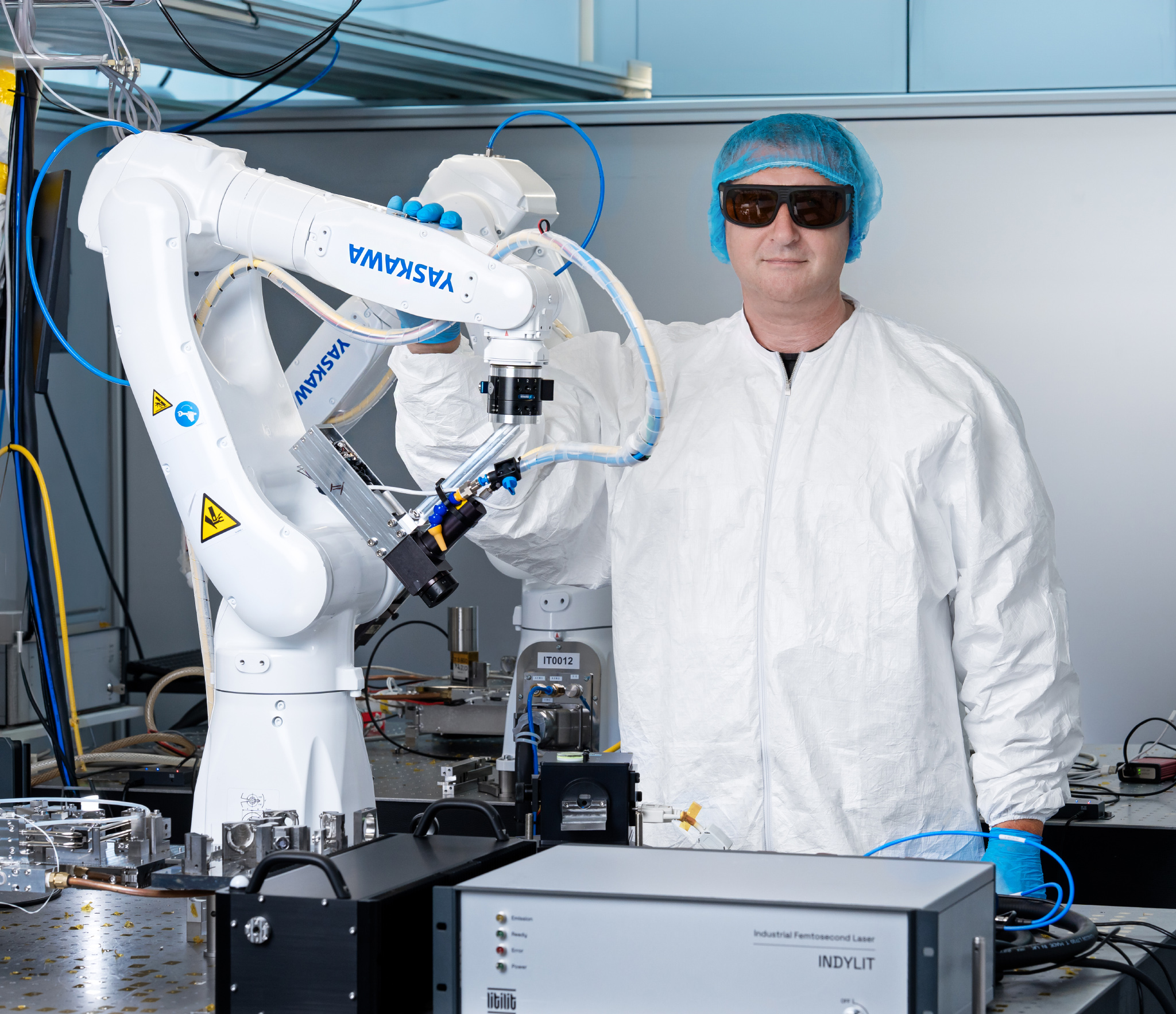
Industrial robots have become faster, stronger, and increasingly capable of handling production variation, but the tool mounted on the end of the arm still determines what the machine can actually manufacture. Lithuanian laser specialist LITILIT believes compact femtosecond lasers could move robots into a considerably higher-value class of work.
The argument is straightforward. Most industrial robots spend their working lives gripping components, loading machinery, tightening fasteners, packing products, welding, or carrying conventional cutting tools. Replace that end effector with an ultrafast laser and the same programmable motion platform could perform precision material processing across electronics, semiconductors, batteries, and medical manufacturing.
Femtosecond lasers generate pulses measured in quadrillionths of a second. The extremely short interaction with the workpiece allows material to be removed or modified while limiting heat transfer into surrounding structures, making the technology useful where conventional thermal processing risks damaging nearby material.
Nikolajus Gavrilinas, co-founder and CEO of LITILIT, said: “Most industrial robots today are used with tools for gripping, screwdriving, bolting, drilling, packing, or similar tasks. Once you equip the same machine with an advanced laser, it can move into a different category of work: precision manufacturing.”
Applications identified by the company include drilling through-glass vias in semiconductor interposers, processing curved cover glass used in foldable electronics, and applying durable traceability marks to electric-vehicle batteries.
Those examples highlight the potential advantage of combining a multi-axis robot with a non-contact processing tool. Fixed laser machines normally depend on controlled positioning of the workpiece or a defined optical system, whereas a robot can move around large, curved, or otherwise awkward components and approach a surface from several orientations.
The idea is technically attractive, but it immediately creates a packaging problem: the laser itself has to be compact enough to become part of a moving automation system.
LITILIT says many femtosecond lasers still reflect their origins in scientific equipment, with large optical architectures, complex supporting systems, and maintenance requirements that are difficult to reconcile with a production robot. The company says reducing the size and complexity of its own systems has been a deliberate design objective.
“Most femtosecond lasers historically came from scientific systems. They can deliver strong performance, but they are often large, complex, and require periodic maintenance,” Gavrilinas said. “Our lasers use a modular design, high level of automation and reduced component complexity, making them compact enough for robotic integration and practical enough for industrial use.”
LITILIT says its units are around 1.5 to two times smaller than a typical femtosecond laser. Its current industrial range includes air-cooled systems intended for material processing, with the company’s architecture based on patented ultrafast-laser technology developed by its founders in collaboration with the Center for Physical Sciences and Technology in Vilnius.
Shrinking the laser does not solve the whole integration problem. A unit installed on a robot has to tolerate acceleration, vibration, changes in orientation, dust, and continuous factory operation without losing the beam stability or optical alignment required for precision processing.
The robot creates another accuracy constraint. Industrial arms are capable of excellent repeatability, but repeatability is not identical to absolute positional accuracy. Micromachining applications may require external calibration, machine vision, metrology, or dynamic path correction if the laser spot has to follow features measured in micrometres.
Process control also becomes more complex once the workpiece itself varies. A robot may need to locate a component, establish its orientation, compensate for manufacturing tolerances, and then keep the laser correctly focused as the tool moves across a three-dimensional surface.
Safety is equally important. A powerful industrial laser moving through several axes requires containment, guarding, interlocks, extraction, and monitoring designed around a beam path that is less predictable geometrically than that of a fixed machine.
Those requirements suggest early deployment will favour applications where the processing value is high enough to justify the additional integration. Semiconductor manufacturing is one candidate because advanced packaging and interconnect structures require increasingly fine features in materials that can be sensitive to heat.
Medical production presents similar possibilities where manufacturers work with miniature parts or need precise cutting, drilling, structuring, or marking without creating a large heat-affected zone. Battery manufacturing offers a different scale but places growing value on permanent traceability and controlled processing around thermally sensitive assemblies.
The wider industrial case depends on whether ultrafast lasers can move from specialist photonics equipment towards a more standardised manufacturing product. LITILIT is addressing that question through its own production expansion in Vilnius.
According to material supplied directly by the company on 9 September, its new femtosecond-laser factory is due to begin production in October 2026. LITILIT plans to increase output over the following years to as many as 3,000 lasers annually.
That scale would require a different manufacturing model from the highly individual assembly often associated with specialised scientific lasers. Components, optical modules, alignment processes, test routines, calibration, software configuration, and final quality assurance all have to become sufficiently repeatable for greater production volumes.
The same standardisation would help robotic adoption. An integrator is more likely to design a repeatable automation platform around a laser with consistent interfaces, predictable service requirements, and established production availability than around equipment requiring substantial individual engineering.
The opportunity is therefore less about creating a robot that can perform every manufacturing task and more about increasing the value of tasks already suited to robotic motion. A six-axis arm does not need to become humanoid to become more capable; changing the tool can be enough to shift it from handling a component to processing that component at micrometre scale.
LITILIT’s proposition still has to prove itself through integration, cycle time, process yield, maintenance, and cost. If compact femtosecond systems can meet those factory measures, however, the next significant advance in industrial robotics may come from improving what sits at the end of an existing arm rather than replacing the arm itself.