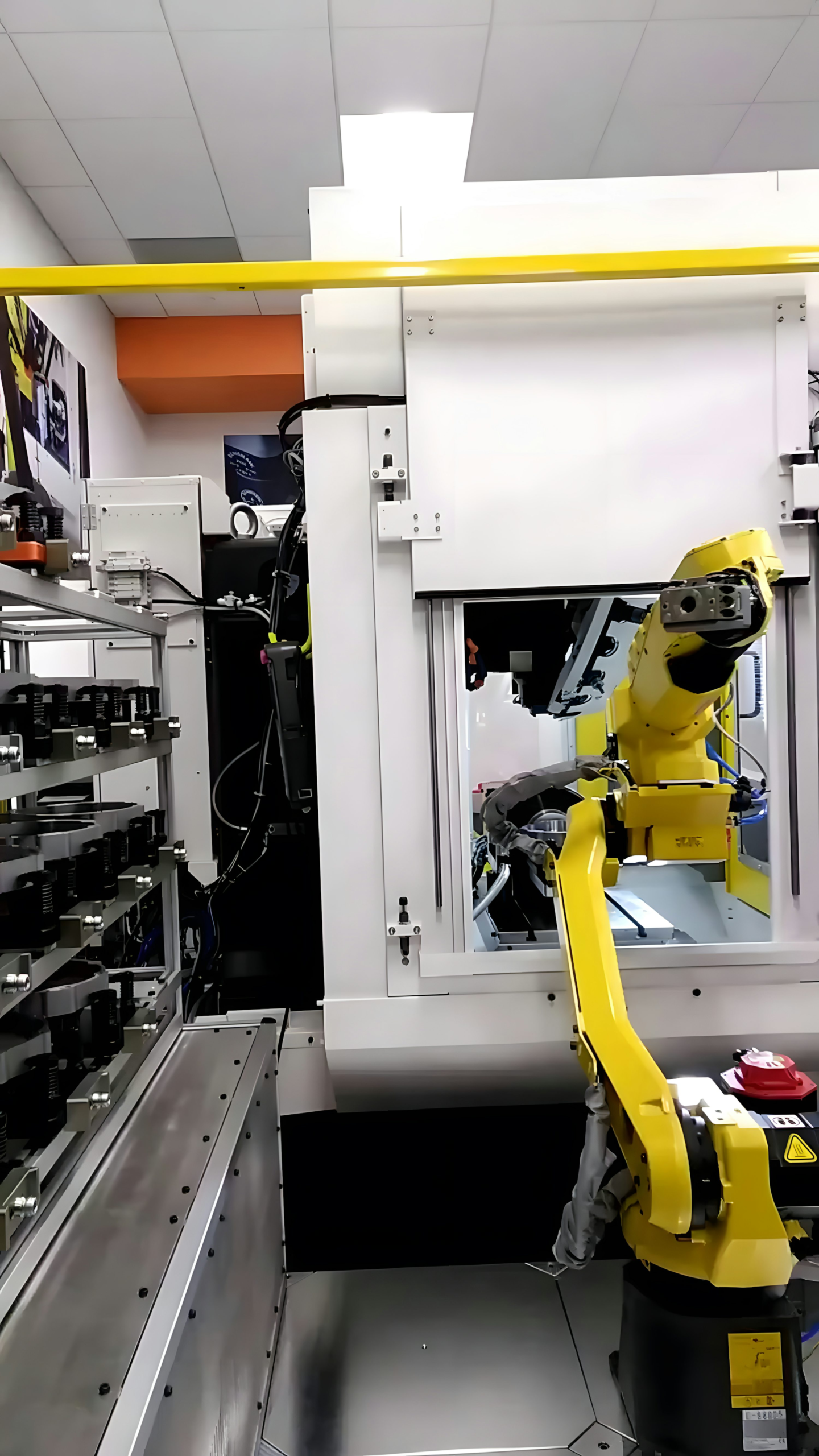
FANUC America and Palladyne AI have begun a strategic collaboration to develop more adaptable industrial-robot deployments, combining FANUC hardware with Palladyne IQ software for motion planning, teleoperation, simulation, learning, and changing operating conditions.
The companies will optimise Palladyne IQ for FANUC robot platforms and jointly validate customer applications across manufacturing, warehousing, and logistics. Their work will also cover standardised deployment methods intended to reduce the amount of bespoke engineering required when similar automation is introduced at different sites.
Conventional industrial robotics performs particularly well where the task, workpiece, tooling, and surrounding environment are tightly controlled. A robot welding a known seam or moving a component between fixed positions can follow a validated sequence at high speed for long production runs.
Greater variability increases the integration burden. Parts may arrive in changing orientations, production batches can switch between products, pallets can be loaded inconsistently, and people or mobile equipment may alter the space around an automation cell. Each variation introduces more sensing, programming, path planning, or operator intervention.
Palladyne IQ is designed to provide a software layer that allows the robot to respond to those changing conditions rather than relying only on a fixed path written in advance. The collaboration will focus on AI-driven motion planning and adaptive behaviour within FANUC’s industrial robot environment.
Motion planning becomes important where obstacles or workpiece locations can move. A traditional robot programme may define a sequence of positions explicitly, while an adaptive system can calculate a path according to current conditions while remaining inside limits covering robot reach, collisions, tooling, and joint movement.
Teleoperation forms another part of the programme. Remote guidance allows a human operator to control or assist a robot when an unusual task or condition exceeds what the autonomous system can handle reliably, giving companies a route to automate processes without requiring every possible situation to be solved in advance.
Human-assisted learning can use those guided operations as examples for subsequent automated behaviour. For some tasks, that could allow a process to be demonstrated and refined through supervised operation rather than created entirely through conventional robot programming.
Simulation will be used alongside physical robots. Virtual environments allow movements, cell layouts, process sequences, and operating conditions to be evaluated before changes are introduced onto the production floor, reducing disruption during application development.
AI model training can also use simulated scenarios to expose the control software to more variations than would be practical to reproduce repeatedly in a live manufacturing cell. The resulting model still has to be validated on physical equipment, but simulation can widen the range of conditions considered before commissioning begins.
Joint customer validation will cover manufacturing, warehouse, and logistics applications. Those environments create different automation requirements, from machine tending and assembly to picking, palletising, packaging, and material movement, but all can become expensive to automate when every deployment requires extensive re-engineering.
Integration remains a substantial part of the cost of an industrial robot cell. The robot is only one component alongside grippers, vision systems, sensors, safety equipment, conveyors, fixtures, programmable controllers, manufacturing software, and connections to surrounding machinery.
Greater adaptability can reduce part of that burden if the same basic robot and software architecture can accommodate a wider range of products or layouts without rebuilding the entire application. Standardised deployment workflows could then help integrators repeat successful engineering patterns across multiple cells and customer sites.
The approach does not remove conventional industrial safety requirements. Robots operating around workers, equipment, and production materials still need defined operating limits, risk assessment, appropriate guarding or collaborative safety functions, and predictable responses to faults.
Adaptive behaviour therefore operates inside an engineered automation system rather than replacing the protection and control layers around it. The potential advantage is flexibility once those boundaries have been established, allowing the robot to adjust its movement or task strategy without every change becoming a manual reprogramming exercise.
That is particularly relevant to manufacturers working with shorter runs and higher product variety. Traditional fixed automation delivers strong economics when the same operation is repeated at high volume, while more adaptable robotics can potentially lower the threshold at which automation becomes practical for variable production.
Warehousing faces a similar challenge. Cartons, totes, pallets, and individual items arrive in combinations that cannot always be constrained as tightly as components inside a dedicated fixture, making perception and adaptive handling increasingly important to robotic picking and movement.
The programme now moves through software optimisation and joint application validation. Its industrial value will depend on whether the same integration approach can be repeated across robot models, customer plants, products, and operating conditions without each installation becoming a largely bespoke software project.
If that repeatability can be demonstrated, adaptive motion planning and assisted learning would extend the range of processes that can be automated using established industrial robot hardware, particularly where variability rather than robot speed or payload has been the principal barrier to deployment.