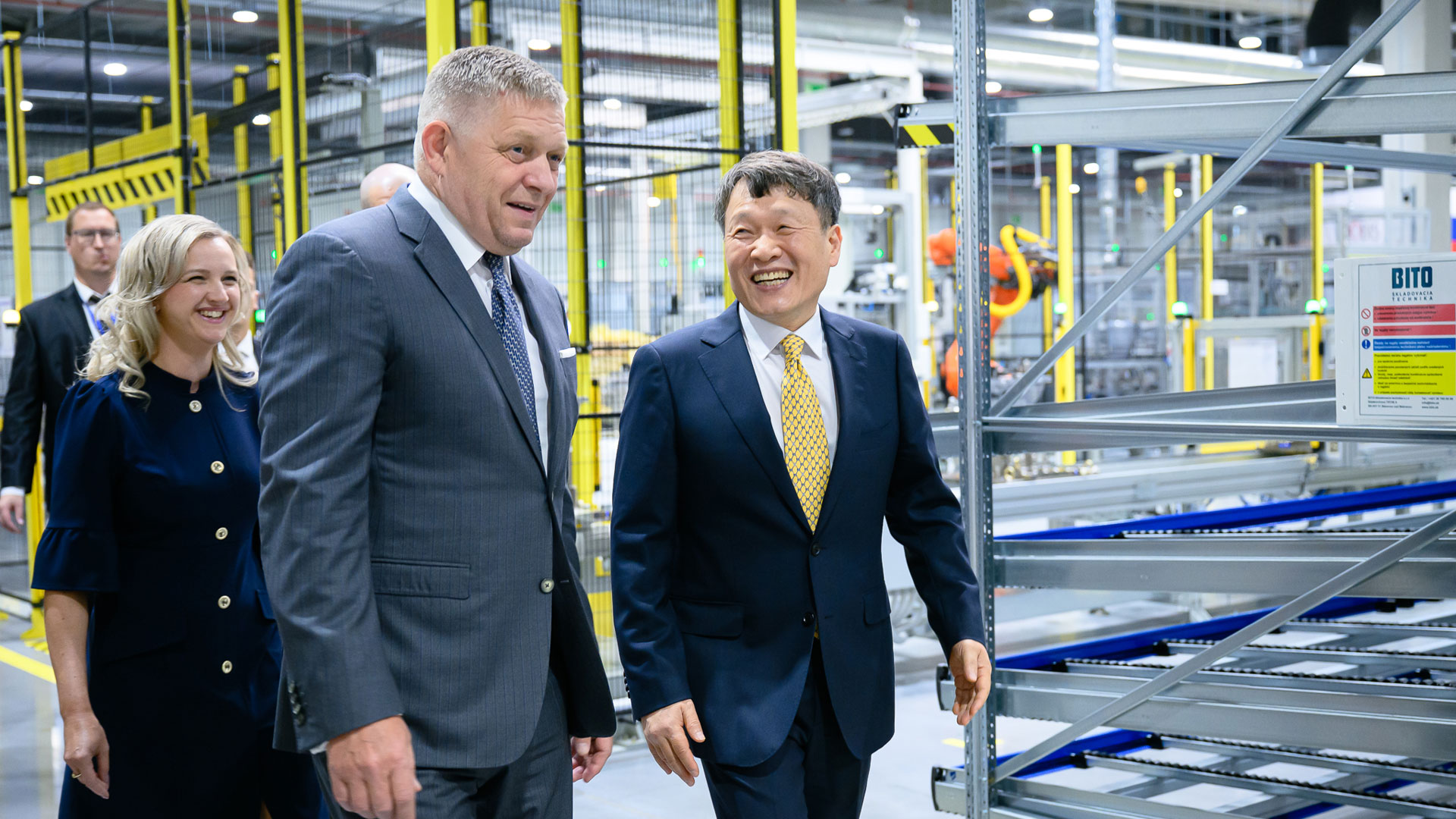
Hyundai Mobis has started mass production at its new power-electric systems plant in Nováky, Slovakia, establishing its first European manufacturing operation dedicated to integrated EV propulsion units.
The facility has annual capacity for up to 280,000 PE systems and contains production lines for stators, inverters, and associated components. Hyundai Mobis defines the PE system as an integrated electric powertrain combining an electric motor, inverter, and reduction gear.
The Nováky operation occupies a site of approximately 106,000 square metres, with a total floor area of 8,500 square metres. Hyundai Mobis says around KRW250 billion has been invested in the plant.
It becomes the company’s third electrification production base in Europe, following battery-system assembly operations in the Czech Republic and Spain. Adding PE-system manufacturing gives Hyundai Mobis another major part of the electric drivetrain within its regional production network rather than limiting its European footprint to battery assemblies.
The production start follows an investment agreement signed with the Slovak government in October 2024. At that stage, Hyundai Mobis planned annual capacity of 300,000 PE systems at Nováky, alongside additional investment in braking-system and airbag production at its existing Žilina operation.
The completed Nováky plant is now rated at up to 280,000 systems annually. The difference between the original planning figure and installed capacity is relatively modest, but it underlines the distinction between an announced investment and the production configuration that eventually reaches the factory floor.
Vehicle-component plants are routinely adjusted during engineering as customer schedules, equipment layouts, cycle times, line balancing, and product specifications become firmer. What matters at the current stage is that Nováky has progressed from a planned manufacturing asset to one running serial production.
The integrated PE system brings together manufacturing disciplines that would otherwise sit in separate component streams. Stator production involves electrical conductors, insulation, joining, impregnation, and dimensional control, while inverter production combines power electronics, electrical connections, cooling interfaces, control electronics, and high-voltage testing.
Those components ultimately have to operate as one propulsion system with the motor and reduction gear. A production defect may therefore appear as an electrical, thermal, acoustic, durability, or efficiency problem at vehicle level rather than presenting itself neatly as a fault within one manufacturing process.
That places considerable weight on end-of-line testing and traceability as output rises. A plant capable of producing 280,000 systems a year cannot rely on extensive manual investigation of each unit; processes need to detect variation early enough to prevent faults travelling through assembly and into completed vehicles.
Hyundai Mobis expects the site to supply Hyundai Motor and Kia as well as other global vehicle manufacturers. Slovakia already hosts production operations for Kia, Volkswagen, Stellantis, and Volvo, giving component suppliers access to one of Europe’s densest automotive manufacturing clusters.
The company is using that concentration as part of its strategy to increase business with customers outside Hyundai Motor Group. Hyundai Mobis has said it wants global customers to account for 40% of revenue by 2033, although the latest plant announcement does not disclose individual customers or contracted volumes for Nováky.
Installed capacity should therefore not be mistaken for expected annual output. Production will depend on awarded vehicle programmes, shift patterns, utilisation, component availability, product mix, and the speed at which European EV programmes move through launch and volume ramp-up.
That last variable remains difficult for suppliers. European manufacturers have altered the timing of individual EV programmes as consumer demand, regulation, battery economics, and investment priorities have changed. Production equipment has to be installed years before the final market volume is known, leaving suppliers to balance future capacity against the cost of underused lines.
Regional manufacturing can reduce transport distances and shorten the physical supply route between component and vehicle plants, but it also concentrates more fixed assets in Europe. The business case consequently depends on sustained programme awards rather than the strategic appeal of localisation alone.
Hyundai Mobis already operates electrification production facilities in Korea, the US, the Czech Republic, Spain, and Indonesia. Nováky adds a European base for propulsion systems to that network and gives the company another route to serve vehicle plants without importing every major electrification component from outside the region.
Serial production is now the relevant measure. The opening establishes the available capacity; quality, yield, takt time, equipment availability, and repeat customer orders will determine how much of the 280,000-unit ceiling is eventually used.