Fairbanks Morse Defense is investing €6.98 million to expand its Vestdavit manufacturing operation at Redzikowo in northern Poland, creating a global Davit Manufacturing Centre of Excellence for maritime launch-and-recovery equipment. The enlarged site is intended to support European and NATO customers and is targeted for completion in the fourth quarter of 2027.
The project will increase the existing building from approximately 3,000m² to 5,600m² and is expected to raise annual production by about 80%. Fairbanks Morse says the additional space will provide capacity for up to 150 davits a year while allowing several systems to move through assembly in parallel rather than relying on a more sequential production flow.
About €5 million of the investment is allocated to new buildings, with a further €1.9 million directed towards production equipment and a test yard. New halls will cover steel fabrication, machining, assembly, and testing for systems produced by Fairbanks Morse businesses Vestdavit and Welin Lambie, alongside hydraulic and electrical assembly, winch installation, advanced CNC machining, and expanded test capability.
Davits are specialised handling systems used to deploy and recover boats, uncrewed vessels, rescue craft, and other equipment from ships. The engineering requirement extends beyond nominal lifting capacity because the system must operate while the host vessel moves, with structures, hydraulics, electrical drives, winches, controls, and the craft itself remaining within defined load and motion limits.
Manufacturing repeatability is therefore important. Structural fabrication, machining tolerances, welding, corrosion protection, hydraulic assembly, electrical installation, and load testing all influence the finished system, particularly where naval customers expect equipment to remain serviceable in harsh environments over long operating lives. Bringing more of those activities into one enlarged plant reduces the number of external production interfaces while giving the manufacturer tighter control over final assembly and verification.
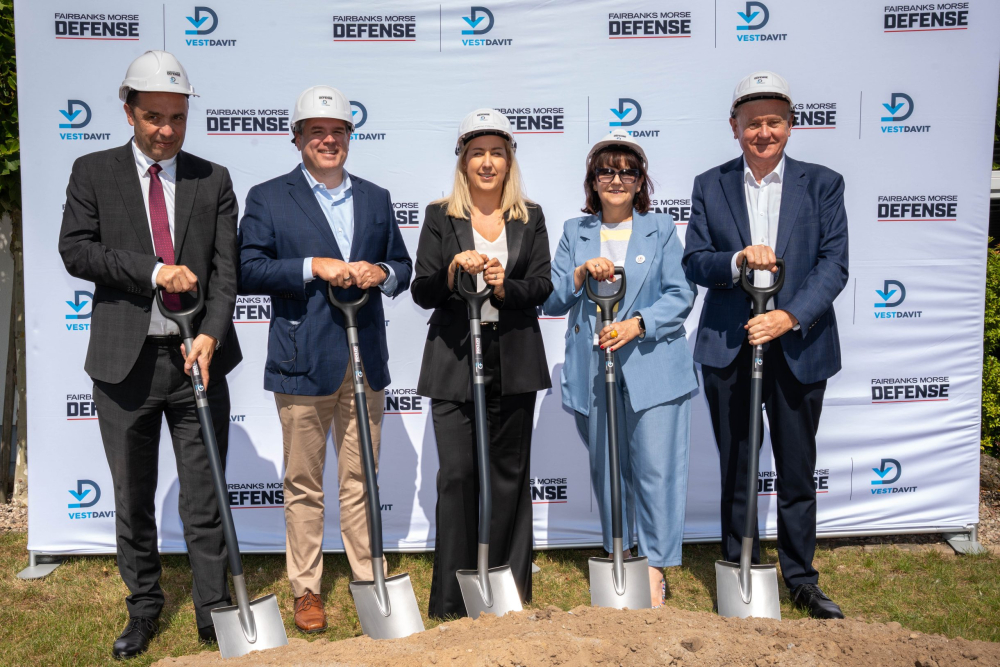
The Redzikowo facility is being developed with the Pomeranian Regional Development Agency, which manages the Słupsk Special Economic Zone and supports investment through the Polish Investment Zone programme. A groundbreaking ceremony was held on 13 August before the expansion was announced publicly on 17 August.
Headcount is expected to rise with the building. Fairbanks Morse anticipates workforce growth of around 30% over the next three years, creating demand for welders, electricians, hydraulic technicians, assemblers, and engineers. The company and Vestdavit are working with local municipalities and educational institutions on recruitment, tying the capital programme to a requirement for specialised manufacturing skills.
Location is part of the operating case. The Polish site will provide more localised manufacturing and lifecycle support for European naval fleets, reducing the distance between customers and production, maintenance, engineering, and spare-parts capability. That is particularly relevant to equipment intended to remain in service for many years, when inspection, repair, upgrades, and technical support can become as important as the initial delivery.
The expanded factory is also being configured for demand from both crewed and autonomous maritime platforms. Uncrewed craft still have to be launched safely, recovered in changing sea conditions, secured aboard a host ship, maintained, and returned to service. More autonomous vessels therefore create an additional equipment requirement around the handling systems that connect them to larger ships.
Fairbanks Morse’s investment forms part of a broader move towards more regional defence manufacturing and support capacity in Europe. The company is headquartered in the United States, but the Polish plant gives it an industrial base closer to European customers and reduces dependence on moving complete handling systems across longer international supply chains.
Localisation does not remove supply chain exposure. Davit production still depends on steel, machined parts, hydraulic equipment, motors, controls, winches, electrical components, and specialist coatings sourced from a wider network. The difference is the point at which those inputs are integrated and tested, with additional CNC capacity and a dedicated test yard bringing more manufacturing stages under direct control.
Testing capacity is particularly relevant because launch-and-recovery systems have to demonstrate structural, hydraulic, electrical, and control performance before delivery. A dedicated yard gives the site more room to verify complete assemblies under controlled conditions, reducing reliance on external facilities and helping production and acceptance testing move through the plant together.
By the end of 2027, the practical measure will be whether the enlarged operation can sustain the promised 80% increase in output while maintaining the testing and quality requirements associated with naval equipment. The programme at least provides concrete numbers against which that claim can be judged: €6.98 million of investment, 5,600m² of factory space, a larger skilled workforce, and capacity for up to 150 davits each year.