Quinbrook has brought Stage 2 of its Supernode battery storage project into commercial operation and reached financial close on A$469 million of debt funding for Stage 3, advancing the Queensland development towards more than 3GWh of capacity.
The first three stages at Brendale, north of Brisbane, are planned to provide 780MW and 3,074MWh once the current expansion is completed. Financing across those phases now totals approximately A$1.2 billion.
Stages 1 and 2 use CATL EnerC Plus storage systems and have moved through commissioning into operation under long-term contracted arrangements. Stage 3 will use CATL’s TENER S platform and is now backed by its own debt package and offtake structure.
The site sits adjacent to the South Pine substation, an important hub in Queensland’s power network. CATL and Quinbrook say the location offers approximately 4,000MW of available connection capacity, allowing Supernode to be expanded in phases without relying on a completely new transmission corridor.
That grid position is one of the project’s most valuable physical characteristics. Battery developers can secure land, equipment, and financing only to find that network access becomes the longest part of the programme. A storage asset earns revenue by moving power into and out of the grid, so connection capability determines how much of the installed battery can actually be used.
Supernode’s first three stages are structured around long-term contracted revenue rather than an entirely merchant exposure to electricity prices. That makes equipment reliability and availability particularly important because the project has to provide defined capacity to counterparties over many years.
CATL’s role consequently extends beyond supplying battery containers. The company will support the project through a long-term service agreement covering condition monitoring, performance tracking, fault response, and preventive maintenance across the operating life of the storage systems.
Those functions become increasingly important as grid batteries mature from new installations into long-lived infrastructure assets. Cell degradation, cooling performance, auxiliary systems, control electronics, and balance-of-plant equipment all influence how much usable power and energy remain available after repeated cycling.
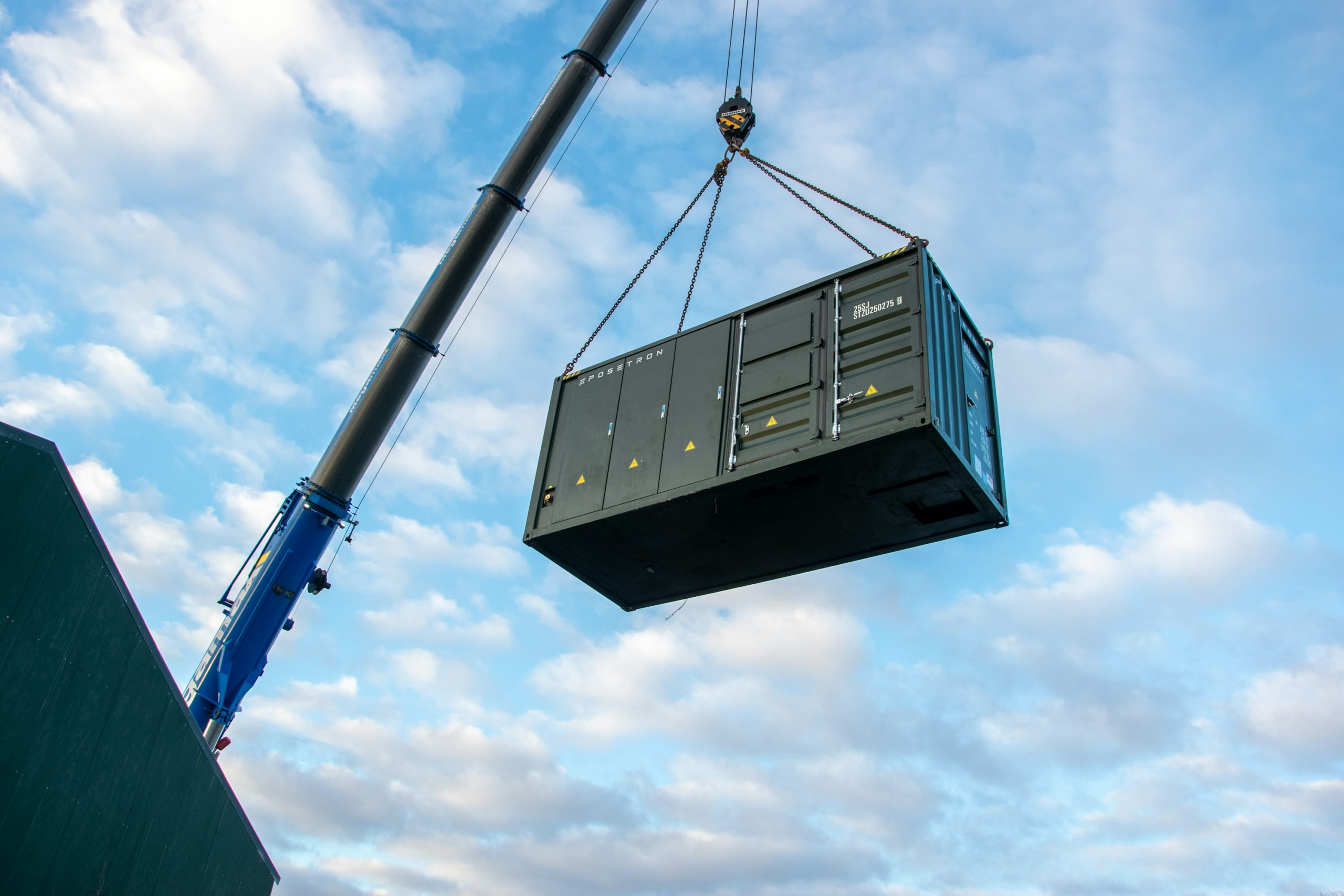
The EnerC Plus equipment used in Stages 1 and 2 is designed for high-density installation. CATL says the system permits back-to-back container placement and can reduce required site footprint by around 20% compared with its preceding EnerC design, allowing more storage capacity to be installed within a constrained industrial site.
Thermal control forms another part of that design. CATL specifies an integrated liquid-cooling system intended to keep temperature differences inside a container within 5°C, with the product engineered around a 20-year lifecycle.
Temperature consistency affects both safety and asset performance. Cells exposed repeatedly to different thermal conditions can age at different rates, creating imbalance within a pack and reducing the amount of energy that can be used without exceeding operating limits.
At hundreds of megawatts, those small differences accumulate into an asset-management problem. Operators need to know which racks or containers are degrading more quickly, when maintenance is required, and whether contractual capacity can still be delivered without pushing equipment outside warranty or safety limits.
Stage 3 adds another 260MW and 1,216MWh to the first two phases, taking the combined project to a duration of just under four hours at full rated output. That makes the completed three-stage development capable of shifting a substantial block of electricity between periods rather than functioning only as a short-duration frequency-response asset.
The project is being developed as Queensland adds variable renewable generation and network infrastructure. Storage can absorb electricity during periods of high supply and discharge it later, but its value depends on network location, market conditions, operating strategy, and the contractual services it is required to provide.
Quinbrook and CATL are also studying an eight-hour storage system called EnerQB for possible later Supernode stages. That work remains prospective and is separate from the financed three-stage project, so the additional duration should not be counted as committed capacity.
The distinction between operating, financed, and proposed capacity is important in a storage market containing large development pipelines. Supernode has already moved substantial equipment into commercial service, Stage 3 has reached financial close, and any later expansion still has further investment and delivery decisions ahead.
The South Pine connection gives the site room to consider that expansion. Quinbrook has previously identified potential for further storage and other power-intensive infrastructure around the campus, although future phases will still require their own commercial case and approvals.
The immediate programme is simpler: complete Stage 3 using the newly financed package and bring the full 780MW/3,074MWh first-three-stage development into operation. With Stage 2 now commercial rather than merely installed, Supernode has moved another substantial portion of its capacity from project pipeline into working grid infrastructure.