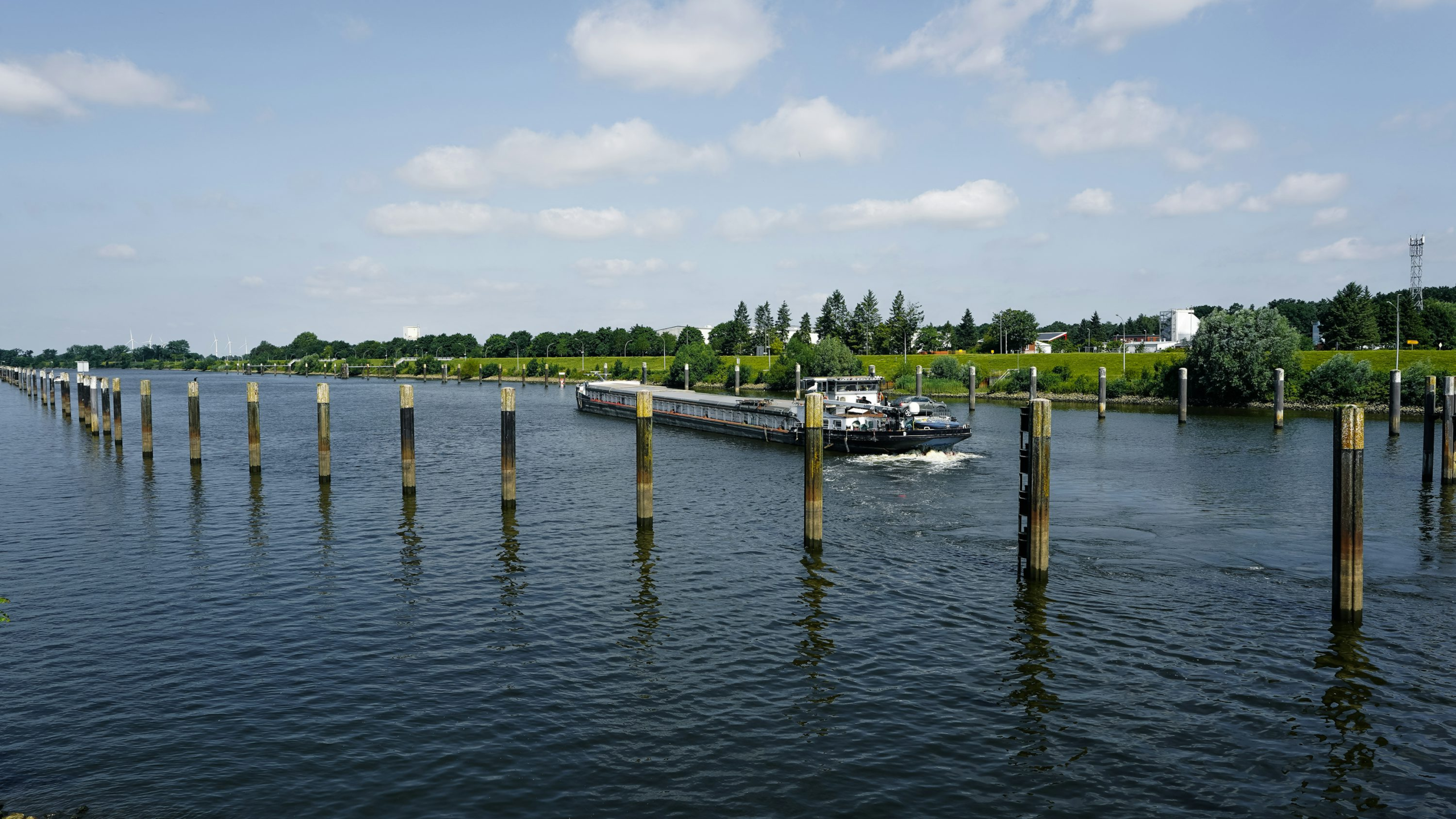
Persistently low water levels on the Rhine are disrupting freight movements for German steel producers, renewing pressure on one of Europe’s most important industrial transport corridors. The German Steel Association, WV Stahl, says restricted navigation is threatening supply security in a sector that depends heavily on inland waterways for large-volume freight.
Kerstin Maria Rippel, managing director of WV Stahl, raised the issue at a meeting convened by German Federal Transport Minister Steffen Bilger with representatives from government and industry. Around one-third of the German steel industry’s freight volume moves by inland waterway, leaving mills exposed when reduced river depth limits the load vessels can safely carry.
Lower draught does not necessarily stop a barge moving, but it can sharply reduce the tonnage carried on each journey. More vessels or more voyages are then needed to move the same quantity of ore, coal, scrap, alloys, semi-finished material, or finished steel, increasing freight costs and making delivery schedules harder to maintain.
Steel producers have strengthened their contingency arrangements since previous periods of severe Rhine disruption. Companies have expanded storage capacity and made logistics chains more flexible, providing additional inventory and alternative routing when river conditions deteriorate. Those measures reduce immediate exposure but cannot create railway paths, locomotives, wagons, trucks, terminals, or river depth.
The limitations become particularly visible in heavy industry because the underlying material flows are so large. River transport remains efficient for bulk commodities precisely because one vessel can move quantities that would require many road vehicles or substantial rail capacity. Replacing that movement at short notice is therefore a network-capacity problem rather than simply a question of choosing another transport mode.
Rippel has called for faster measures to improve navigation on the Middle and Lower Rhine, stronger rail capacity as a dependable alternative, and additional rail and road freight options during disruption. She said: “Low water levels must not become a permanent competitive disadvantage for Germany’s industrial sector.”
The warning comes as German and wider European steel producers are already managing weak demand in parts of the manufacturing economy, high energy costs, decarbonisation investment, and a changing trade regime. Additional freight costs and unreliable arrival times add another operational variable, particularly for plants dependent on continuous raw-material supply.
Inventory can provide a buffer but carries its own cost. Larger stock holdings tie up working capital, require storage space, and can only cover disruption for a finite period. Maintaining alternative rail or road contracts also costs money even when those routes are not required, which means resilience has to be funded rather than treated as spare capacity that appears when the river falls.
Competition for alternatives can intensify quickly because the Rhine serves far more than steelmaking. Chemicals, refining, construction materials, energy, and other bulk industries use the same corridor, so several sectors can seek rail paths, trucks, terminal capacity, and storage at the same time. A hydrological problem can therefore become a wider industrial-logistics constraint.
The steel sector is particularly sensitive to uneven deliveries because integrated and continuous production processes are designed around stable material flows. Delayed raw materials can affect stockyard management and furnace scheduling, while difficulties moving finished material can fill storage areas and interfere with outbound customer commitments. Disruption does not need to halt a vessel completely to create a factory problem.
Germany has invested in contingency measures since the Rhine’s severe low-water periods exposed these vulnerabilities, but company-level adaptation has physical limits. Operators can carry more stock and spread freight across different modes, yet they cannot independently expand public rail networks or accelerate river-engineering projects.
The current episode therefore brings infrastructure policy back into the cost base of industrial production. A tonne of steel does not become easier to transport because the customer is prepared to wait, and high-volume alternative freight capacity cannot be ordered overnight. If periods of restricted Rhine navigation become more frequent, the cost will increasingly appear in inventories, freight contracts, plant schedules, and capital expenditure rather than merely in river-gauge readings.