Eni’s Liverpool Bay carbon capture and storage project has entered into a lease with The Crown Estate, securing the seabed rights required for the offshore transport and permanent storage elements of the HyNet industrial cluster.
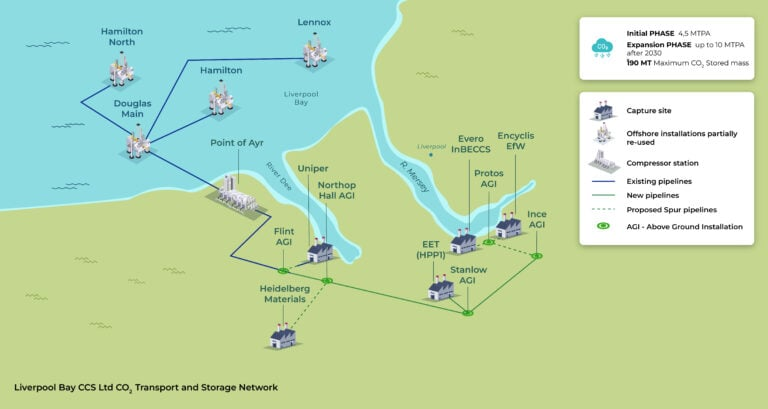
The agreement advances a network that will move captured carbon dioxide from industrial sites across northwest England and north Wales through a combination of new and repurposed infrastructure. Once offshore, the gas will be injected into depleted hydrocarbon reservoirs beneath Liverpool Bay for permanent geological storage.
Liverpool Bay CCS received an agreement for lease in August 2024 before reaching financial close in April 2025. Conversion into the full lease provides the legal basis for the storage development as engineering, procurement, construction, and commissioning work proceeds towards first injection in 2028.
More than 75 miles of existing pipelines, three offshore structures, and an onshore gas treatment plant are expected to be reused, while approximately 21 miles of new pipeline will connect industrial capture facilities into the network. Initial storage capacity is planned at around 4.5 million tonnes of carbon dioxide per year, rising towards 10 million tonnes annually after 2030 as further emitters connect.
Repurposing oil and gas infrastructure reduces the amount of new offshore construction required, but the original assets cannot simply be placed into carbon dioxide service without extensive assessment. Pipelines, structures, wells, valves, seals, control systems, and treatment equipment were designed around hydrocarbon production and must now be demonstrated as suitable for a different fluid and operating regime.
Dense-phase carbon dioxide places specific demands on dehydration, pressure control, corrosion management, compression, metering, and emergency isolation. Water content must remain tightly controlled because moisture combined with carbon dioxide can produce strongly corrosive conditions, while impurities from different capture plants may alter phase behaviour and transport limits.
Engineers must establish whether existing pipeline materials, welds, valves, and seals remain suitable after years of service. Fracture control receives particular attention because decompression behaviour in carbon dioxide pipelines differs from conventional natural gas operation, increasing the need for reliable modelling, inspection, and crack-arrest strategies.
The offshore wells and reservoirs introduce a further layer of assurance. Legacy drilling records, cement condition, casing integrity, reservoir pressure, fault behaviour, and historical production data must support evidence that injected carbon dioxide will remain contained over the long term.
Monitoring will continue throughout injection and after operations cease, using pressure data, seismic information, well surveillance, and other techniques to confirm how the stored plume moves underground. Storage is therefore managed as an extended industrial process rather than completed when carbon dioxide leaves the pipeline.
The Crown Estate lease follows the regulatory progress made by the Morecambe carbon storage project, as depleted offshore fields are repositioned within a broader carbon management system. Although the projects differ in timing and commercial structure, both depend on transferring offshore engineering experience into a new regulated storage market.
HyNet was selected as a Track-1 carbon capture, utilisation, and storage cluster in 2021, with Liverpool Bay CCS forming the shared transport and storage backbone. Industrial emitters from sectors including cement, hydrogen, energy from waste, and chemicals can connect to a common route instead of developing separate offshore infrastructure.
Shared networks reduce duplication, although they also create strong interdependence between projects. A capture plant cannot deliver its intended emissions reduction when compression, pipeline, or storage infrastructure is unavailable, while the network operator needs sufficient connected volume to support efficient operation.
Commissioning schedules must therefore be coordinated across businesses using different capture technologies, contractors, financing structures, and regulatory approvals. A delay at one large emitter can alter network throughput, while a delay in the transport system can leave completed capture equipment unable to operate commercially.
Approximately £2 billion of supply chain investment has been associated with the Liverpool Bay development, with around 2,000 construction roles expected during delivery. Contracts extend across offshore structures, pipelines, modifications, compression, fabrication, installation, control systems, inspection, and engineering services.
British offshore contractors have decades of experience in subsea systems, process equipment, platform modification, pipeline installation, and integrity management. Carbon storage provides a route to apply those capabilities as conventional hydrocarbon production declines, although the new market will depend heavily on regulated returns and durable government policy.
Capture systems also add energy demand to industrial plants, particularly through solvent regeneration, gas treatment, drying, and compression. Their operation must therefore be considered alongside process efficiency, electrification, fuel switching, and material changes rather than treated as a substitute for reducing avoidable energy use.
Some emissions remain difficult to remove through those routes alone, particularly where carbon dioxide arises directly from the chemistry of cement, lime, hydrogen, or other processes. Access to common transport and storage infrastructure may determine whether those activities can continue under tightening carbon constraints.
The lease moves Liverpool Bay CCS beyond site reservation and into a more concrete stage of delivery. Reused offshore assets, new pipelines, industrial capture plants, and reservoir monitoring must now be assembled into a single operating system by 2028, leaving limited tolerance for delay across the cluster’s connected engineering programmes.