ModuleWorks has made four machining and data exchange plugins available within Siemens NX CAM, extending the platform with physics-based roughing, turning, feed optimisation, and manufacturing data export.
The tools are being offered through the Siemens Xcelerator portfolio and operate within the established NX manufacturing environment. Engineers can apply the additional capabilities without exporting components into a separate CAM system or rebuilding the programming workflow in another application.
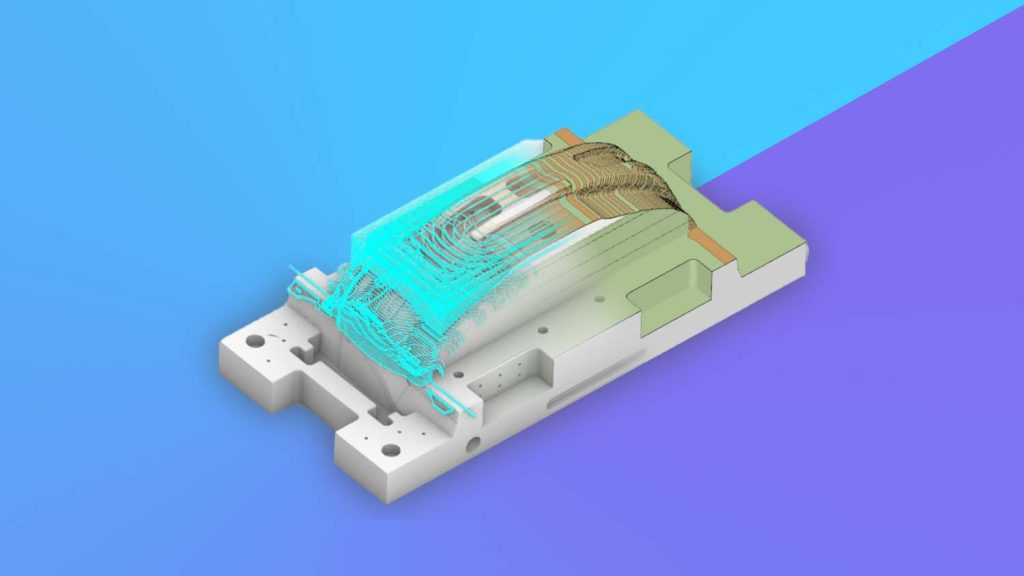
VoluMill is intended for high-performance rough milling, generating toolpaths that control engagement and cutting conditions to increase material removal while reducing sudden changes in cutter load.
Conventional offset or pocketing strategies can force a tool into corners or rapidly changing engagement angles, producing peaks in cutting force. Programmers commonly compensate by reducing the feed rate across an entire operation, leaving less demanding sections below the practical capability of the machine and cutter.
VoluTurn applies a related optimisation approach to turning. It automates parts of toolpath creation, reduces the amount of manual CAD construction required, and controls insert engagement during roughing operations.
FeedControl uses physics-based simulation to examine cutting conditions along a programmed path. Feed rates can then be adjusted according to the workpiece material, tool, machine, and local engagement rather than remaining fixed through sections with substantially different loads.
The MDES Exporter produces standardised descriptions of tools, fixtures, components, and associated manufacturing information. Those data can be passed into simulation, computer-aided setup, verification, or other digital production systems.
Keeping all four functions within NX CAM reduces file transfers and interface stages between programming activities. Companies can retain their established NX data structure, post-processors, revision controls, and permissions while adding specialised optimisation tools.
CAM moves closer to the cutting process
Traditional CAM systems concentrated principally on generating collision-free geometry for a cutting tool. Newer optimisation methods incorporate information about material removal, tool engagement, force, machine capability, and thermal behaviour.
The change is being driven partly by the cost of machine time. Five-axis machining centres, mill-turn systems, and automated cells represent substantial capital investments, making idle time and conservative toolpaths increasingly expensive.
Cutting tools are also capable of higher performance, although manufacturers cannot exploit their full operating envelope when programs rely on general feed values that ignore local engagement. A physics-based method can increase speed where the cut is stable and reduce it when the tool encounters a heavier load.
More consistent loading can shorten the cycle while reducing breakage, improving surface condition, and making tool life more predictable. Predictability becomes particularly valuable during unattended machining, where a failed cutter may stop a cell until personnel return.
Turning optimisation addresses a related programming burden. Complex profiles and interrupted cuts often require engineers to construct avoidance geometry or control entry and exit movements manually, consuming skilled programming time before the job reaches the machine.
Software cannot compensate for unstable workholding, incorrect tool selection, poor machine condition, or inconsistent stock. Calculated strategies remain dependent on accurate data describing tool geometry, holder limits, spindle performance, material, and starting condition.
Manufacturers adopting the plugins will therefore need validated libraries and disciplined setup practices. Incorrect values can produce sophisticated toolpaths that bear little relationship to the physical process, potentially increasing rather than reducing risk.
Data exchange has become more valuable as optimisation extends beyond CAM. Tool presetters, simulation packages, machine monitoring systems, scheduling platforms, and digital work instructions all depend on consistent descriptions of the planned manufacturing process.
Manual re-entry creates opportunities for error. A tool can be assigned the wrong gauge length, a fixture may differ from the simulated configuration, or a revised component can reach the machine without the corresponding setup information.
Standardised export does not produce a complete digital thread by itself, although it reduces the need to reconstruct manufacturing information within each downstream application. The benefit grows when companies operate multiple machines, programming departments, or production sites.
Integration inside NX also removes some of the organisational friction associated with adopting separate software. New applications create training, licensing, support, governance, and post-processor requirements that may outweigh their technical benefit in smaller production teams.
Regulated manufacturers will still need to validate new toolpath methods before using them on controlled aerospace, medical, energy, or defence components. Deployment is therefore likely to begin with selected operations where cycle time, insert life, or tool breakage can be measured against the existing process.
Machine shops continue to face shortages of experienced programmers as product variation increases. Automating routine toolpath decisions can release skilled personnel for process planning and problem solving, although judgement remains necessary to determine whether a proposed operation is stable and appropriate.
ModuleWorks and Siemens are placing physics-based optimisation closer to the point where production data is created. Its value will be measured on the machine through repeatable cycle reductions, longer tool life, and fewer interruptions rather than the complexity of the generated path.