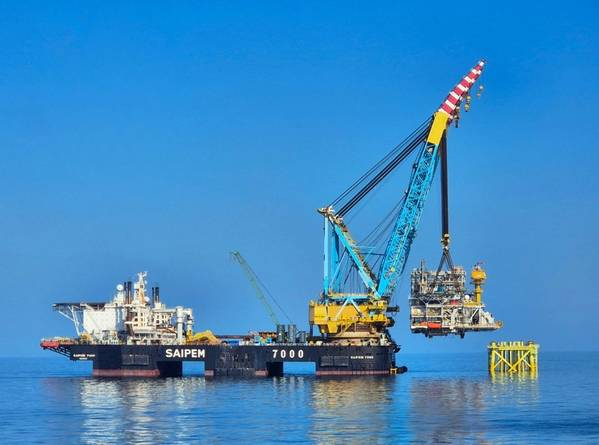
Saipem has completed a major offshore installation campaign for the Neptun Deep gas development in the Romanian Black Sea, including the jacket and topside for the project’s remotely operated production platform.
The Saipem 7000 heavy-lift vessel installed a 135-metre jacket weighing approximately 7,500 tonnes before lifting the 9,000-tonne topside into position. Eight steel piles secure the structure to the seabed, creating a combined installed platform weight of around 16,500 tonnes.
Neptun Alpha will receive gas from the Domino and Pelican fields before sending production through a 160km, 30-inch export pipeline towards the Romanian coast. OMV Petrom operates the development in partnership with Romgaz.
The wider project includes ten production wells, three subsea production systems, manifolds, flowlines, the offshore platform, export infrastructure, and an onshore metering station near Tuzla. Domino lies in water depths of around 1,000 metres, while Pelican is located in approximately 125 metres.
Connecting fields across those depths requires deepwater subsea engineering and more conventional platform infrastructure within one integrated development. Control systems, flow assurance, power, communications, metering, and export capacity must operate across both environments before commercial production can begin.
Saipem fabricated the jacket at its Arbatax yard in Italy and the topside at Karimun in Indonesia. The multinational production programme involved transporting two large structures to the Black Sea before weather-sensitive installation work could start.
The platform has been designed for automated, remotely controlled operation, reducing the requirement for permanent offshore accommodation. Instrumentation, communications, power continuity, condition monitoring, and onshore control systems consequently assume a larger role in routine production.
Under the engineering, procurement, construction, installation, and commissioning contract awarded in 2023, Saipem is also responsible for the project’s subsea works and export pipeline. Castorone is handling deepwater pipelay, while Castoro 10 is supporting nearshore sections.
Construction moves towards subsea integration
Neptun Deep is expected to contain around 100 billion cubic metres of recoverable gas, with planned annual production of approximately eight billion cubic metres. That output could increase Romanian supply substantially and reduce the country’s dependence on imported gas.
First production remains scheduled for 2027, although the platform installation represents only one stage of the remaining programme. Drilling, subsea installation, pipeline work, testing, commissioning, and the integration of offshore and onshore equipment must still be completed.
Subsea reliability will be especially important at Domino, where equipment is installed at depths that prevent direct human access. Valves, connectors, controls, and monitoring equipment must be qualified for long-term operation while retaining the ability to support remotely operated vehicle intervention.
Flow assurance presents another demanding area. Pressure, temperature, water content, and fluid composition affect how gas moves through subsea lines and the export pipeline, with hydrates, liquids, corrosion, or deposits capable of reducing production when they are not controlled.
The development is advancing as Europe attempts to reduce dependence on Russian pipeline gas while increasing renewable electricity. Black Sea production cannot replace all imported energy, but it offers a regional source connected to infrastructure within the European Union.
Gas remains contested within European energy policy because a new field can operate for several decades. The project partners will therefore face continued examination of methane leakage, operational emissions, energy consumption, and the long-term role of the infrastructure as demand changes.
Neptun Deep also draws from a limited pool of offshore construction resources. Heavy-lift vessels, pipelay ships, subsea engineers, welders, remotely operated vehicle crews, and commissioning specialists are required across oil and gas, offshore wind, interconnectors, and carbon storage projects.
When several developments enter the installation phase simultaneously, vessel availability and specialist labour can influence schedules as strongly as equipment manufacturing. Weather windows in the Black Sea add a further constraint because heavy lifts and pipelay operations require defined sea conditions.
Romania must also ensure that its onshore network can receive and distribute increased production. Offshore capacity creates commercial value only when pipelines, metering stations, storage, and regional connections can deliver gas to domestic or export customers.
The remotely operated platform reflects a broader change in offshore design. Sensors, data transmission, digital models, and condition monitoring allow more activity to be supervised from shore, reducing routine travel and personnel exposure.
Remote operation simultaneously raises the requirements placed on cyber security and communications resilience. A loss of connectivity must not compromise safe operation, while control systems require segregation, access management, and recovery arrangements suited to critical infrastructure.
Completion of the heavy-lift work removes one of the project’s most visible construction risks. The remaining subsea and commissioning activity will determine whether wells, pipelines, controls, processing equipment, and onshore systems can operate as one production chain.
Neptun Deep is now moving from structural installation towards integration. Progress over the following year will determine whether one of Europe’s largest offshore gas developments reaches first production on schedule and delivers the regional supply expected from its substantial Black Sea reserves.