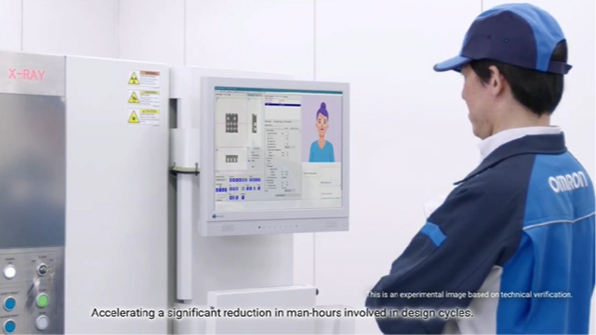
OMRON is integrating NVIDIA simulation and artificial intelligence technology with optical and CT X-ray inspection systems used in advanced electronics manufacturing.
The development combines OMRON’s automated optical inspection and VT-X 3D CT X-ray platforms with NVIDIA Omniverse, Metropolis, and Cosmos technologies. Digital twins will reproduce board deformation, while AI agents will search manufacturing data and assist with defect diagnosis.
One of the first applications concerns printed circuit board warpage created during heating and cooling. Even small deformation can alter component position, solder-joint geometry, mechanical loading, coplanarity, and the reliability of densely populated assemblies.
Warpage is influenced by board construction, copper distribution, component mass, package materials, moisture, tooling, reflow temperature, heating rate, peak temperature, dwell time, and cooling. The deformation changes throughout the thermal cycle rather than existing as one fixed condition.
OMRON plans to use physics-based simulation within Omniverse to reproduce the board’s movement and the forces resisting it. Engineers will be able to examine changes that are difficult to see directly and adjust the thermal profile before defects become established.
Reliable simulation requires accurate material and process data. Thermal expansion, elastic behaviour, package geometry, layer construction, boundary conditions, and oven conditions all affect the result, while a simplified model can produce convincing but misleading deformation.
The inspection system will also combine three-dimensional surface information from automated optical inspection with internal structures captured by CT X-ray. Overlaying the two datasets can reveal relationships that remain obscured when each inspection result is reviewed separately.
A component displaced at the surface may correspond with a void, solder distribution, package condition, or internal feature beneath it. Connecting those observations moves inspection beyond identifying a visible anomaly towards reconstructing how the defect developed.
Manufacturers are already linking inspection stages so that information from solder-paste inspection, optical inspection, and X-ray systems can be examined together. Connected surface mount inspection platforms increasingly use results from one machine to guide analysis elsewhere on the line.
OMRON’s planned visual inspection agents will use NVIDIA Metropolis Blueprint for Video Search and Summarisation with Cosmos models. An operator will be able to ask about a defect, after which the system can search historical images, compare similar boards, and propose likely causes or next actions.
Factories already retain large quantities of inspection data for traceability, but much of it is never reused to improve the process. Images may be stored under defect codes that vary by product, machine, shift, or engineer, making earlier cases difficult to retrieve when a similar problem reappears.
Visual search can identify related conditions even when the textual description differs. Process settings, board revision, component lot, machine history, earlier corrective action, and subsequent yield can then be considered alongside image similarity.
The resulting recommendation still requires engineering validation. Boards showing comparable deformation may have different causes, while historical corrective action may have coincided with improvement without producing it.
AI output therefore needs an auditable connection to the evidence used. Operators should be able to see which images, process records, and assumptions informed a recommendation rather than accepting an unexplained instruction to alter production.
Data quality presents another constraint. Incorrect defect labels, incomplete maintenance records, inconsistent process names, and missing board revisions can cause a model to reproduce earlier mistakes at greater speed.
Governance will have to cover access permissions, model versions, data retention, cybersecurity, and the approval of changes proposed by an agent. Electronics programmes serving automotive, medical, aerospace, and other regulated sectors may require records showing exactly how an inspection decision was reached.
Motohiro Yamanishi, company president of OMRON’s Industrial Automation Company, said the combined system would allow production factors to be visualised while helping less experienced operators interpret inspection data.
The shortage of skilled technicians gives the technology a clear operational role. High-density assemblies, hidden connections, smaller packages, and demanding reliability requirements have increased the number of results requiring specialist judgement.
Automating routine classification can free experienced engineers to concentrate on new or ambiguous failures, provided that false calls do not increase reinspection and line stoppage. Accuracy must therefore be measured against manufacturing outcomes rather than the apparent sophistication of the model.
Yield improvement offers the strongest economic test. A useful digital twin should reduce defect escape, rework, programming time, and repeated process investigation while shortening the introduction of new products.
OMRON’s integration places simulation, inspection, and historical knowledge within the same production environment. Its industrial performance will depend on whether those systems remain synchronised and whether the AI can distinguish genuine process relationships from the large volume of incidental variation present on an electronics line.