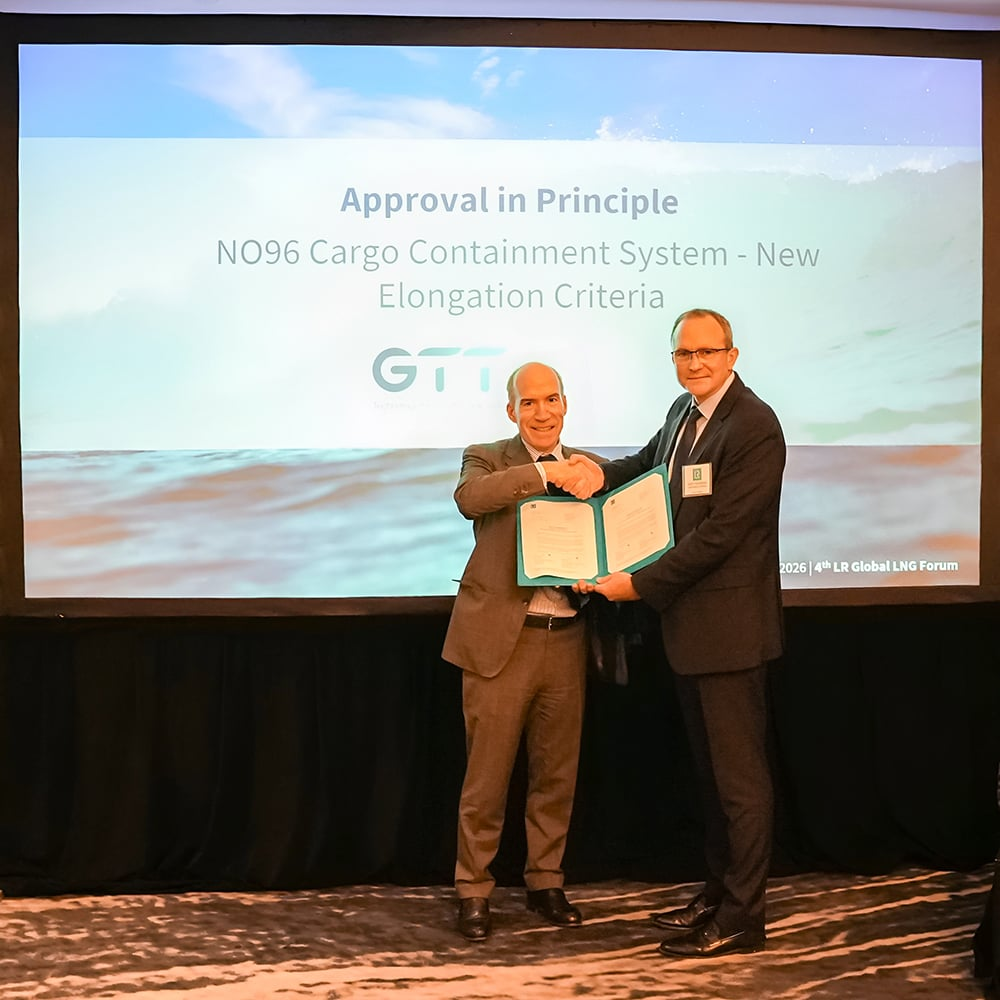
GTT has received approval in principle from Lloyd’s Register for revised elongation criteria covering LNG carriers equipped with its NO96 membrane cargo containment system.
The approval confirms that updated limits governing allowable hull deformation beneath the membrane and insulation system comply with classification requirements and relevant international regulations.
Lloyd’s Register examined operational, thermal, hydrodynamic, and hull-induced loads using a representative LNG carrier design. The assessment considered several NO96 variants, hull geometries, and load cases before confirming that the revised criteria remained within established safety margins.
Naval architects can now work within a broader structural design envelope while retaining requirements for stress, fatigue, membrane integrity, and insulation performance. The change could support lower lightship weight and more efficient use of steel where detailed analysis demonstrates sufficient margin.
NO96 is a membrane containment system in which the LNG tanks form part of the ship’s internal structure rather than existing as independent pressure vessels. Metallic membranes contain the cryogenic cargo, while insulation boxes transfer loads towards the surrounding hull and limit heat ingress.
That arrangement makes the relationship between hull movement and containment performance particularly important. A ship bends, twists, expands, and contracts under waves, loading changes, cargo temperature, ballast condition, and operational forces.
Deformation must remain compatible with the membrane, insulation, supporting structure, and connections throughout the vessel’s service life. Local movement that appears modest at hull scale may still affect a containment component designed to remain leak-tight at cryogenic temperature.
Approval in principle does not certify a finished ship. It confirms that the proposed technical method is feasible and capable of satisfying the applicable rules, allowing designers and shipyards to proceed towards detailed, project-specific analysis with greater confidence.
Weight reduction has become more valuable as LNG carrier designs incorporate additional equipment for emissions control, reliquefaction, boil-off gas management, lower-carbon propulsion, and onboard power. Each system competes for structural allowance, machinery space, electrical capacity, cooling, and maintenance access.
Removing unnecessary steel can reduce propulsion demand or preserve capacity for cargo and equipment. The benefit must be considered against fabrication complexity, material cost, welding, inspection, vibration, and fatigue behaviour rather than assessed solely through nominal weight.
Fatigue remains a defining constraint because LNG carriers can operate for several decades and accumulate a large number of wave-induced load cycles. A structure may remain below its maximum stress limit while still developing cracks at welded details or geometric transitions after repeated loading.
More refined modelling allows engineers to identify where earlier criteria contained excess conservatism and where margin remains necessary. Finite element analysis, hydrodynamic simulation, material data, and full-scale service experience can support selective optimisation without reducing the overall safety standard.
Cryogenic temperature adds further complexity. Materials contract and their mechanical behaviour changes as the cargo approaches -162°C, requiring the containment system to accommodate thermal movement while remaining resistant to fatigue, impact, and accidental loading.
Partial filling conditions can generate sloshing loads that differ from those experienced when a tank is full. Vessel route, sea state, loading practice, and operating profile therefore influence the structural cases that must be assessed for a specific design.
Independent classification review gives shipyards, owners, insurers, charterers, and regulators a common technical basis before construction begins. It can also reduce duplicated assessment when a revised criterion is applied across a series of vessels sharing the same design principles.
GTT’s systems are installed across a substantial portion of the LNG carrier fleet, so revised design guidance can influence a large number of future ships. Adoption will remain dependent on individual owners and yards demonstrating compliance for each hull.
Constantinos Chaelis, global gas segment director at Lloyd’s Register, said: “Our review confirmed that GTT’s updated NO96 elongation criteria remain within established safety margins while allowing designers greater flexibility.”
François Michel, chief executive officer of GTT, said: “These enhanced design criteria provide greater flexibility for ship designers while preserving the highest standards of safety and membrane integrity.”
The revised criteria do not prescribe how designers should remove weight or rearrange structure. They permit a more closely optimised solution where analysis supports it, leaving naval architects responsible for balancing global hull strength, local stress, fatigue, fabrication, containment performance, and operating life.
As gas-carrier designs become more densely equipped and emissions requirements add further systems, that freedom can help prevent structural conservatism from consuming capacity needed elsewhere. The resulting vessels will still require detailed assurance, since efficiency gained through optimisation is valuable only when the containment system remains dependable throughout decades of service.