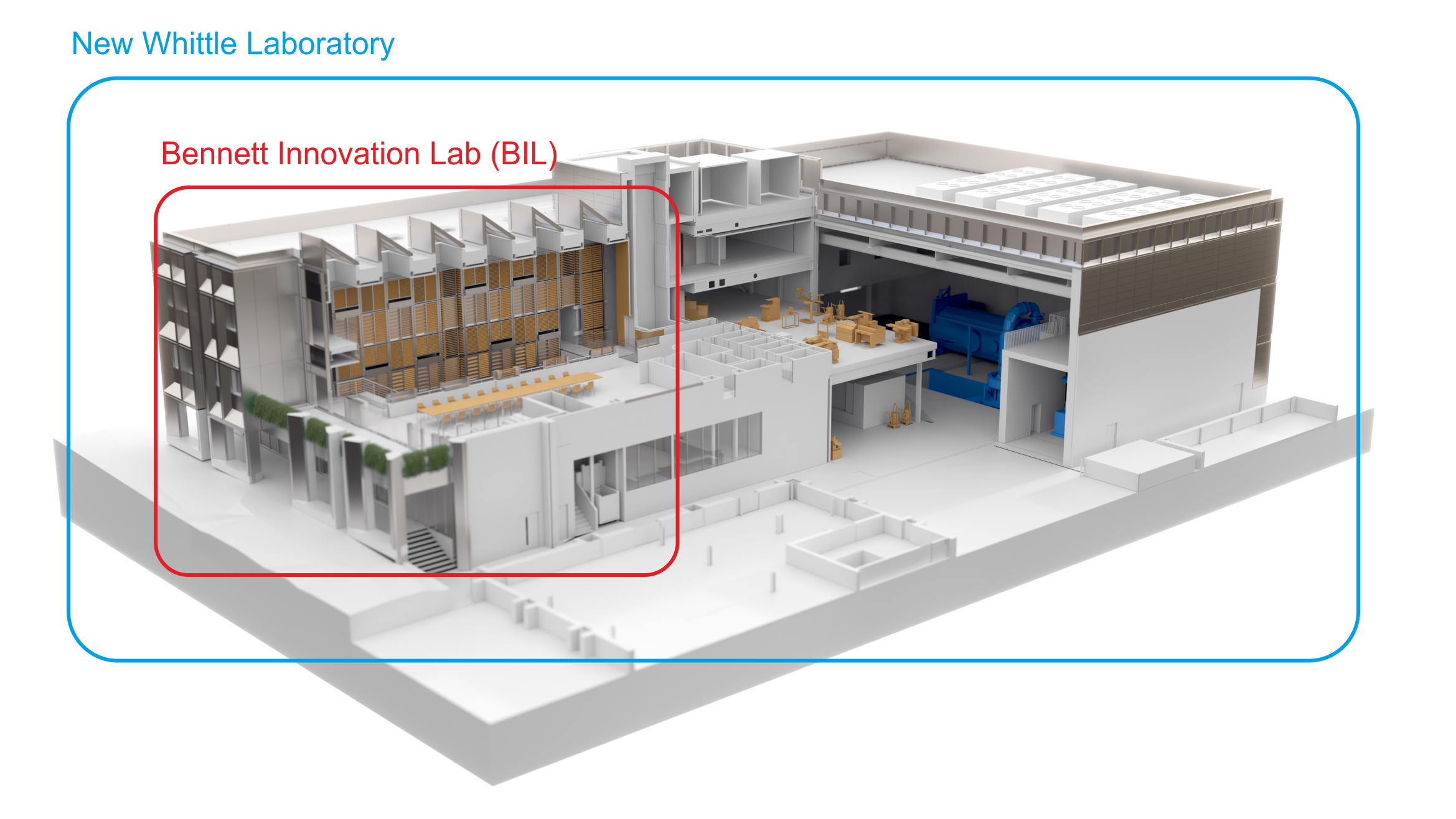
The University of Cambridge has opened advanced high-pressure testing capability at the Whittle Laboratory, allowing engineers to reproduce representative turbomachinery conditions while developing new propulsion and energy technologies on shorter cycles.
Forming part of the Bennett Innovation Laboratory and the UK National Centre for Propulsion and Power, the facility brings aerodynamic design, manufacturing, instrumentation, testing, and data analysis into a closely connected research environment.
High-pressure operation allows smaller experimental hardware to reproduce many of the flow conditions found within full-scale compressors, turbines, and fans. Researchers can examine efficiency, stability, heat transfer, loading, vibration, noise, and component interaction without immediately manufacturing a complete engine or industrial machine.
Scaling a test does not remove the underlying engineering difficulty. Reynolds number, Mach number, pressure ratio, temperature, blade speed, surface finish, and geometric tolerance must be managed carefully if data from a reduced-size rig is to represent a production system accurately.
Turbomachinery performance is particularly sensitive to interactions across several components. A blade geometry that improves efficiency at one operating point can increase losses, stall risk, noise, or mechanical loading elsewhere, while small changes to tip clearance or surface condition may alter the behaviour of an entire compressor stage.
The Whittle Laboratory has organised the new infrastructure around rapid design, manufacture, and test loops. Instead of moving between separate organisations and waiting months for specialist facilities, engineers can modify a concept, produce representative hardware, collect data, and feed the results into another iteration within a more continuous process.
Much of the delay in conventional development arises between technical activities rather than within them. Procurement lead times, test-cell availability, handovers between disciplines, bespoke instrumentation, safety approvals, and repeated rig configuration can extend a programme even when individual simulations or experiments are completed quickly.
Co-locating the work encourages aerodynamic, mechanical, thermal, materials, controls, and manufacturing teams to resolve constraints concurrently. That approach becomes increasingly important as propulsion architecture moves beyond incremental improvements to established gas turbines.
Future aircraft concepts include ultra-high bypass engines, open fan systems, hybrid-electric propulsion, hydrogen combustion, distributed propulsion, and tighter integration between engines and airframes. Each changes the loading, dimensions, temperature, electrical demand, and operating profile imposed on turbomachinery.
Larger fan diameters can improve propulsive efficiency but create installation problems around ground clearance, nacelle size, structural weight, drag, and wing integration. Hydrogen changes combustion behaviour, storage requirements, and fuel-system design, while hybrid-electric systems introduce generators, motors, power electronics, and thermal-management loads.
These interactions make component optimisation less useful when separated from the complete system. A more efficient compressor may require heavier structures or operate within a thermal environment that reduces the performance of another subsystem. Representative testing provides evidence for those trade-offs before they become embedded in a certified engine.
Power generation and process industries face comparable questions. Gas turbines continue to support industrial power and grid balancing, while compressors are central to hydrogen production, carbon capture, liquefied gases, refrigeration, pipelines, chemical plants, and energy storage.
Machines used in those sectors often operate for many thousands of hours each year, so modest efficiency gains can reduce fuel consumption and operating expenditure substantially. Reliability carries equal weight, since an unexpected compressor or turbine outage can halt an entire process train.
Computational fluid dynamics has improved dramatically, but experimental validation remains essential where flows involve turbulence, separation, shock waves, rotating components, cooling, transient operation, and strong interaction between stages. Accurate test data also strengthens the models used to design later generations of equipment.
Manufacturing technology now allows engineers to create shapes that were previously impractical. Five-axis machining, additive manufacturing, advanced coatings, composite fan structures, and embedded sensors can improve aerodynamic performance or reduce weight, although they introduce new constraints around tolerance, surface quality, inspection, repair, and fatigue life.
Rapid testing helps determine whether those manufacturing advances create a measurable system benefit. Designs that appear effective in simulation may prove too sensitive to production variation, too expensive to inspect, or too fragile for a realistic maintenance environment.
The facility is intended to support industrial users beyond aerospace, allowing energy and process-equipment manufacturers to assess technologies under controlled but representative conditions. Shared infrastructure can be especially valuable where the capital cost of a specialist rig would otherwise restrict development to the largest companies.
Cambridge’s new capability narrows the distance between numerical design and working hardware, but its value will come from disciplined engineering rather than speed alone. Faster iteration is useful only when each cycle produces trustworthy data, exposes manufacturing limitations, and moves a technology closer to safe, repeatable operation.
Propulsion and energy systems are entering a period in which several architectures must be tested before clear winners emerge. The ability to reject weak concepts quickly, refine promising ones, and validate the resulting hardware gives British engineering programmes a stronger chance of influencing those choices before industrial standards and supply chains become fixed.