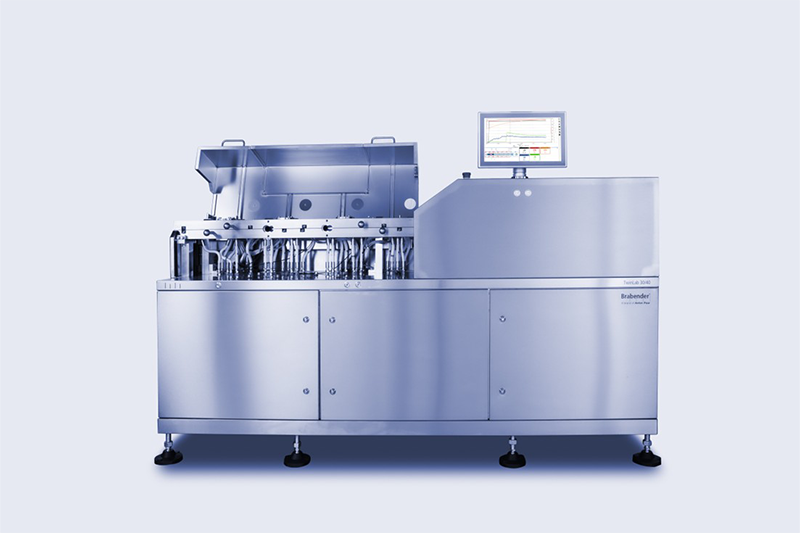
Anton Paar has expanded its Brabender extrusion portfolio with a pilot-scale twin screw system designed to connect laboratory formulation work more closely with industrial process development.
The TwinLab B-TSE-S 30/40 is specified for throughput between 5kg/h and 100kg/h, operating temperatures up to 450°C, process pressure up to 300 bar, and screw speeds reaching 1,200rpm.
Built around 30mm screws with a length-to-diameter ratio of 40, the machine provides maximum torque of two times 150Nm through a 39kW drive. Its modular arrangement is intended for polymers, compounds, food products, animal feed, battery materials, chemicals, and other extruded formulations.
Twin screw extrusion uses two rotating screws to convey, mix, melt, disperse, react, devolatilise, and shape material within a continuous process. Individual screw elements can be configured to apply different levels of conveying, kneading, shear, residence time, and pressure according to the formulation.
The new system records pressure, temperature, torque, screw speed, and throughput, while configurable inputs and outputs allow feeder, pump, die, and downstream-equipment data to be incorporated. Development teams can therefore examine the complete line rather than interpreting the extruder in isolation.
A clamshell barrel opens for inspection, cleaning, and access to the screws, while detachable liners allow worn or application-specific surfaces to be replaced without changing the complete barrel. Such access is valuable during development, when several formulations may be processed in close succession.
Material remaining on a screw, local degradation, incomplete melting, unexpected build-up, and patterns of wear can reveal conditions that do not appear clearly in the finished extrudate. Opening the barrel gives engineers direct evidence with which to compare process data and product results.
Cleaning time also determines pilot-line utilisation. Lengthy dismantling between trials can restrict development capacity, particularly where allergen management, colour changes, reactive formulations, or contamination-sensitive materials require a high standard of separation.
Anton Paar’s MetaBridge software provides browser-based control, device detection, process logging, run comparison, and data export. Integrating machine settings with material and product records reduces manual transcription and creates a more consistent basis for process transfer.
Scale-up remains difficult because a formulation that performs well on a small laboratory extruder may behave differently when screw diameter, free volume, heat transfer, feed rate, pressure, and downstream conditions change.
Increasing output is not achieved by simply multiplying laboratory settings. Surface-area-to-volume ratios alter, the material experiences a different thermal history, and the relationship between screw speed, shear, filling, and residence time changes with the equipment geometry.
Pilot-scale trials provide an intermediate stage in which those effects can be measured before production machinery is committed. Reliable data are essential because process transfer depends on understanding the relationship between operating conditions and finished material properties.
Torque can indicate changes in viscosity or barrel filling, while pressure helps identify restrictions and die behaviour. Temperature readings must be interpreted alongside the material’s actual history, since barrel setpoints do not necessarily represent the temperature experienced throughout the formulation.
The B-TSE-S 30/40 can also support limited production where a material has moved beyond laboratory testing but does not yet justify a full manufacturing line. Specialist compounds, battery materials, medical products, colour masterbatches, and high-value formulations may need qualification or market-development batches before larger investment is approved.
Operating at pilot scale nevertheless brings greater material consumption, energy demand, heat generation, and cleaning work. Feeders must deliver accurately, safety systems must account for temperature and pressure, and downstream equipment requires sufficient capacity to avoid constraining the extruder.
Abrasive fillers, fibres, minerals, and battery powders can also damage screws and liners. Material selection and screw configuration must balance resistance to wear and corrosion against processing performance and replacement cost.
By combining accessible hardware, integrated measurement, and production-relevant throughput, Anton Paar is positioning the machine between formulation research and factory implementation. Its contribution will be measured through the quality of the data generated and the extent to which pilot trials reduce uncertainty before full-scale manufacture.