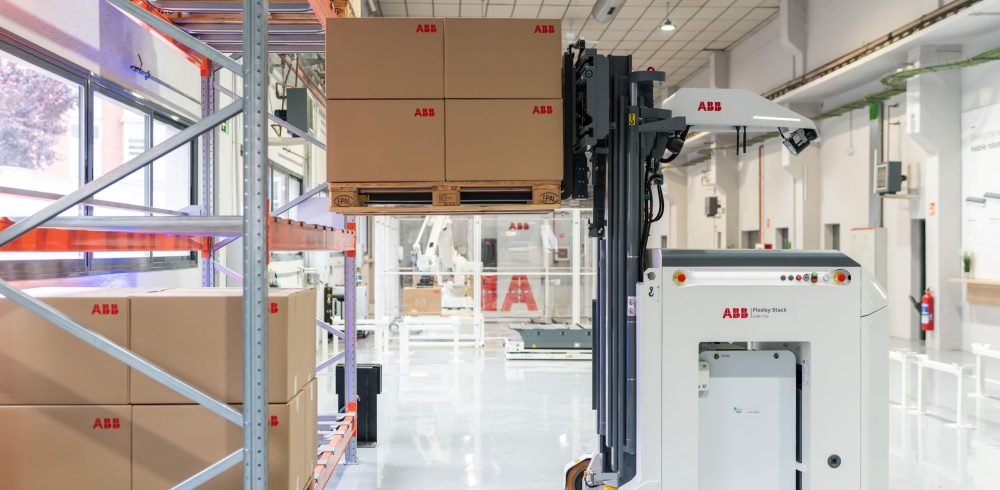
ABB Robotics has expanded its autonomous mobile robot portfolio with the Flexley Stack AMR F712, a counterbalanced autonomous forklift using AI-powered Visual SLAM navigation.
The launch completes ABB’s Visual SLAM AMR portfolio, adding forklift capability to a range that already includes tug and mover platforms. The F712 is designed for pallet transport, intralogistics, line supply, storage and retrieval, end-of-line handling, and material movement between production and warehouse areas.
Visual SLAM, or simultaneous localisation and mapping, allows a mobile robot to map and navigate its environment using vision data rather than relying on fixed infrastructure such as reflectors, magnetic tape, or installed markers. ABB says the approach enables more flexible deployment in dynamic industrial environments where layouts and traffic patterns may change.
The F712 can handle multiple load types, including open and closed pallets, containers, and racks, with loads up to 2,000kg and lift heights up to 8.5m. It operates on the same navigation, fleet management, and software platform as ABB’s other Visual SLAM-powered mobile robots, allowing mixed fleets to be coordinated through common tools.
Autonomous material handling has become a central part of factory automation because many production losses occur between processes rather than inside the primary production equipment. Components, pallets, work in progress, packaging, tooling, and finished goods must move reliably between receiving, storage, assembly, inspection, packing, and dispatch. If those flows are unstable, expensive machinery can sit idle while operators wait for materials.
The pressure is visible across automotive, electronics, food, pharmaceutical, medical device, and warehouse operations. Plants are dealing with higher product variation, tighter traceability requirements, labour constraints, and demand for faster throughput. Autonomous mobile robots are being adopted not only to reduce manual movement, but to make material flows more predictable and measurable.
ABB’s launch sits within a broader shift toward more intelligent industrial robotics. Hardware for edge AI and multi-camera robotics, work on physical AI in production, and new deployment models for mobile and humanoid systems are all pushing robotics away from fixed automation cells and toward perception-led operation. Navigation, sensing, software, and fleet control are becoming as important as the mechanical platform.
Deployment remains technically demanding. Autonomous forklifts must share space with people, manual vehicles, racking, changing loads, temporary obstructions, lighting variation, and emergency procedures. Navigation accuracy is only one part of the system. Safety certification, route planning, fleet orchestration, charging, maintenance access, operator behaviour, and integration with warehouse management or manufacturing execution systems all influence performance.
Visual SLAM can reduce installation friction by lowering dependence on fixed navigation infrastructure. That can help in brownfield facilities where layouts change, production cells are reconfigured, or installing markers across the site would disrupt operations. Faster commissioning can also support incremental deployment, allowing manufacturers to automate specific flows before expanding across the plant.
The wider market direction is toward mixed mobile fleets. Tugs can move carts, movers can handle totes or racks, and autonomous forklifts can manage pallets and storage tasks. The operational value comes from coordinating the right vehicle for each movement while maintaining safe and predictable traffic patterns.
The F712 extends ABB’s automation portfolio into one of the most persistent internal logistics tasks in factories and warehouses. Autonomous forklifts will not transform a site without disciplined planning, but they can remove recurring bottlenecks when material movement is measured, integrated, and managed as part of production. In modern plants, uptime increasingly depends on what happens between machines as much as what happens inside them.