Advantech has expanded its edge AI portfolio with industrial platforms based on Qualcomm’s Dragonwing IQ9 architecture, targeting robotics, automation, smart surveillance, and multi-camera vision applications.
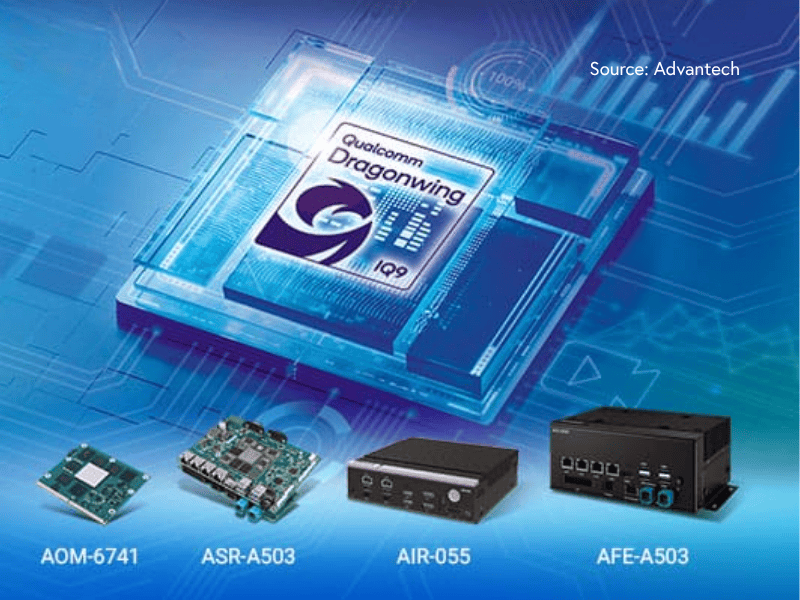
The new platforms are built around the Qualcomm Dragonwing IQ-9075 processor, which supports up to 100 TOPS of dense AI performance and up to 200 TOPS for sparse workloads. Advantech says the processor can support up to 16 concurrent camera streams, making it suitable for systems that need real-time image analysis close to the point of operation.
The portfolio includes the AOM-6741 SMARC module, ASR-A503 and AFE-A503 robotic controller platforms, and the AIR-055 edge AI system. The range is aimed at industrial-grade vision intelligence, including autonomous machines, inspection systems, robot perception, smart infrastructure, and physical AI applications.
Edge AI is moving from proof-of-concept demonstrations into practical hardware decisions. Manufacturers and machine builders need systems that can run vision models reliably, handle multiple data streams, operate within power and thermal limits, and survive industrial environments. Processing images in a remote cloud environment is often too slow, too expensive, or too dependent on continuous connectivity where machine safety, process control, or real-time decision-making is involved.
Robotics remains one of the clearest use cases. Mobile robots, cobots, autonomous guided vehicles, humanoids, and specialist inspection platforms increasingly depend on cameras, depth sensing, object recognition, localisation, and scene understanding. More local decision-making reduces dependence on network latency and gives machines greater autonomy in changing conditions.
The wider automation market is moving in the same direction. Safety-certified 3D sensing for robots is being developed to support closer human-machine interaction, while adaptive robot platforms are adding force sensing, tactile response, and simulation-led deployment. Edge AI hardware is part of that shift toward machines that perceive, interpret, and react more intelligently in industrial environments.
Integration quality will determine how useful the new platforms become. AI acceleration is valuable only if modules and controllers can be connected to cameras, networks, sensors, safety systems, actuators, and software frameworks without excessive engineering effort. Industrial customers also need long product life, support, documentation, and predictable availability.
The inclusion of robotic controllers shows how edge AI is moving closer to motion and machine control. Vision analysis used to sit as a separate inspection layer in many factories; it is now being pulled into real-time control loops, where machines use image data to adjust position, identify objects, monitor conditions, or guide manipulation. Performance, determinism, thermal management, and software compatibility all become more important when perception affects action.
Multi-camera support is particularly relevant as industrial systems add more sensing points. A robot may need forward navigation, depth sensing, payload inspection, operator awareness, and tool alignment at the same time. A production line may require simultaneous checks for labels, seals, fill levels, orientation, contamination, and code readability. Local processing can reduce latency and network load while keeping critical decisions close to the machine.
Keeping image processing at the edge can also reduce the volume of raw visual data moved across networks. Factories handling sensitive products, proprietary processes, or images that may include personnel can process locally and send only results, alerts, or compressed events. That model supports both faster control and tighter data governance.
Industrial AI adoption still faces hard practical constraints. Models must be trained on representative data, maintained as products and conditions change, and validated against false positives, false negatives, lighting variation, dirt, vibration, and mechanical drift. Hardware acceleration does not remove those engineering tasks; it provides the compute base required to run more capable models at the machine.
The Dragonwing IQ9-based systems also reflect Qualcomm’s continued movement into industrial embedded markets, where performance per watt, camera pipelines, AI acceleration, and software ecosystems are becoming competitive differentiators. Advantech’s role is to package that silicon into industrial formats and support structures that equipment makers can deploy.
As factories adopt more autonomous machines, inspection systems, and connected production assets, edge AI hardware is becoming part of standard automation architecture. The strongest deployments will be those where compute capability is matched with robust engineering, clean data, and a process problem significant enough to justify the additional intelligence.