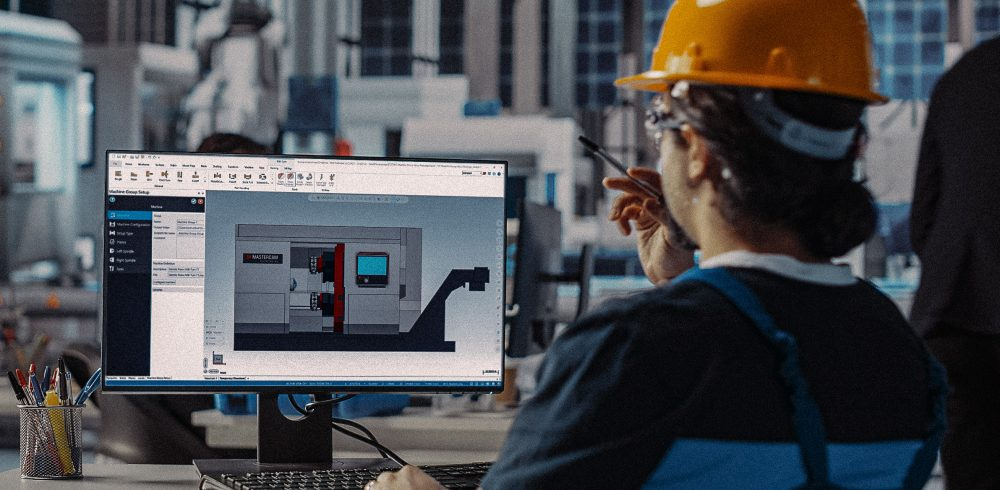
Mastercam has released Mastercam 2027, the latest version of its CAD/CAM platform, with updates focused on motion quality, automation, setup efficiency, and production reliability.
The release includes improvements across machining strategies, deburring, multiaxis toolpaths, Mill-Turn workflows, tooling definitions, and simulation. The company has focused the update on production-ready performance, with emphasis on reducing programming time, improving part quality, and giving manufacturers greater confidence between programming and cutting.
CAD/CAM software now acts as a central control layer in modern machining rather than a specialist programming tool used in isolation. As components become more complex and delivery schedules tighten, manufacturers need toolpaths that are efficient, collision-aware, repeatable, and easier to prove before material reaches the machine.
Motion quality remains one of the less visible but more consequential parts of machining performance. Smoother toolpath movement can influence cycle time, tool life, surface finish, machine wear, and operator confidence. In high-value machining, especially across aerospace, medical, motorsport, defence, and precision engineering, small changes in toolpath behaviour can have measurable effects on scrap, rework, and machine utilisation.
Deburring is another practical target. Edge finishing remains time-consuming in many machine shops, particularly where complex geometries, intersecting holes, delicate features, or tight burr control requirements are involved. Stronger software support for deburring can reduce manual intervention and improve consistency, provided the toolpath can be validated against the realities of fixtures, cutters, machine limits, and part variation.
Multiaxis machining continues to move deeper into mainstream production. Five-axis and mill-turn equipment can reduce setups and improve access to complex features, but they require disciplined programming. Errors in rotary movement, clearance, axis limits, or simulation can create expensive failures, particularly on high-value parts where scrap is not easily absorbed.
The Mill-Turn updates address machines that sit at the intersection of productivity and complexity. Combining turning, milling, drilling, and secondary operations in one machine can reduce handling and work-in-progress, but the programming environment must manage tool stations, spindles, turrets, synchronisation, part transfer, and collision risk. A more coherent workflow helps manufacturers use those assets as integrated production systems rather than expensive single-process machines.
The release aligns with a wider movement toward closed-loop manufacturing, where design, programming, machining, inspection, and process improvement are increasingly connected. Automated measurement workflows are also developing quickly, including CT inspection software updates designed to scale quality control. Machining and inspection software solve different problems, but both are being pushed toward the same operational goal: less manual repetition and more reliable production data.
Skills pressure adds further weight to software development. Skilled programmers and machinists remain difficult to recruit, and experienced staff often carry process knowledge that is hard to formalise. Automation inside CAM software can preserve some of that knowledge by standardising repetitive steps, but it still depends on competent engineering judgement.
Toolpath generation, deburring routines, and simulation features must be applied with an understanding of material behaviour, workholding, cutter selection, machine dynamics, thermal effects, and inspection requirements. Poor process planning cannot be repaired by a polished software interface. The strongest gains come when software reduces friction around decisions already grounded in manufacturing knowledge.
Customers are also placing more pressure on machine shops to deliver shorter lead times, better documentation, stable repeatability, and faster response to design changes. CAM workflows that reduce programming friction can support that shift, especially where small-batch production and complex parts make manual setup time a major cost driver.
Digital manufacturing is adding another layer of demand. Shops want software that can support simulation, process traceability, tooling consistency, and integration with wider manufacturing systems. CAD/CAM platforms are likely to face continued pressure to connect more cleanly with tool management, machine monitoring, inspection, quoting, and enterprise workflows.
Mastercam 2027 is a production-oriented release aimed at familiar machining constraints: programming time, motion behaviour, setup control, deburring, verification, and confidence at the machine. Machining competitiveness is being shaped not only by machine capability, but by the quality of the digital workflow that turns designs into controlled cuts.