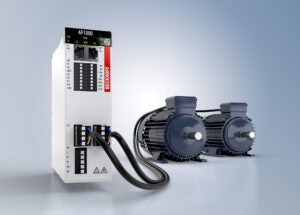
Beckhoff has introduced the AF1000 variable frequency drive series, targeting low-to-medium power applications such as conveyors, pumps, and fans.
The new VFD range is designed as a cost-effective drive option for basic automation duties while remaining integrated into Beckhoff’s TwinCAT automation environment through EtherCAT. That gives the AF1000 access to familiar commissioning, diagnostics, and configuration workflows already used with the company’s servo drive technology.
The AF1000 is available in two versions. One supports single-phase 240VAC supply with a power range from 0.37kW to 1.5kW, equivalent to 0.5HP to 2HP. The other supports three-phase supply up to 480VAC, with a power range from 0.37kW to 5.5kW, or 0.5HP to 7HP.
Despite its compact dimensions and gap-free installation, the drive integrates a control power supply, DC link capacitors, and a ballast circuit. The control voltage is generated by the integrated power supply from the DC link, reducing separate cabinet hardware requirements in basic drive applications.
Both versions are available as single-axis modules or two-axis modules. The two-axis format is intended to reduce cost and cabinet space where multiple low-power drives are required. Supported motor types include synchronous servomotors, asynchronous motors, and reluctance motors without feedback, operated in UF mode or vector control.
The AF1000 is commissioned using TwinCAT Drive Manager 2, allowing engineers to work through a consistent software environment. Basic drive applications are often numerous across a plant, and pumps, fans, small conveyors, dosing units, material handling equipment, and auxiliary machines all influence energy use, uptime, maintenance, and process consistency.
Variable frequency drives have become a standard route to better control and efficiency in rotating equipment. Running motors at fixed speed and throttling output mechanically wastes energy in many pump and fan applications. Speed control allows the motor to match demand more closely, reducing energy consumption and mechanical stress while improving process response.
The AF1000’s integration is as important as its power range. Drives used for simple applications have often been configured separately or treated as standalone devices. As factories become more connected, even routine motor control benefits from shared diagnostics, remote visibility, coordinated commissioning, and integration into the wider automation architecture.
That direction is visible across industrial connectivity, where rugged Ethernet switching platforms such as high-availability industrial network hardware are being developed to support deterministic control, diagnostics, and data movement. Drives, networks, controllers, and software tools increasingly operate as parts of one engineering system.
Machine builders often need a mix of servo axes and simpler controlled motor functions. Integrating VFDs into the same engineering environment as the rest of the automation system can reduce commissioning friction, simplify documentation, and improve support after installation.
Panel builders and plant engineers also face continuing pressure around cabinet space and installation time. Compact drives, gap-free mounting, integrated supply functions, and two-axis modules can reduce enclosure size and wiring complexity. Those gains become especially useful in retrofit projects where space is limited and downtime has to be kept short.
The drive reflects a mature view of automation hardware. Not every axis needs high-end servo performance, but basic control should not mean poor integration. Conveyors, pumps, and fans may perform routine work, yet failures can stop production, disrupt utilities, or create quality problems. Diagnostics and consistent commissioning therefore have practical value even in low-to-medium power applications.
Energy management strengthens the case for connected drive hardware. Industrial sites are under pressure to reduce consumption and understand where power is used. Drives connected into automation systems can provide better visibility into operating patterns, running hours, load conditions, and fault events, supporting maintenance planning and energy optimisation across multiple small motor loads.
The AF1000 does not try to replace high-performance drive systems. Its role is to bring compact, integrated, and modular VFD hardware to lower-power applications that keep production moving and increasingly need the same engineering discipline as the headline automation equipment around them.