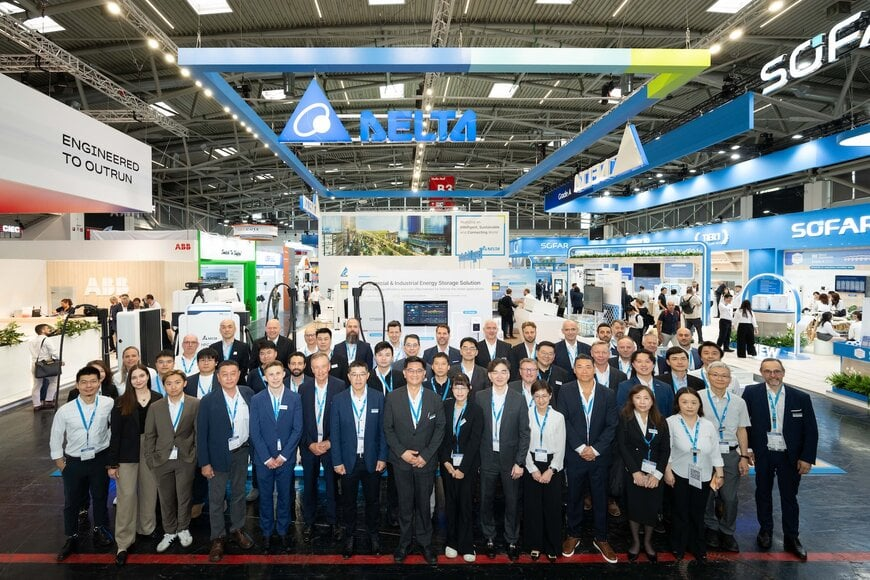
Delta is presenting new energy infrastructure technologies at The Smarter E Europe in Munich, including microgrid systems, energy storage, EV charging, power conversion, solid oxide fuel cells, hydrogen, and solar solutions.
The company’s showcase at Messe Munich is aimed at commercial and industrial energy users dealing with higher electrification demand, grid constraints, resilience requirements, and more complex site energy management. Delta is exhibiting in Hall B3, Stand 350, during the event from 23 to 25 June 2026.
The portfolio includes clean mobility and energy infrastructure systems that combine EV charging, energy storage, and energy management. Delta is also presenting its UFC500 high-power charging station, a 500kW system designed for high-traffic locations, heavy-duty charging, and fleet operations.
The UFC500 can serve two vehicles simultaneously at 2 x 250kW, supports up to 920VDC, and offers power efficiency of up to 96%. It can be integrated with DeltaGrid EVSE operation and maintenance software, allowing real-time monitoring and proactive management across charging assets.
High-power charging is increasingly an infrastructure management issue rather than a charger specification alone. Fleet operators and industrial sites need to understand uptime, utilisation, load patterns, maintenance requirements, and grid capacity. A high-rated charger that cannot be scheduled, monitored, or balanced against site constraints can quickly become a bottleneck.
Delta is also highlighting microgrid systems for data centre applications. The architecture integrates renewables, batteries, fuel cells, gensets, and other energy sources to support reliable power delivery where grid connection delays or off-grid operation create risk. The design includes substation-grade modelling, a real-time microgrid controller, and a resilient multi-bay architecture.
Industrial energy demand is no longer shaped only by production equipment. AI workloads, data centres, fleet electrification, heat electrification, robotics, automated warehouses, and distributed renewables are changing site-level power requirements. The grid edge is becoming more complex, with electrical infrastructure expected to deliver flexibility, controllability, and resilience.
The same pressure was visible at Hannover Messe, where industrial power infrastructure became central to discussions around electrification, AI, and digital factories. EV charging, energy storage, hydrogen, automation, and data infrastructure all add load and operational complexity. Installing more equipment is not enough when generation, storage, conversion, protection, and demand have to work together.
Delta’s solid oxide fuel cell technology adds another route into local generation. The system converts natural gas, ammonia, or hydrogen into electricity and thermal energy through a high-temperature electrochemical process. With heat recovery, Delta says the system can reach up to 85% energy efficiency, with modular design and AC or DC output options.
Data centres and industrial sites are examining fuel cell systems as part of broader resilience and power quality strategies. They are not universal replacements for grid connection, but they can form part of decentralised energy architectures where uptime, connection delays, and local power stability are decisive.
The company’s C-Series energy storage system is also being shown for commercial and industrial applications. The range extends from 125kW / 261kWh to 1.25MW / 2.61MWh and integrates power conversion, liquid cooling, and battery packs. Paired with solar and EV charging, storage can support peak shaving, load shifting, backup, and more controlled use of grid capacity.
Grid constraints are becoming a practical barrier across Europe. Industrial users planning fleet electrification, heat pump deployment, production expansion, or AI and data infrastructure often face connection delays and reinforcement costs. Microgrids and storage cannot remove grid dependency, but they can help sites use available capacity more intelligently while network upgrades progress.
The engineering challenge is integration. A site energy system may include chargers, batteries, solar, fuel cells, grid imports, critical loads, building systems, and production equipment from different vendors. Without coherent control, those assets remain separate installations rather than an operating platform.
Delta’s Munich showcase points to a more integrated phase of industrial energy infrastructure. Storage, charging, power conversion, local generation, and microgrid control are increasingly being treated as one engineering problem, shaped by electrification growth and the need to keep industrial sites operating under tighter grid conditions.