Allotex has entered a collaboration with Daicel High Performance Polymers to develop a next generation storage and delivery system for corneal allograft technologies.
The partnership combines Allotex’s ophthalmic biologics and tissue-based implant work with Daicel HPP’s materials expertise, including TOPAS COC cyclic olefin copolymer. The companies are developing a storage and delivery system intended to preserve tissue integrity, support product reliability, and enable consistent clinical outcomes.
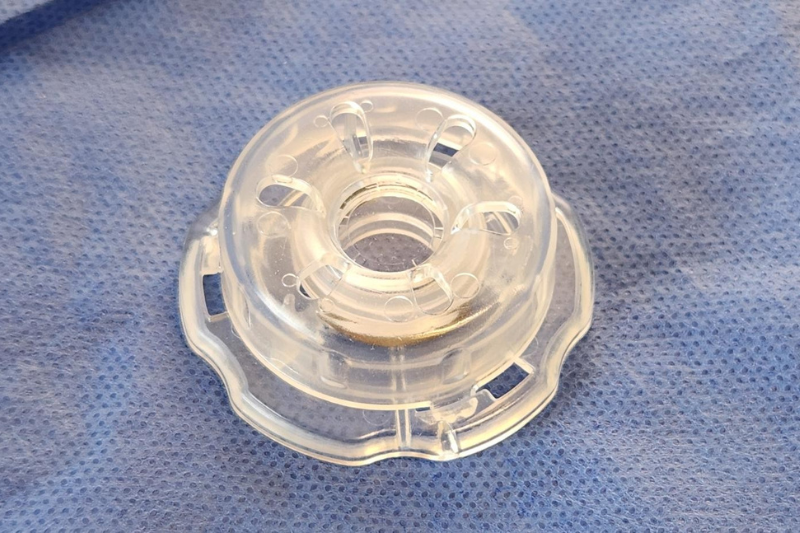
Allotex’s platform uses biological corneal implants, creating a demanding storage requirement. Corneal allografts must be maintained in a moist environment for extended periods, with the storage system protecting tissue condition throughout shelf life. The system uses precision moulded TOPAS COC components, selected after evaluation of multiple polymer options.
The material choice is central to the manufacturing challenge. TOPAS COC is a glass clear, high purity polymer used in healthcare, packaging, and electronics applications. Its transparency and water vapour barrier performance make it suited to a storage chamber where tissue condition, visual inspection, and reliable handling all have to be considered together.
The collaboration sits at the boundary of medical device manufacturing, polymer engineering, and biological product handling. That boundary is becoming more important as medtech products combine materials, biologics, delivery systems, and regulated production processes. A storage chamber is not merely packaging in this context. It forms part of the product system that helps preserve the biological implant before clinical use.
Regulated manufacturing is moving in the same direction across several areas. IMA MED-TECH’s modular assembly platform for medical devices points to increasing demand for flexible, validation-ready production systems, while pharmaceutical cold chain investments show how controlled handling and packaging are becoming strategically important. Allotex and Daicel are working in a narrower ophthalmic segment, but the industrial principle is similar: product performance increasingly depends on the surrounding manufacturing and handling system.
Precision moulding also matters because repeatability is essential for regulated products. A storage component may need tight dimensional control, clean surfaces, consistent sealing behaviour, and compatibility with sterilisation or controlled manufacturing processes. Material purity, extractables and leachables, moisture transmission, and mechanical stability can all influence suitability.
Corneal disease and transplant-related treatment create specific clinical demands. Products in this area must protect delicate tissue structures and support predictable outcomes. From a manufacturing perspective, that means the device or storage system must perform reliably across production, storage, transport, and use. Failure at the packaging or delivery stage could undermine an otherwise strong implant platform.
The use of TOPAS COC also reflects a wider movement towards engineered polymers in medical technology. Plastics used in medtech are increasingly selected for optical, barrier, chemical, and processing properties rather than simply cost or mouldability. Pre-filled syringes, vials, diagnostic components, microfluidic devices, and implant-adjacent systems often depend on material behaviour that must be consistent at volume.
Device developers need material partners who understand both polymer performance and regulated production. Material suppliers, in turn, need to work earlier in the design process so that the storage system, moulding route, and product requirements are aligned before validation begins. Late material changes in medical devices can be costly because they may affect testing, documentation, and regulatory submissions.
The Allotex and Daicel partnership shows how product reliability can depend on components that sit outside the clinical spotlight. In regulated healthcare manufacturing, the container, chamber, or delivery system is often part of the therapy’s practical success, even when the clinical innovation sits elsewhere.