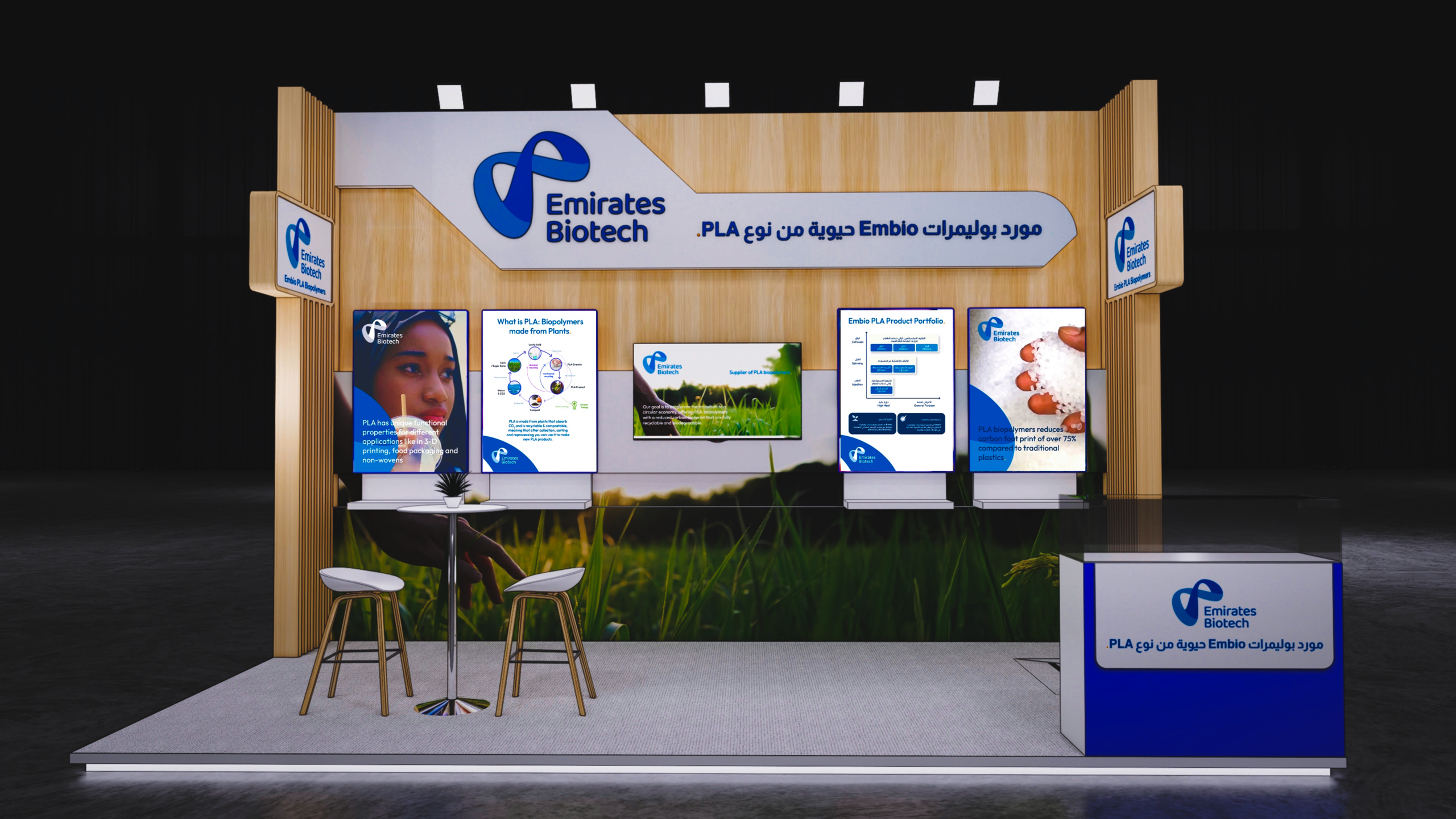
Emirates Biotech will introduce its Embio PLA biopolymer portfolio to the Saudi market at Saudi Plastics & Petrochem 2026.
The event takes place from 21–24 June at the Riyadh International Convention & Exhibition Centre, where Emirates Biotech will exhibit within the UAE Pavilion at stand 2-142. The company will use the show to present its plant-based PLA materials and discuss commercial availability across the Middle East.
Embio PLA is being offered for applications including packaging, food service wares, consumer goods, 3D printing, and other everyday products. Emirates Biotech says the material provides sustainability advantages as companies and governments look for alternatives to conventional fossil-based plastics.
Saudi Arabia is one of the region’s largest industrial and petrochemical markets, with a growing focus on circularity, material diversification, and manufacturing localisation under Vision 2030. Biopolymer suppliers entering the kingdom are engaging with both a plastics market and a policy-driven industrial development programme.
François de Bie, Chief Commercial Officer of Emirates Biotech, said: “The Kingdom of Saudi Arabia is an exciting and fast-growing market for sustainable materials. Biopolymers like PLA provide the Kingdom with opportunities to realize its Vision 2030 sustainability goals; PLA supports the transition toward more circular and responsible material solutions.”
The company has recently added regional sales capability. Hashim Alfulful has joined Emirates Biotech as Sales Development Manager for Saudi Arabia, Bahrain, and Kuwait, giving the business dedicated local support for customers evaluating PLA materials.
Alfulful said: “Having a dedicated presence in Saudi Arabia allows us to work closely with customers and support them in evaluating and implementing PLA solutions. We look forward to building strong partnerships as the market continues to demand more sustainable materials.”
Prashant Lohade, Sales Development Manager for the UAE, Oman, and India, said: “PLA biopolymers not only offer a reduced carbon footprint, but PLA is also recyclable and biodegradable. They do not leave any microplastics in the environment.”
PLA, or polylactic acid, is produced from renewable feedstocks and is used across rigid packaging, flexible packaging, coated paperboard, fibres, nonwovens, and additive manufacturing. Its commercial value depends on material properties, processing compatibility, application performance, waste-management routes, regulatory acceptance, and cost.
Plastics producers and converters are under pressure from regulation, brand commitments, waste policy, and customer demand, but substitution is rarely straightforward. A material must run on existing or modified equipment, meet product requirements, survive storage and transport, and fit end-of-life infrastructure. Sustainability claims are tested hardest when they meet production economics.
PLA can be attractive where applications benefit from plant-based content, compostability or biodegradability under appropriate conditions, and reduced reliance on fossil feedstock. Food service ware, certain rigid packaging formats, and 3D printing filaments are among the more established use cases. Broader adoption depends on clearer standards, suitable collection systems, and education across converters, brand owners, and waste handlers.
The Gulf’s deep petrochemical expertise, plastics-processing capability, and industrial investment capacity give the launch an interesting industrial context. Introducing biopolymers into that ecosystem is not a rejection of materials engineering; it is another route for the sector to diversify into lower-carbon and specialised polymer markets.
Packaging sustainability pressures are already reshaping procurement in the UK and Europe, where recycled content, tax rules, certification, and customer assurance have become central to material selection. Amcor’s RecyClass certification across selected UK flexible packaging lines shows how quickly packaging suppliers are being asked to align material choices with regulation and proof of performance. Different markets are moving at different speeds, but the underlying pressure is increasingly familiar.
Saudi Plastics & Petrochem gives Emirates Biotech a launch platform that brings converters, raw material suppliers, equipment manufacturers, and industrial buyers into one place. The next phase will depend on how quickly trials move from sustainability interest to validated production. Material substitution usually requires processing trials, packaging tests, customer qualification, cost modelling, and clarity around disposal or recovery routes.
The company’s regional sales appointments suggest adoption will require technical and commercial support rather than catalogue selling. Customers will need to understand grades, availability, processing windows, mechanical performance, food-contact suitability, and how PLA fits with local sustainability objectives.
PLA will not replace every conventional polymer, and poorly chosen substitutions can create new production or waste problems. Used where its properties and end-of-life routes are understood, it gives converters another option as plastics markets shift towards lower-carbon and more accountable material systems.