
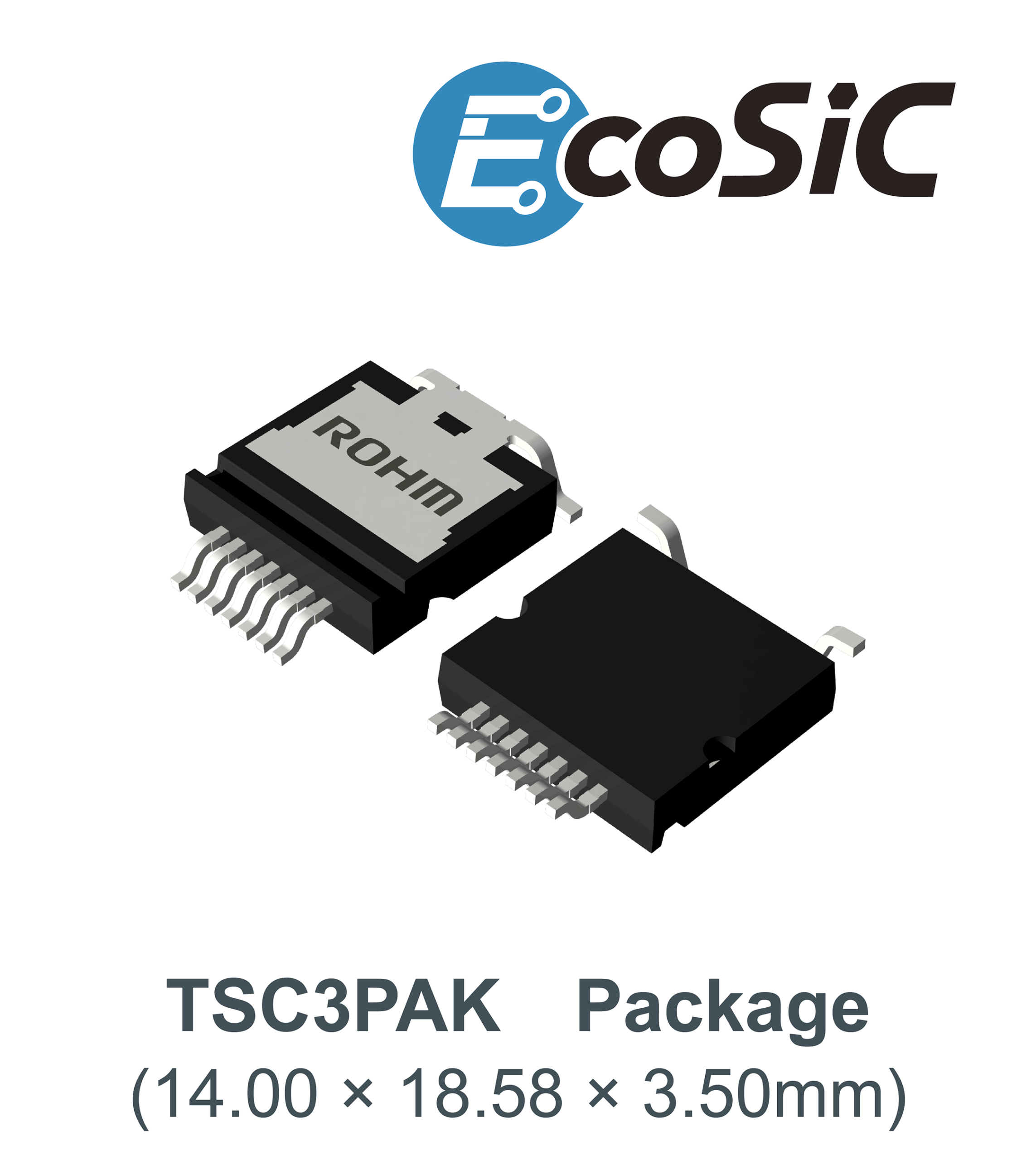
ROHM has developed the TSC3PAK package for silicon carbide MOSFETs, targeting high-voltage power conversion in electric vehicles and industrial systems.
The surface-mount package measures 14.00 × 18.58 × 3.50mm and uses a top-side heat dissipation structure, placing the main thermal path on the upper side of the package. ROHM says the design enables automated mounting while delivering heat dissipation performance closer to conventional through-hole packages such as TO-247-4L.
The package incorporates a groove structure designed to secure a creepage distance of 6.66mm. That allows the package to support an AC peak voltage of 1200V in Pollution Degree 2 environments while maintaining compatibility with products already widely used in the market.
SiC devices can reduce switching losses, improve efficiency, and support higher-temperature operation, although those advantages depend heavily on package design, insulation distance, thermal paths, assembly method, and manufacturability. Top-side cooling is gaining traction where engineers need higher power density without reverting to bulky through-hole layouts or more complex mechanical assemblies.
EV chargers, industrial drives, renewable power conversion, AI power infrastructure, and high-density power modules are all pushing packaging closer to the centre of system performance. The die remains important, but the thermal interface, package geometry, creepage distance, and production route increasingly decide how easily a device can be adopted.
Recent SiC activity has also placed more emphasis on reliability guidance and high-voltage power architectures, including work around server backup power and qualification methods. Power device competition is moving beyond headline semiconductor material choices and into the practical engineering around packaging, mounting, cooling, and production economics.
