
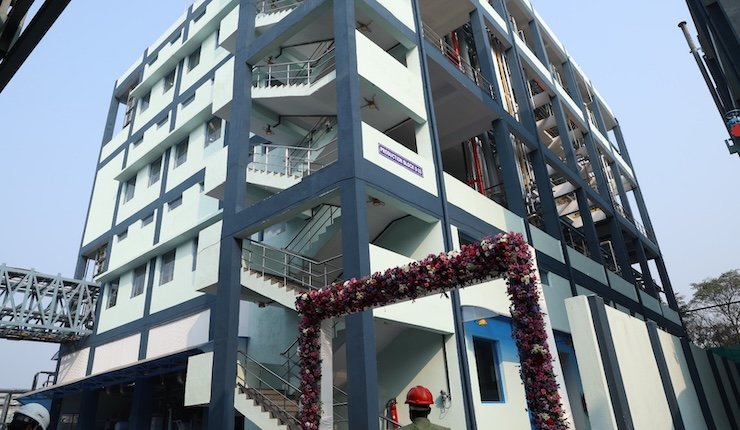
Axplora is consolidating ursodeoxycholic acid manufacturing at its Vizag site in India, with production transitioning fully from the company’s Gropello Cairoli site in Italy by the end of 2026.
The move follows previous investment at Vizag to expand UDCA capacity and create an integrated production platform from bile sourcing through to active pharmaceutical ingredient manufacturing. The Vizag facility sits within Axplora’s PharmaZell business unit, while the Gropello Cairoli site forms part of the Farmabios business unit.
UDCA is a bile acid-derived API used in therapies for chronic liver and gallbladder diseases. Axplora says global demand continues to grow, driven by increasing diagnosis and treatment of chronic liver conditions, wider healthcare access in emerging markets, and demand for specialty therapies requiring reliable API supply.
Manufacturing at Vizag uses the company’s proprietary enzymatic synthesis route. Axplora says the process reduces manufacturing steps and minimises the use of solvents and reagents compared with conventional approaches. The site also provides backward integration and full traceability through controlled bile sourcing and integrated API production.
The company says the Vizag operation uses the same enzymatic process and equivalent manufacturing standards as Gropello while providing additional expansion potential, integrated operations, and access to US FDA-approved infrastructure. Regulatory approvals for the transition are in place, UDCA is already being manufactured at Vizag, and the facility has completed a recent US FDA inspection.
Martin Meeson, chief executive officer of Axplora, said: “By consolidating UDCA manufacturing at Vizag, we are creating a more streamlined and scalable supply platform that strengthens resilience, simplifies operations and enhances service for customers worldwide.”
The decision also changes the role of the Italian site. Axplora says Farmabios will be reinforced as a centre of excellence for highly potent APIs, including steroid and HPAPI handling capability. The site operates one of the largest OEB5 manufacturing workshops in Europe and will focus on advanced containment and high-potency work as demand grows for complex therapeutics.
Pharmaceutical manufacturing networks are increasingly separating mature, scalable API production from high-complexity, high-containment activities. That can improve operational focus, although it places heavy demands on technology transfer, regulatory management, customer communication, and supply continuity. API production cannot be moved cleanly without disciplined process comparability and documentation.
The use of enzymatic synthesis adds another layer of technical interest. Pharmaceutical manufacturers are under pressure to reduce process intensity, solvent use, waste, and supply-chain exposure while maintaining quality and yield. Enzymatic routes can offer advantages where they simplify chemistry, improve selectivity, and reduce environmental burden, provided they remain robust at industrial scale.
Backward integration gives the Vizag site a strategic advantage in a product where source material control and traceability are central. Pharmaceutical customers need confidence that starting materials, intermediates, process controls, and release testing remain consistent. Integrated production can reduce external dependency and improve visibility across the supply chain, provided upstream controls are managed with the same rigour as final API production.
The move also shows how global API networks are being rebalanced. Europe remains important for advanced chemistry, high-potency production, specialist development, and regulatory expertise, while large-scale API manufacturing often follows capacity, integration, cost, and expansion logic. Multi-site networks are increasingly being arranged around differentiated roles rather than duplicated production across regions.
Specialisation creates both opportunity and exposure. A more focused site network can improve efficiency and customer value, but it can also increase dependency on particular locations for key products. Resilience depends on inventory strategy, dual-sourcing options, regulatory filings, continuity planning, and the ability to manage disruptions without affecting medicine supply.
The Gropello repositioning is notable for European pharmaceutical manufacturing because it moves the Italian site further toward highly potent and complex APIs rather than treating the transfer as a simple loss of capacity. That direction is consistent with where European sites often have the strongest competitive position: specialised, regulated, technically difficult manufacturing rather than commodity-scale production.
The broader CDMO and API market is being shaped by outsourcing, supply security, environmental scrutiny, and increasing molecular complexity. Customers want partners able to scale established products while also supporting complex pipelines. Axplora’s three-unit structure — PharmaZell, Farmabios, and Novasep CDMO — gives it a platform for that segmentation, although execution will depend on how smoothly production, customer requirements, and regulatory commitments are transferred.
By consolidating UDCA at Vizag and refocusing Farmabios on high-potency work, Axplora is making a clear network-management move. The operational test will be uninterrupted, compliant supply. In pharmaceutical manufacturing, a stronger network is measured less by organisational design than by what leaves the plant on time, in specification, and with full regulatory confidence.
