Méca-Précis has deployed a robotic measurement cell to increase inspection capacity and remove a quality-control bottleneck in the production of complex aerospace and satellite components.
The French precision engineering company specialises in prototype parts, one-off components, small and medium production runs, and welded mechanical assemblies. Its customer base includes aerospace and space-sector clients, as well as a long-standing relationship with a global leader in carton packaging machinery.
The company already operated a standard measuring machine on the shop floor and a coordinate measuring machine in a thermally controlled environment. As production volumes increased and multiple palletised machining centres began running through the night, dimensional inspection could no longer keep pace with machining output.
The inspection burden was especially heavy for aerospace and space-sector work, where certain customers require 100% inspection of all dimensions on every part before and after surface treatment. A simple pin may take only a minute to inspect, but batches can involve hundreds of parts. At the other end of the spectrum, a single complex satellite component can require up to 80 hours of inspection.
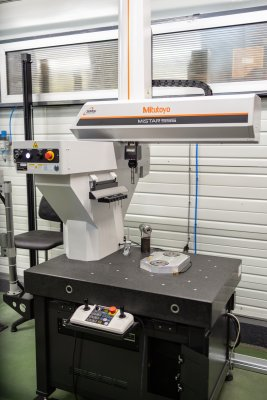
After the manufacturer of the company’s existing CMM was unable to provide a suitable solution, Méca-Précis turned to Mitutoyo. The proposed system combines a Mitutoyo MiSTAR CMM with a robotic measurement cell developed in collaboration with Engineering Data, a specialist in fixturing solutions and machining-centre automation.
The parts are mounted on pallets designed for robotic handling, allowing the inspection process to be automated rather than dependent solely on manual loading and operator availability. Less than a year after the first meeting between the companies, the cell was installed in the workshop. Further phases were then needed for inspection programme development, commissioning, configuration, and technical fine-tuning before the system became fully operational.
Robotics is moving into manufacturing functions that were once treated as difficult to automate because they relied heavily on specialist judgement. Welding, machine tending, and material handling remain major use cases, but quality control, metrology, non-destructive testing, and inspection workflows are increasingly being automated where repetitive handling and capacity constraints slow production.
Inspection bottlenecks become more visible as machining centres, pallet systems, and unattended production improve throughput. A workshop can add spindle hours and night-time machining, but if dimensional inspection remains manual and sequential, quality control becomes the rate-limiting step. Aerospace, defence, medical, and high-value engineering sectors cannot simply relax documentation and verification requirements to match production output.
The same pressure can be seen in large-scale aerospace inspection, where automated metrology workflows are being applied to bigger, more complex structures. Méca-Précis is working at a different scale, but the underlying challenge is similar: measurement systems need to move closer to the production rhythm rather than sitting as a slow, separate stage after machining.
Automated measurement cells still depend on robust fixturing, reliable part identification, validated programmes, environmental control, calibration discipline, and integration with quality systems. They also require skilled metrology staff who understand what the data means and how to respond when a process drifts. Automation removes repetitive loading and capacity constraints, but it does not remove engineering judgement.
The benefit is that scarce metrology expertise can be redirected toward programme development, process improvement, root-cause analysis, and customer documentation rather than routine loading and unloading. That shift is becoming a significant productivity lever in small and medium-sized precision manufacturers, where the quality department may be only a few people while the inspection requirement continues to grow.
Automated inspection can also improve delivery performance. Long inspection queues can undermine lead times even when machining is complete, particularly when parts have to be checked before and after surface treatment. A robotic cell that runs repeatable checks with fewer manual interventions gives the production system a better chance of matching machining capacity with verification capacity.
Méca-Précis’ deployment shows robotics and metrology converging around a practical manufacturing constraint. Faster machining only creates value when inspection can keep up, and in high-specification production the quality department is increasingly becoming part of the automation plan.