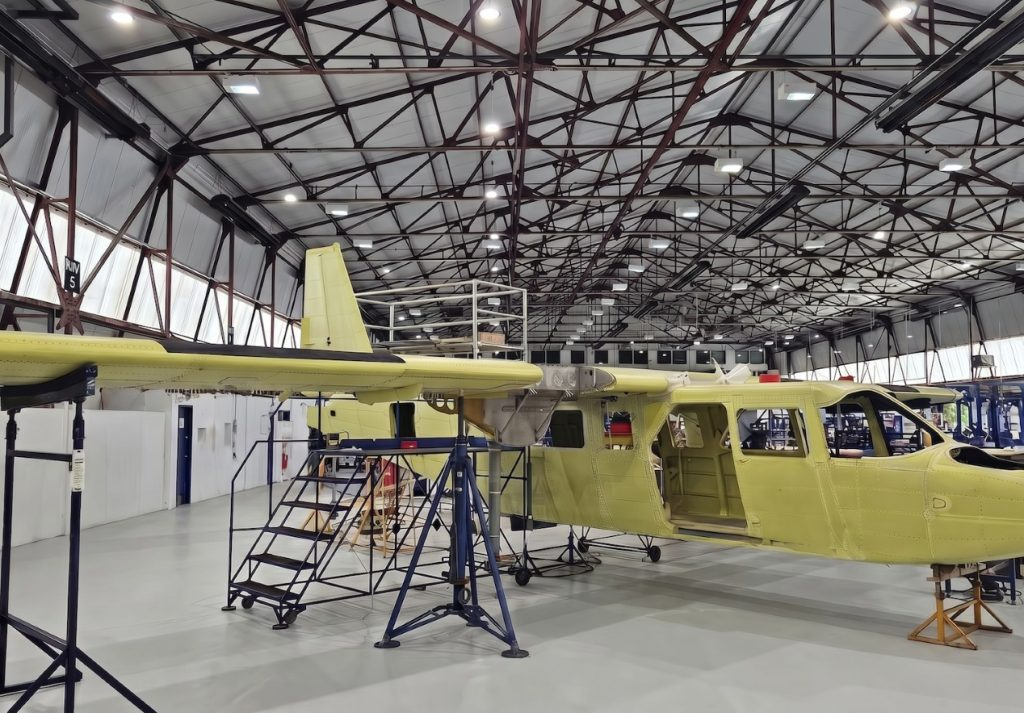
Britten-Norman has passed the 75% completion mark on the first new Islander aircraft being produced through its fully reshored UK production line at Bembridge on the Isle of Wight.
The aircraft is scheduled to enter final assembly in the coming weeks before delivery to the Falkland Islands Government Air Service later this year. A second airframe is already approaching 25% completion on the same line, while components for follow-on aircraft are also in manufacture.
The milestone marks a significant stage in the return of full civil Islander manufacturing to the UK. The aircraft was originally developed and first flown from Bembridge in the 1960s, before major assemblies later moved overseas and final assembly remained in the UK. Britten-Norman announced in 2023 that Islander production would return to Bembridge, citing the changing economics of overseas manufacture and the value of rebuilding capability at the company’s historic base.
Since the first aircraft reached 50% completion earlier this year, work has advanced across key structural areas. Fuselage sub-assemblies and the fin have been joined, fuel tank tests have been completed, and the 15-metre wing assembly has been completed and attached to the fuselage. The company also has Letters of Intent in place with further operators in the regional passenger and special-mission sectors.
The Islander occupies a specialised but durable niche in aviation manufacturing. It is a rugged, high-wing utility aircraft used for short-haul regional operations, island services, freight, surveillance, and special missions. Its commercial value lies in durability, simplicity, load capability, and access to short or remote airstrips, which makes production continuity and long-term parts support central to the aircraft’s business case.
Bringing the line back to Bembridge places manufacturing closer to Britten-Norman’s engineering base, certification knowledge, and aftermarket operation. In lower-volume aircraft manufacturing, that proximity can sharpen decision-making across tooling, inspection, supplier management, engineering changes, and customer-specific configuration. When production is fragmented across long supply chains, even modest design or quality issues can travel slowly through the system.
Aerospace manufacturers are still working through a difficult supply environment, with pressure on materials, castings, forgings, electronics, engine parts, and skilled labour. Smaller aircraft manufacturers face those constraints without the buying power of major airframers, which makes internal control and supplier discipline especially valuable. Reshoring does not remove supply-chain risk, but it can shorten the distance between the problem and the people responsible for fixing it.
Regional and specialist aviation also continues to create demand for aircraft that are robust rather than fashionable. Island communities, remote public services, surveillance operators, and special-mission users need platforms that can operate reliably away from dense airport networks. The Islander’s long service history gives it an established support base, although new-build aircraft must still meet modern expectations for documentation, quality assurance, maintainability, and production traceability.
The production milestone also carries a skills dimension. Aircraft assembly depends on manual craft, jigs and fixtures, inspection discipline, systems integration, and certification control. Rebuilding a production line requires more than relocating work packages; it depends on a workforce, supplier network, documentation system, and production rhythm that can be repeated after the first aircraft leaves the line.
That makes the second airframe and follow-on component activity an important part of the story. A single aircraft can demonstrate intent, but a production system is proven by whether subsequent builds move through the process with greater consistency. Britten-Norman’s parallel focus on aftermarket parts availability and service support points to the same requirement, since operators buy operating confidence as much as airframe capability.
If the first aircraft moves through final assembly and delivery as planned, the Bembridge programme will give UK aerospace manufacturing a useful reshoring case study. The Islander is not a mass-production platform, but it shows how legacy designs, local engineering capability, and targeted production control can still support a credible industrial strategy.