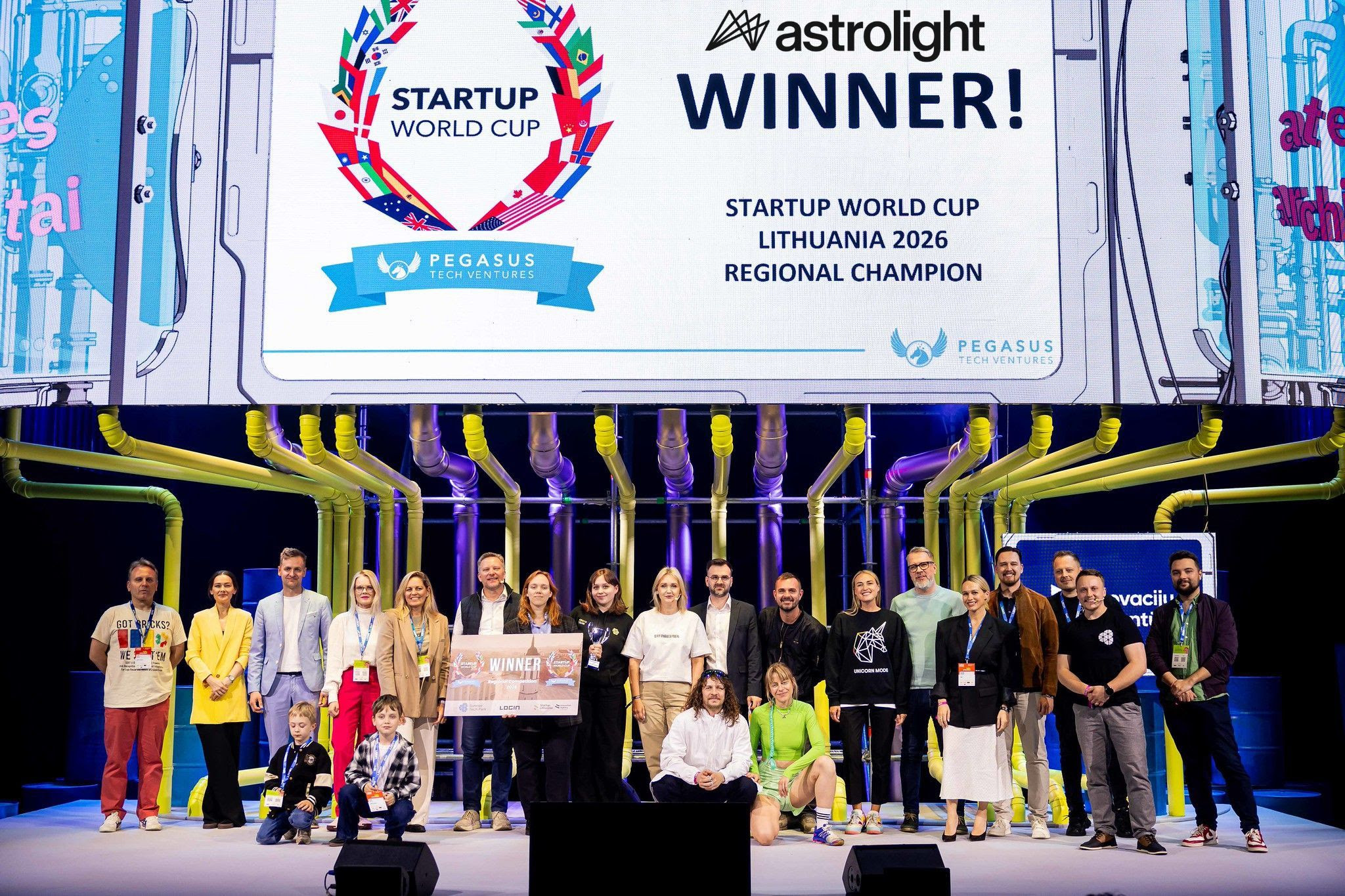
Astrolight will represent Lithuania at the Startup World Cup Grand Finale in San Francisco after winning the country’s regional competition for the global startup pitch event.
The Vilnius-based space and defence company develops laser communication systems for space, ground, and maritime applications. It will compete against regional winners from around the world on 6 November 2026 for the global title and a US$1 million investment prize.
Astrolight has already secured contracts and partnerships with the European Space Agency, industry primes, and satellite manufacturers. The company has launched three ATLAS-1 laser terminals into orbit for testing, joined a Kepler Communications-led team developing ESA’s HydRON optical multi-orbit transport network, and is working with ESA on an Arctic optical ground station in Greenland.
Laurynas Mačiulis, CEO of Astrolight, said: “Representing Lithuania at the Startup World Cup Grand Finale is an important milestone for Astrolight as we enter our next stage of growth. Laser communication is becoming critical for the space economy, and our focus on integrated systems for both space and ground gives us a strong position in a market expected to reach billions of dollars over the coming decade.”
Satellite operators are moving more data through orbit as Earth observation, defence, emergency response, maritime monitoring, and broadband constellations expand. Radio-frequency communications remain central to satellite networks, but spectrum pressure, licensing requirements, interference, and congestion are pushing optical links into a larger role for high-throughput space-to-space and space-to-ground connectivity.
Laser communication uses narrow beams of infrared light rather than broad RF transmission. The approach can support much higher data rates, while the narrower beam profile improves resistance to interception, electronic interference, and jamming when compared with conventional wide-area radio transmission.
Novaspace has projected global revenues for space laser communication terminals at US$12.9 billion through 2035, reflecting the industry’s move from demonstration payloads towards operational optical networks. Astrolight’s work spans both flight terminals and ground infrastructure, giving the company exposure to the two parts of the optical communications chain that must scale together.
Mačiulis added: “Because satellite constellations grow and missions expand across Earth observation, defense, emergency response, and future AI infrastructure in orbit, the need to move data between space and Earth is rising fast. Traditional radio-frequency communications alone will soon struggle to keep pace – on both the technological and regulatory level.”
Startup World Cup is organised by Pegasus Tech Ventures and includes more than 100 regional events across North America, South America, Europe, Africa, Asia, and Australia. Astrolight’s appearance at the San Francisco final gives the company a platform as optical communications move from specialist satellite missions into the infrastructure layer for larger, more data-intensive space networks.