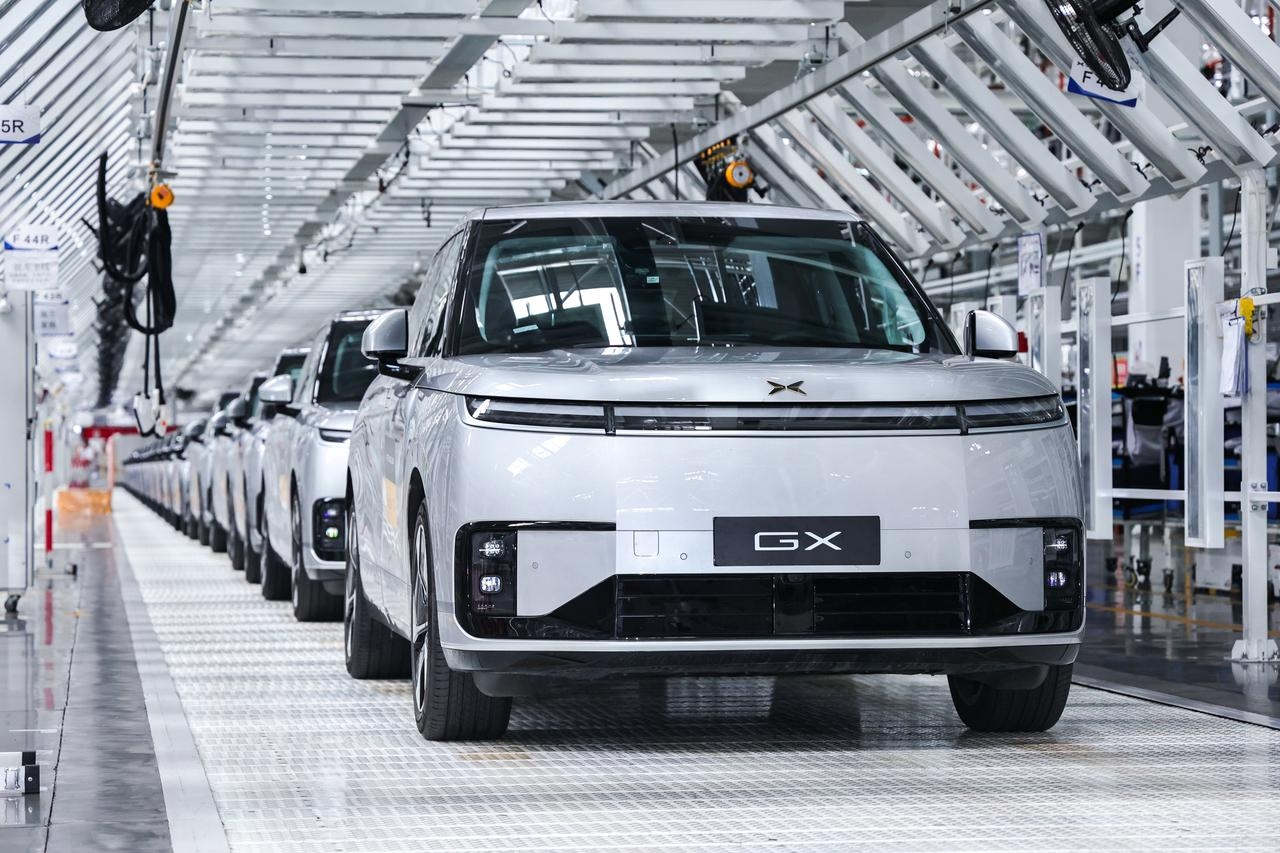
XPENG has rolled out its first mass-produced Robotaxi in Guangzhou, advancing an autonomous vehicle programme built around in-house vehicle, chip, and software development.
Based on the XPENG GX platform, the vehicle has been engineered to L4 autonomous driving standards and is being positioned by the company as China’s first mass-produced Robotaxi developed through a full-stack in-house approach. The production milestone follows earlier public road testing activity in Guangzhou.
Four self-developed Turing AI chips provide 3,000 TOPS of effective on-board computing power. Rather than relying on LiDAR or high-definition maps, XPENG has adopted a pure vision system with decision-making handled by its VLA 2.0 end-to-end model.
The company said VLA 2.0 removes the language-translation stage used in conventional Vision-Language-Action architectures, reducing system response latency to below 80 milliseconds. That architecture is intended to improve urban generalisation, allowing the system to operate across different cities and, potentially, different markets.
XPENG secured a road-testing permit for intelligent connected vehicles in Guangzhou in January 2026 before establishing a dedicated Robotaxi business unit in March. The unit oversees product definition, R&D testing, and operations, giving the programme a dedicated commercial structure as it moves beyond vehicle development alone.
Pilot Robotaxi operations are planned for the second half of 2026, when XPENG expects to validate technical performance, user acceptance, and the operating model. The company is targeting fully autonomous operations without an on-site safety officer by early 2027, subject to operational validation and regulatory progress.
The Robotaxi also includes passenger-facing features such as privacy glass, comfort-focused rear seating, rear entertainment screens, and voice assistant control for in-car settings. XPENG plans to open its Robotaxi SDK, with Amap named as the first global ecosystem partner.