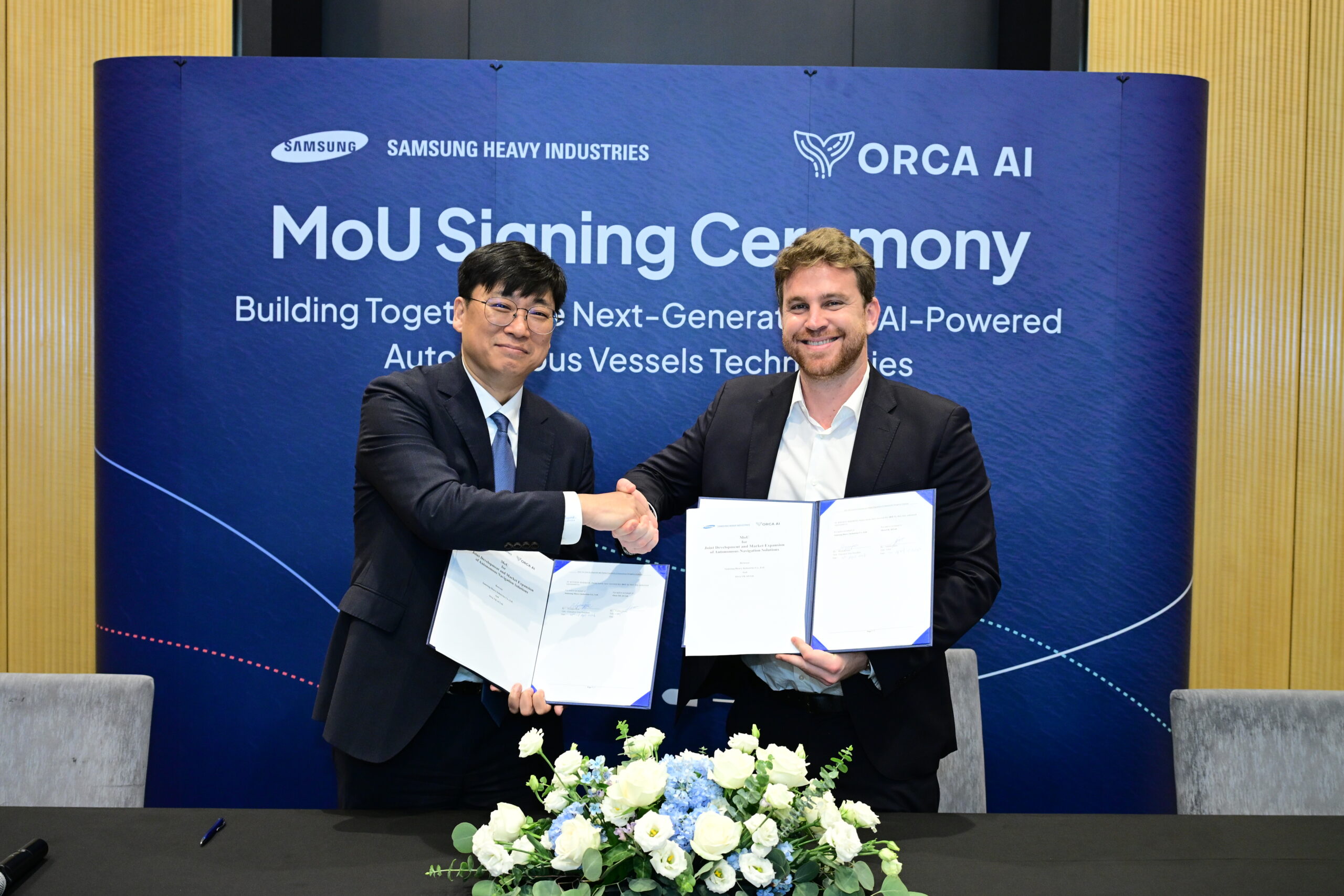
Orca AI and Samsung Heavy Industries have signed a memorandum of understanding to accelerate autonomous vessel technology across newbuild ships and existing fleets.
The phased collaboration will combine Samsung Heavy Industries’ autonomous vessel systems with Orca AI’s maritime operations platform. The companies plan to offer an integrated package covering autonomous navigation, berthing assistance, and speed control across newbuild and retrofit vessel markets.
Under the agreement, Orca AI will integrate Samsung Heavy Industries technologies including the SVISION berthing assistance system and an autonomous speed control solution focused on RPM optimisation for fuel efficiency. Samsung Heavy Industries will also embed Orca AI’s AI-powered situational awareness platform as standard on newbuild vessels equipped with its Samsung Autonomous Ship solution.
The retrofit pathway gives shipowners a route to add higher levels of autonomy without waiting for replacement tonnage. Orca AI says its platform is already deployed on more than 1,200 vessels, with more than 500 additional vessels in the pipeline, giving the company a large operational data base for further AI model development.
Yarden Gross, CEO and co-founder of Orca AI, said: “Bringing together SHI’s deep expertise in vessel design and integration with our AI-driven situational awareness platform creates a practical path to scaling autonomous capabilities – from newbuild vessels to existing fleets. This partnership enables both companies to accelerate innovation and deliver tangible value to the industry.”
Orca AI’s SeaPod system uses AI and computer vision to support bridge teams by detecting, tracking, and prioritising navigational risks in real time. Its shore-based FleetView application extends that visibility to fleet operations teams, giving them access to vessel performance, risk exposure, and operational trends across multiple ships.
The joint R&D work will focus on real-time decision support, adaptive navigation, and continuous performance optimisation using large-scale fleet data. Autonomy is moving from demonstrator technology into integrated design and systems packages as owners seek to reduce navigational risk, improve efficiency, and standardise digital capabilities across fleets.
Hyun Joe Kim, head of Samsung Heavy Industries’ Research Institute, said: “We are excited to collaborate with Orca AI, a leading maritime AI company that has demonstrated its ability to deliver production-grade AI and autonomous capabilities. Enhancing our business portfolio and advancing technologies through AI-based autonomous navigation is a key competitive factor for the future of the shipbuilding industry. Through this collaboration, we will actively pursue technological leadership by internalising differentiated autonomous navigation technologies and expanding our platform strategy.”