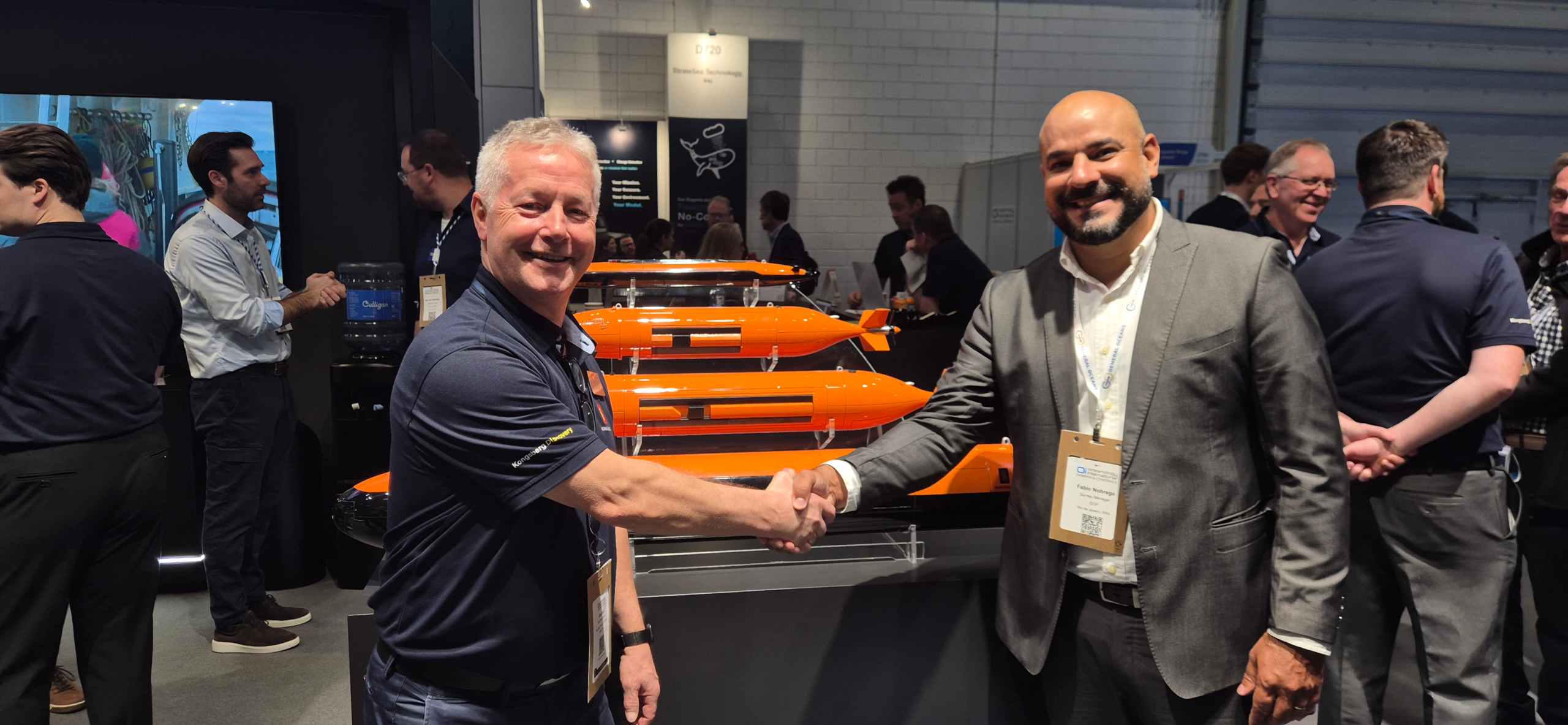
Kongsberg Discovery has landed the first commercial order for its Kongsberg Listen electromagnetic sensing system, with offshore services specialist DOF selecting the technology for integration on a new HUGIN autonomous underwater vehicle destined for deepwater work in Brazil.
The agreement, announced at Oceanology International in London, places Listen inside a sensor package that also includes the EM2042 multibeam echosounder and the HISAS1032 synthetic aperture sonar. The vehicle is rated to 3,000 metres and is set to operate under a long-term contract supporting survey and inspection activity across offshore Brazilian fields. That makes the order more than a launch customer announcement: it is an early commercial test of whether electromagnetic sensing can move from specialist capability into a more routine place inside subsea survey payloads.
That matters because the case for Listen is not that it replaces acoustic tools, but that it fills in what acoustics can miss. Synthetic aperture sonar and multibeam systems remain central to high-resolution seabed imaging and infrastructure inspection, but electromagnetic methods can add another layer of information where operators need to understand buried assets, cable positioning, seabed conditions, or the status of cathodic protection around subsea infrastructure. In practical terms, the technology is being positioned as a way to improve decision-making in environments where a single sensing mode does not tell the whole story.
The choice of HUGIN is also significant. Kongsberg describes the platform as its most commercially successful AUV line, built around concurrent data gathering from multiple sensors and long-duration survey work. That makes it an obvious candidate for testing whether Listen can become part of a broader standard payload rather than a niche bolt-on. The commercial logic is straightforward: if more data types can be captured on one mission, operators reduce vessel time, simplify planning, and increase the value of each deployment.
This year’s timing is notable. Kongsberg only pushed the upgraded Listen system to market in February, following the acquisition and further development of Argeo’s electromagnetic sensing technology. Securing a commercial deployment within weeks of that relaunch gives the company an early reference project at a point when offshore operators are looking for ways to sharpen inspection, environmental assessment, and subsea asset integrity work without adding unnecessary mission complexity.
For DOF, the order also underlines the role autonomous systems are taking in Brazil’s offshore sector. The company already operates a large subsea fleet and lists Hugin AUV capability within its broader offshore operations portfolio. Adding a more diverse sensing stack to a new vehicle strengthens its hand in a market where deepwater survey quality, repeatability, and efficiency are under constant pressure.
The bigger question now is whether this becomes a one-off specialist deployment or the start of wider demand for hybrid acoustic-electromagnetic survey packages. Either way, Kongsberg has moved Listen into commercial field use.