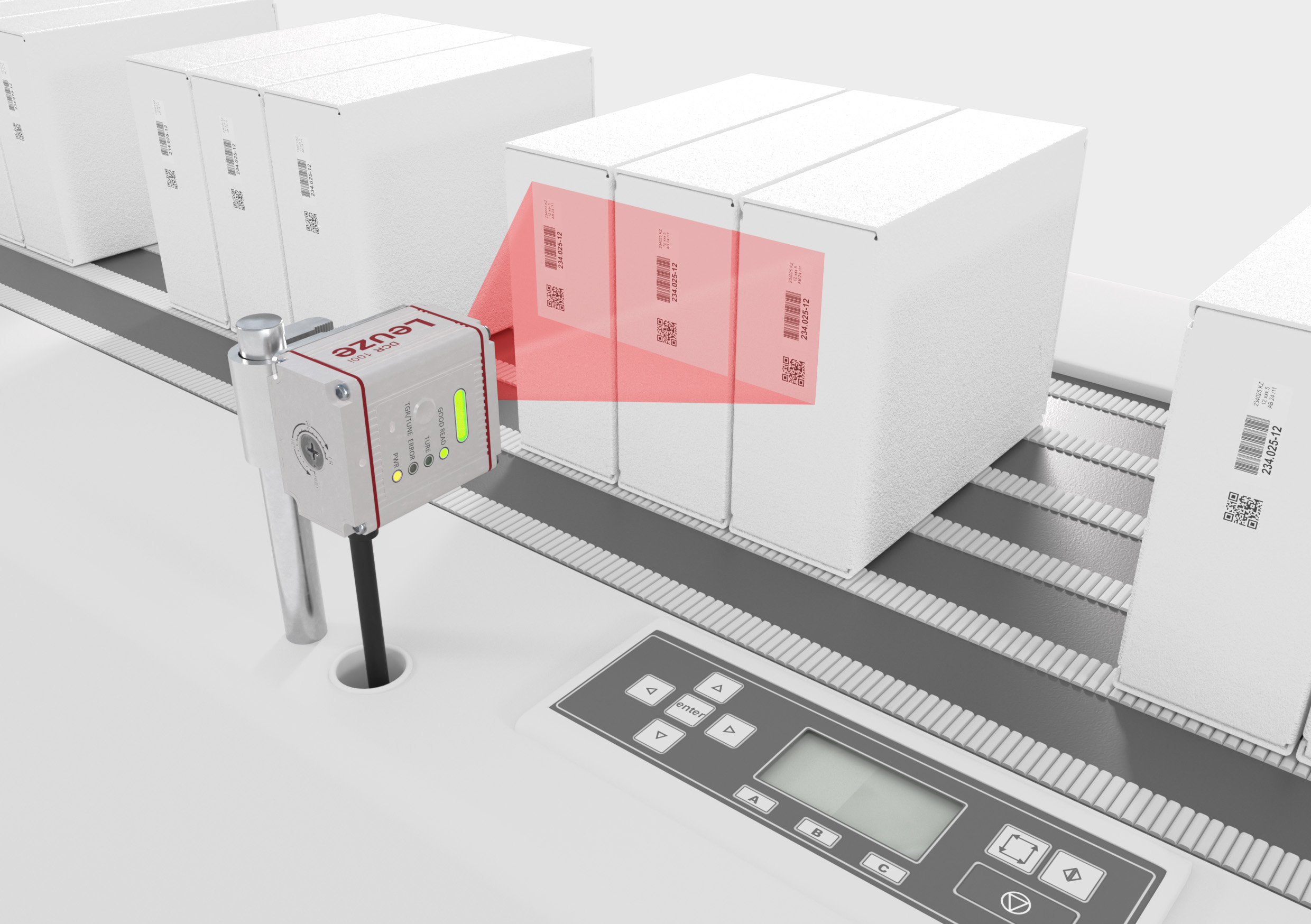
Leuze has expanded its industrial identification portfolio with the launch of the DCR 100i series, a compact code reader designed to support high-speed traceability applications across manufacturing, electronics, and packaging environments.
The DCR 100i is designed to capture 1D and 2D bar codes, including direct part marking (DPM) codes applied to components. Built around a 1.3-megapixel CMOS imager, the device targets applications where reliable code detection is required across variable working distances and fast-moving production lines.
According to Leuze, the sensor’s decoding algorithms and flexible focus configuration enable consistent reading of small and low-contrast codes at different distances. With a frame rate of up to 120 frames per second, the DCR 100i is intended for use on conveyors running at speeds of up to two metres per second, supporting high-throughput inspection and tracking tasks.
The large field of view allows the device to read multiple codes simultaneously, enabling identification of grouped or complex packaging layouts without requiring multiple readers. This capability is particularly relevant in packaging and logistics operations where mixed product flows and multi-code labelling are increasingly common.
The DCR 100i supports four manually selectable focus ranges, spanning working distances from 40 millimetres to 550 millimetres. This adjustment allows the same device to be deployed across different line configurations, code sizes, and surface types without requiring additional optics or model variants.
Commissioning is designed to be carried out directly on the device. Integrated trigger and teach buttons, combined with automatic adjustment of exposure, illumination, and decoding parameters, allow setup without the use of a PC. This approach is intended to reduce installation time and simplify changeovers in production environments where engineering access may be limited.
Connectivity options include Ethernet with support for industrial protocols such as Modbus and TCP/IP, alongside an RS232 serial interface. These interfaces allow the DCR 100i to be integrated into existing automation architectures and machine control systems with minimal modification.
Physically, the reader is housed in a compact aluminium enclosure rated to IP64, providing protection against dust and liquid ingress. A glass cover protects the optics, while the device’s dimensions — 44 × 53 × 29 millimetres — are intended to support installation in space-constrained machinery and production cells.
The DCR 100i is aimed at manufacturers seeking to improve traceability and quality control without increasing system complexity, particularly in sectors where speed, flexibility, and reliable code capture are critical to production efficiency.