“The answer to our transport crisis is lots of boring little things like bus lanes, tram systems, and new stations, and not one grand mega-project (HS2) that is only going to touch a handful of people.” These are the words of Andrew Gilligan, who was a special advisor to Rishi Sunak.
While more tram system and stations are required, it is not credible to suggest that HS2 only touches a handful of people when tens of millions use the congested West Coast Main Line (WCML) each year.
Yet Gilligan was one of few people advising Sunak when he decided to cancel HS2 Phase 2 to Manchester and replace it with the widely derided Network North strategy which could be said to be made up of Gilligan’s “lots of boring little things”. Those not consulted included the Rail Minister, Network Rail, HS2, Mayors of the affected local authorities, and the National Infrastructure Commission, which was specifically set up to advise Parliament on such national infrastructure priorities.
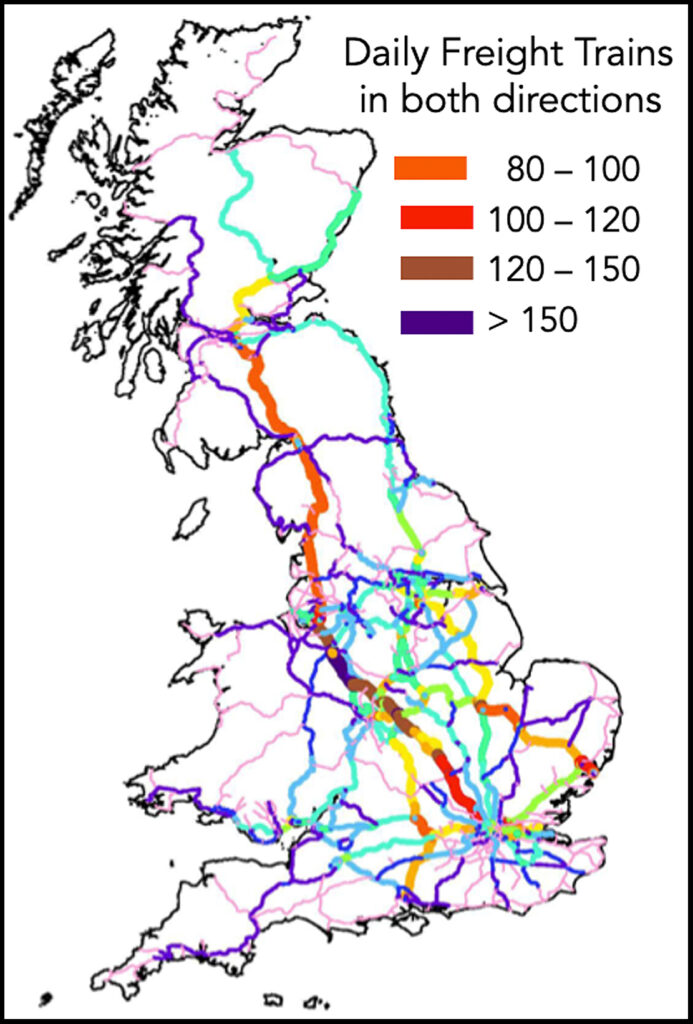
In this way, a project that was 15 years in the making, with constant all party support, was arbitrarily cut back by those who did not understand the consequences of their decision. This was evident at subsequent Parliamentary committee hearings when Ministers claimed that there was no WCML capacity problem. Yet without HS2 Phase 2a to Crewe, the current WCML service north of Birmingham will have to be reduced by one train for every HS2 train introduced and there can be no significant increase in WCML freight traffic which currently carries 90% of intermodal container trains.

With costs spiralling out of control something had to be done about HS2. Yet the October 2023 decision to cut HS2 Phase 2 generally only cut costs in future years, slashed the project’s benefits, and wasted billions already spent. For example, Birmingham’s Curzon Street station will now only have tracks at three of its seven platforms. Cancelling HS2 Phase 2a to Crewe reversed an agreed plan, taken after four years of Parliamentary scrutiny, that was deemed to be the best way to increase WCML capacity.
As we describe in our feature ‘Resetting HS2’, meaningful action is only now being taken to bring HS2’s costs under control. The Transport Select Committee (TSC) was advised that HS2 is being re-organised to provide effective project control, and that Main Works Civils Contracts are to be renegotiated. HS2 CEO Mark Wild also explained how HS2’s budget and programme is being reset.
The TSC considered that gold plating had caused much of HS2’s high costs. Its chair was astonished that no-one knew why HS2 was designed for a 400km/h speed. She has a point, as an informed client would have known the rationale for HS2’s technical specification as shown in DfT documents of which those questioned seemed unaware. Without an understanding of the rationale for this maximum speed, Rail Minister Lord Hendy’s view that HS2’s very high speed is due to ‘zealotry’ is, literally, ill informed.
Hendy did acknowledge the severe WCML capacity constraint north of Birmingham and advised that options to provide more capacity are being seriously considered. This includes a new line on the HS2 Phase 2a route as proposed by the Manchester and West Midland Mayors. However, he stressed that Government could not contemplate a new line until it could be shown that HS2 Phase 1 is under control.
Although this is understandable, Parliamentary powers to build the Phase 2a route will expire in February 2026 unless a Bill is passed to extend them. Time is therefore running out for this one-off opportunity to significantly increase WCML capacity.
The Stuttgart 21 project shows that the UK is not the only country with a seriously over budget and delayed project. Yet, as our feature explains, this project offers significant benefits and, unlike HS2, the German approach is ‘I’ve started so I’ll finish’. This article also explains how the major station project at Amsterdam Centraal will increase capacity by reducing the number of its tracks.
The evolution of railway stations, as described in an article by Mark Phillips, is the latest in our series of Railway 200 features. Another such feature is a technical explanation of why railways are, and most probably always will be, the most efficient way of transporting large traffic volumes. This is something that decision makers need to understand.
The Coventry Very Light Rail (VLR) vehicle is an example of the benefits of rail. As Professor Felix Schmid reports, the alternative of an electric bus service would require three road rebuilds over the life of the VLR.
Although Bob Wright’s report on the transport spending review has some good news for the rail sector, the lack of any mention of the Ely capacity improvement scheme and pausing the Midland Main Line (MML) electrification is cause for concern.
MML electrification has been paused due to the introduction of bi-mode stock which requires only discontinuous electrification. How this works on the Welsh core valley lines on which battery EMUs (BEMU) operate is the subject of Malcolm Dobell’s feature. We also report on an informative IMechE BEMU seminar. However, this did not discuss whole-life system aspects (e.g. freight operation) which need to be considered to determine whether discontinuous electrification is an appropriate option.

Innovation of passenger information systems is considered in two separate features. Clive Kessell reports on a recent online event which considered the perception and reality of passengers’ experiences while Matt Atkins discusses the development of Visual Disruption Map videos. We also explain why passengers using West Midlands trains will be pleased to travel on its new Class 730/2 units.
Implementing ETCS signalling presents huge challenges. The nature of these challenges and how they are being overcome is described in Paul Darlington’s feature on the recent ETCS Business Readiness Congress. One speaker at this event advised: “no individual really grasps the whole challenge, and those who say they do are dangerous.”
Other events attended by our writers included Rail Live at which there were almost 300 exhibitors with much innovative plant on show. As always, this was held at the Long Marston Rail Innovation Centre which, since it was taken over by Porterbrook, now has a 3.5km electrified test loop. As we report, the 3.2 km Stapleford Miniature railway which hosts the annual IMechE Railway Challenge now boasts a turntable. This year’s challenge was won by the Network Rail and Colas team.
After attending the 25th anniversary lunch of the Chartered Institution of Railway Operators (CIRO), it was fascinating to learn of CIRO’s history and how it supports today’s railway operators. Just as it is important that different engineering disciplines understand each other’s challenges, it is important that engineers understand the role of operators. We hope our article about CIRO helps in this respect and indeed that all this issue’s features provide useful information for all railway professionals.
Image credit: HS2