
Image: ESA/Veolia Poland
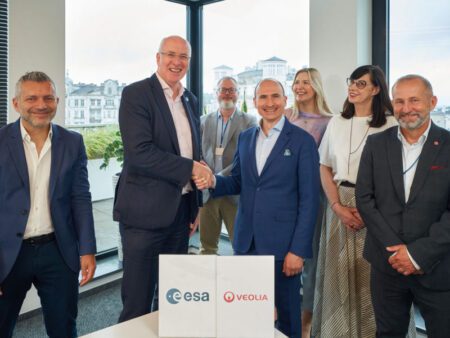
Volia Energia Poland and ESA have signed a memorandum of intent (MOI) to co-develop innovative solutions to accelerate decarbonisation in the areas of energy, water and waste management.
Under the MOI, the two partners intend to explore the application of satellite technologies and downstream space services focused on decarbonisation and the green and digital transformations in sectors that are critical to the sustainability and resilience of European cities
This marked the beginning of a strategic collaboration to harness space technologies in support of sustainable development.
Krzysztof Zamasz, Vice President of the Management Board at Veolia Poland, said the objective is to strengthen the resilience of cities and industries to climate-related challenges.
“Satellite technologies will allow us to monitor and analyse natural resources more effectively, identify energy losses, anticipate environmental risks and optimise operational processes through the implementation of innovative technologies.”
Have you read?
How the energy-space nexus is resulting in a data fusion to boost climate resilience
Energy Transitions podcast: Tapping the power of partnerships to accelerate energy innovation
The Veolia Group in Poland, operating in the market for over 25 years, currently serves 3 million customers across 123 cities and manages district heating networks in 58 of them.
The company delivers integrated services in heat production, energy efficiency, water management and waste solutions.
Anna Kędziora-Szwagrzak, CEO of Veolia Energia Łódź, adds: “The cooperation between the Veolia Group and ESA is, for heating systems such as the Łódź one, a very innovative research and development area for the operation of technological infrastructure responsible for the security of the city’s supply of district heating and in this context its sustainable ecological transformation.”
Nick Appleyard, Head of ESA’s Business Applications and Space Solutions programme, says the Polish economy offers a wide range of opportunities for innovation using space technologies.
“We are looking forward to working closely with our Polish partners to demonstrate how satellite technologies have a key role to play in addressing infrastructure challenges across multiple sectors.”
As part of the agreement, the two partners plan to launch pilot projects, co-organise workshops and seminars, and collaborate on educational and awareness-raising initiatives showcasing the potential of space applications for environmental protection and urban infrastructure modernisation.
The MOI is valid for three years with the possibility of extension.