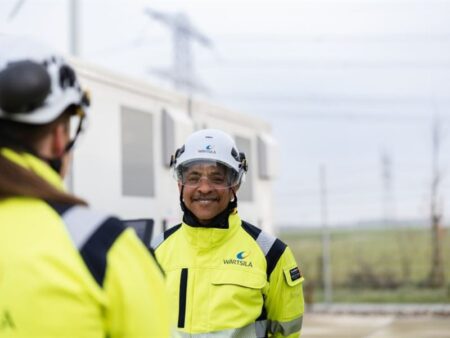

Image courtesy Wärtsilä
The last two weeks have been fruitful for the UK’s battery energy storage (BESS) sector, with contracts and agreements announced by the likes of Balance Power, Wärtsilä, RES and Eku Energy across a range of projects.
The announcements include:
- Balance Power’s planning approval for a 49.5MW project in Radwell Bury, Hertfordshire.
- Wärtsilä’s supply of a 68MW system in Lerwick, Shetland, to Zenobē.
- RES’s operations and maintenance (O&M) contract for the 720MWh Staythorpe BESS in Nottinghamshire.
- Two utility-scale projects at Basildon in Essex and Loudwater in Buckinghamshire, built by Eku Energy and NHOA Energy, which have successfully completed testing and verification and are now fully commissioned.
Balance Power’s Radwell Bury facility
Balance Power is now in the process of securing a grid connection date for the Radwell Bury facility battery storage site. At the end of its lifecycle, the facility will be decommissioned, and the site will be fully restored to land for agricultural use.
Designed to accelerate the UK’s transition to net zero, the Radwell Bury facility will store surplus renewable energy and release it during periods of high demand, helping to unlock greater use of intermittent clean power sources.
Once operational, it will help power approximately 26,767 homes and enhance the stability of the national energy system, says the company in a release.
The project comprises 48 battery units with a total storage duration of two hours, expected to cut CO₂ emissions by around 18,281 tonnes annually.
Balance Power says the development will also deliver a 44.25% biodiversity net gain across the site, incorporating a landscape scheme that will protect woodland belts, hedgerows, and meadow grasslands.
Commenting in a release was Ryan Stott, connections team at Balance Power: “We’re pleased to have received unanimous approval for this vital project and appreciate the strong engagement from the community and local council throughout the process. As well as reinforcing national energy resilience, this site will contribute to local environmental goals and support the transition to a more sustainable future.”
In our Power Playbook:
Is the UK’s BESS market entering its next phase?
Cap and floor: LDES watershed or critical battery barrier?
RES Staythorpe system
Renewable energy company RES secured an operations and maintenance (O&M) contract for the 360MW/720MWh Staythorpe BESS in Nottinghamshire, UK.
The contract was awarded by Elements Green, a European clean tech developer, for the project, which the companies say is set to become one of Europe’s largest grid-scale battery storage assets once operational.
The five-year O&M contract, which marks the beginning of a strategic partnership between RES and Elements Green, is due to commence in 2026.
Said Manuel Sánchez, global head of O&M Services at RES: “We’re proud to be supporting Elements Green on such a transformative project…Staythorpe is a strategically significant project and a strong vote of confidence in RES’ ability to deliver best-in-class performance on battery storage assets.”
James Gates, chief investment officer, at Elements Green, said: “As we scale our battery storage portfolio, having a trusted O&M partner with deep technical expertise and a strong track record is essential. RES stood out for its clear operational strategy, high-voltage capability, and commitment to long-term asset performance.”
Wärtsilä’s Engineered Equipment Delivery (EEQ) contract
Technology group Wärtsilä will supply a 68MW system in Shetland, Scotland, under an Engineered Equipment Delivery (EEQ) contract signed with Zenobē, an owner and operator of grid-scale battery storage.
The Shetland Standby Project, scheduled to go live in 2026, is the third major battery partnership between Wärtsilä and Zenobē; the order was booked in Q2, 2025.
The battery system will enable the Lerwick Power Station to move into a standby role, cutting fossil fuel use and helping integrate more renewable energy from Shetland’s abundant wind resources.
In the event of an outage or planned maintenance on the transmission line to mainland Scotland, the battery energy storage system will maintain uninterrupted power to Shetland’s homes and businesses.
The battery system features a range of innovative technologies: it will deliver Distribution Fault Ride Through (DFRT) capabilities and standby solution services to support Shetland’s mainland interconnector. These capabilities ensure grid stability in the face of transmission faults by keeping the system powered without interruption.
Wärtsilä’s GEMS Digital Energy Platform will manage the battery system’s real-time performance, ensuring fast, intelligent responses to fluctuations in supply and demand. With a power output that exceeds Shetland’s local load, the system will provide a crucial buffer against grid instability. The project will also use Wärtsilä’s Quantum energy storage technology and will be supported by a 15-year long-term service agreement (LTSA) to ensure reliable, efficient performance throughout its lifespan.
Said Tamara De Gruyter, president, Wärtsilä Energy Storage and EVP, Wärtsilä: “As European grids grow increasingly interconnected and interdependent, projects like this signal the importance of energy storage for grid stability.
“With the advanced and proven capabilities of the GEMS platform, Wärtsilä is helping future-proof the grid with battery systems that can react in microseconds to any type of system disturbance, to maintain security of supply for Shetland.”
Said James Basden, Zenobē founder director: “This project combines a battery with an AC chopper in Shetland and will maintain security of supply, ensuring homes and businesses continue to receive the power they need in the event of a transmission system outage, while reducing emissions and utilising more renewables in Shetland.”
Eku Energy battery projects
Two utility-scale energy storage projects at Basildon in Essex and Loudwater in Buckinghamshire, built by global energy storage specialist Eku Energy and global supplier of utility-scale energy storage systems NHOA Energy, have successfully completed testing and verification.
The battery projects, now fully commissioned, add a total of 130MWh of installed capacity for critical grid support. Each project will deliver ancillary and balancing services that will support both the local and the national grid, boosting energy security and reliability for electricity consumers in the UK.
Both projects use BESS equipment supplied by NHOA Energy together with operating infrastructure and auxiliary systems supplied by BOP contractor ESM Power.
Under separate long-term service agreements, NHOA Energy will provide operations and maintenance services for both sites, ensuring continuous performance and system reliability over time.
Loudwater is 39MW in size with a storage capacity of 55MWh and covers 0.6-acres of rural land near the town of High Wycombe in Buckinghamshire. Statkraft Energy will trade the Loudwater BESS on Eku Energy’s behalf.
Basildon is 28MW in size with a storage capacity of 56MWh. It is Eku Energy’s first two-hour battery system in the UK and covers 1.6 acres of land.
The project will support the National Grid in this important network location close to other generation sources including a solar PV farm and two gas-fired peaking power stations, critical 400kV substations and the upcoming grid upgrade from Tilbury to Norwich.
Battery storage optimiser Habitat Energy will manage energy trading on Eku Energy’s behalf.
Commenting in a release was Eku Energy CEO Daniel Burrows: “The commissioning of Loudwater BESS and Basildon BESS creates diversity of our operating portfolio in the United Kingdom. Our growing operating portfolio creates further opportunities to support our customers by structuring innovative long-term contracts.
“With the commissioning of these two projects, Eku Energy is continuing to drive our mission of accelerating the energy transition by delivering safe, secure and reliable battery storage assets that provide cost-effective clean energy.”