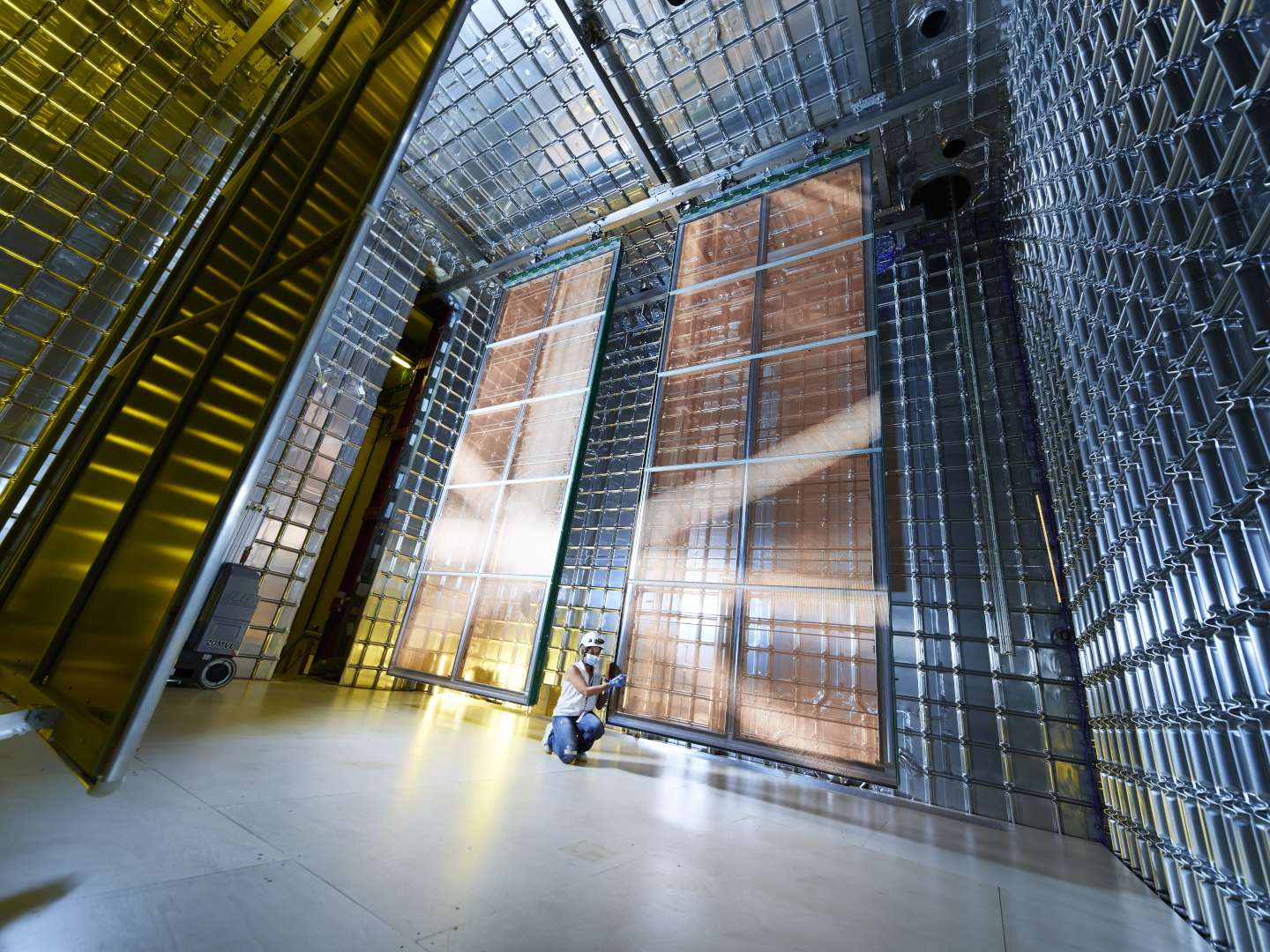
The UK manufacturing programme for the Deep Underground Neutrino Experiment (DUNE) has passed its halfway point, with engineers completing at least half of the 137 anode plane assemblies assigned to British teams. The production milestone, announced on 19 October, concerns large precision detector panels being built at the Science and Technology Facilities Council (STFC) Daresbury Laboratory in Cheshire.
The UK is responsible for 137 of the 150 assemblies required for DUNE’s first far detector module. Each anode plane assembly, or APA, is approximately 6.3 metres high and 2.3 metres wide, yet its function depends on thousands of precisely positioned electrical connections and around 24 kilometres of thin copper-beryllium wire. The combination of a large supporting frame and highly sensitive instrumentation makes this an unusual production programme.
Twenty-five technicians are assembling the panels at Sci-Tech Daresbury, supported by engineering and research teams across six universities: Lancaster, Liverpool, Imperial College London, Manchester, Sheffield and Sussex. The wider DUNE-UK collaboration involves 14 universities and two national laboratories, contributing detector systems, software, computing and accelerator expertise as well as the APA manufacturing programme.
Once installed, the APAs will provide the primary electrical readout for the first far detector at the Sanford Underground Research Facility in South Dakota. The detector will contain an enormous volume of liquid argon, in which interactions involving neutrinos can produce charged particles. As those particles move through the argon, they leave trails of ionisation that can be measured by the detector’s readout system.
Electric fields inside the detector cause liberated electrons to drift towards the APA wires. Signals recorded at different positions and times can then be combined to reconstruct the paths and energies of particles produced in an interaction. The accuracy of that reconstruction depends in part on the geometry and electrical performance of the sensing wires, which must remain consistent across a very large detecting surface.
Manufacturing the panels therefore requires control of more than the dimensions of the frame. Wire placement, tension, electrical continuity and the integrity of the connections all influence whether a completed APA can deliver the measurements required. Production quality is a direct part of the scientific instrument’s performance, rather than simply a check that the assembly can be transported and installed.
The thousands of wires also create a demanding inspection task. A problem affecting a small number of connections may be difficult to identify by visual inspection alone, while components must retain their characteristics during handling and subsequent shipment. The manufacturing and quality assurance teams need records that allow faults to be traced and addressed before the assemblies enter the next stage of the programme.
Shipping creates another interface between manufacturing and the experiment. Each completed panel must be protected against mechanical damage during lifting, packaging and transport, then examined at its destination before installation. Eight completed UK APAs have now arrived at Fermilab in Illinois for final testing, but they have not yet been reported as installed in the underground detector.
The programme reached an earlier milestone in March 2026, when Daresbury had completed 50 assemblies and the first four had arrived at Fermilab. The latest announcement confirms that production has advanced beyond half the UK allocation; it does not give an exact finished total beyond that threshold. Nor does completion of the UK panels mean that the wider DUNE detector, beam facilities or experiment are finished.
DUNE will use a neutrino beam originating at Fermilab and travelling approximately 1,300 kilometres through the Earth to South Dakota. Neutrinos rarely interact with matter, so a detector containing tens of thousands of tonnes of liquid argon is needed to collect enough interactions for detailed study. The underground location, nearly a mile below the surface, reduces interference from cosmic rays that could otherwise obscure the faint signals.
The experiment is intended to compare the behaviour of neutrinos and antineutrinos as they travel over that distance. One principal objective is to examine differences that may help explain why matter dominates over antimatter in the observable Universe. DUNE will also investigate the ways neutrinos change between types and study neutrinos produced by events such as supernovae.
The manufacturing programme illustrates the relationship between fundamental science and industrial engineering. Even though the completed panels are not commercial products, their manufacture requires repeatable assembly processes, controlled materials, specialist fixtures and consistent inspection. A scientific specification has to be converted into a series of physical assemblies that can withstand handling and operate within the detector’s demanding environment.
Coordination between production teams and the universities is especially important where a component or manufacturing change affects the detector’s performance. Technical specifications, acceptance criteria and test results must be shared between organisations so that assemblies completed at different times remain compatible with the common detector design. The same discipline is familiar in aerospace and other industries producing high-value systems from distributed supply chains.
There is also a separation between making a detector component and proving it suitable for operation. Manufacturing completion confirms that the assembly has passed its specified production stages; testing at Fermilab and integration underground are subsequent tasks. Transport and integration schedules must accommodate the build-up of the first detector module as well as the arrival of UK equipment.
STFC currently expects production of the remaining British APAs to be completed by May 2029, with deliveries for installation in South Dakota planned from November 2029. These are programme targets and do not establish a start date for routine scientific operation of the complete experiment.
The next milestones will involve continued assembly at Daresbury, testing of the panels already delivered and further shipments to the United States. Passing the halfway point shows that the UK production process is operating at substantial scale, while the detector’s eventual scientific capability will depend on the panels meeting their specifications through transport, installation and commissioning.