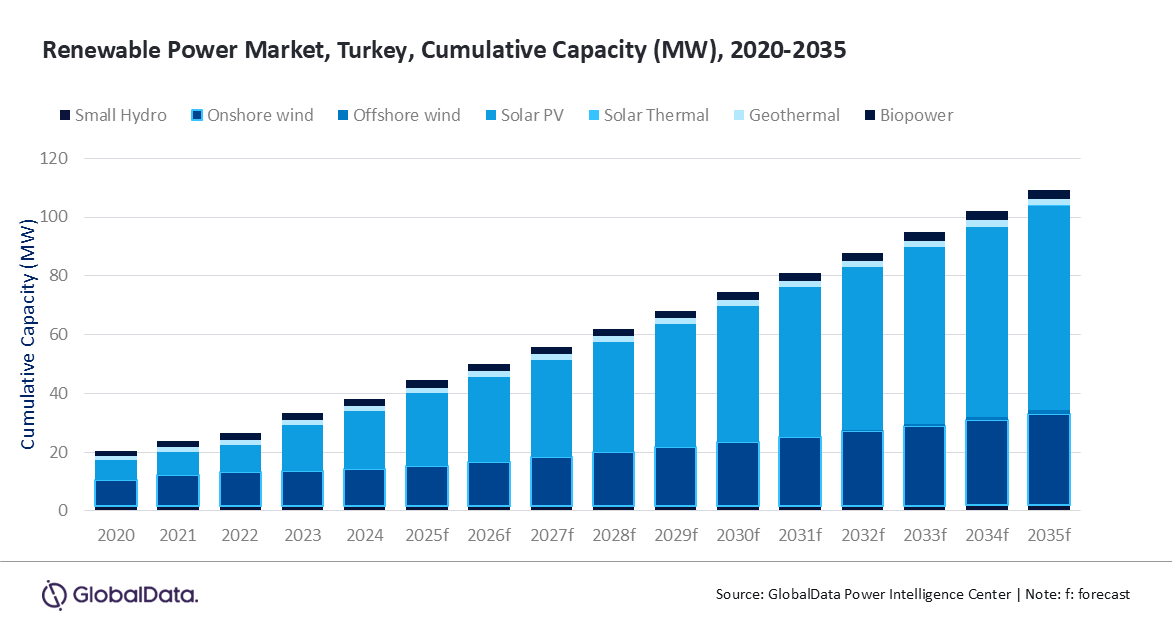
Turkey boasts one of the world’s most rapidly expanding energy markets, driven by its robust economic growth. However, the country relies heavily on fossil and electricity imports to meet its domestic power demand. To reduce this dependency, the country is looking to expand is renewable capacity. In October 2024, Turkey’s Ministry of Energy unveiled its 2035 roadmap for renewable energy. Against this backdrop, the country’s renewable power capacity is forecast to reach 38.2GW in 2035, registering a compound annual growth rate (CAGR) of 17.1% during 2024-35, according to GlobalData, the data and analytics company.
GlobalData’s latest report, Turkey Power Market Outlook to 2035, Update 2025 – Market Trends, Regulations, and Competitive Landscape, shows that annual power generation in Turkey is expected to increase at a CAGR of 8.6% during 2024-35 to reach 213.5TWh.
Attaurrahman Ojindaram Saibasan, Senior Power Analyst at GlobalData, comments: “Turkey aims to quadruple its wind and solar capacity, targeting a goal of 120GW by 2035. To achieve this, the country plans to install between 7.5 and 8GW of renewable energy capacity annually, with an investment of $80 billion. The strategy includes the addition of at least 2GW of wind capacity each year through YEKA auctions, which included 1.2GW of wind and 800MW of solar in the YEKA 2024 auction. Furthermore, the development of 5GW of offshore wind is targeted. These targets are expected to augment renewable power development.”

Saibasan adds: “Turkey’s increasing demand for power has been driven by the nation’s expanding GDP and population growth, with projections indicating a continued upward trend. As the primary source of power generation in Turkey, thermal power—predominantly derived from natural gas, followed by hard coal and lignite — plays a crucial role.”
However, Turkey domestic fossil fuel resources are limited, necessitating a heavy reliance on imported fuels to satisfy its energy needs, including those for power generation. According to Ministry of Foreign Affairs, Turkey, approximately 74% of the country’s energy requirements are met through imports. The country sources natural gas from Russia, Iran, Azerbaijan, Algeria, and Nigeria, while its crude oil imports primarily come from Iraq, Iran, Russia, Saudi Arabia, Colombia, Kazakhstan, and Nigeria.
Saibasan concludes: “To overcome the challenge, the country has placed focus on nuclear and renewable power. Within the renewable power segment, solar PV constituted nearly 51.3% of the total renewable power capacity followed by onshore wind, accounting for 32.9% in 2024. The country is looking to add offshore wind into its capacity mix by 2032. In the Offshore Wind Roadmap, Turkey has established a goal of achieving 5GW of installed capacity for offshore wind power by 2035.”