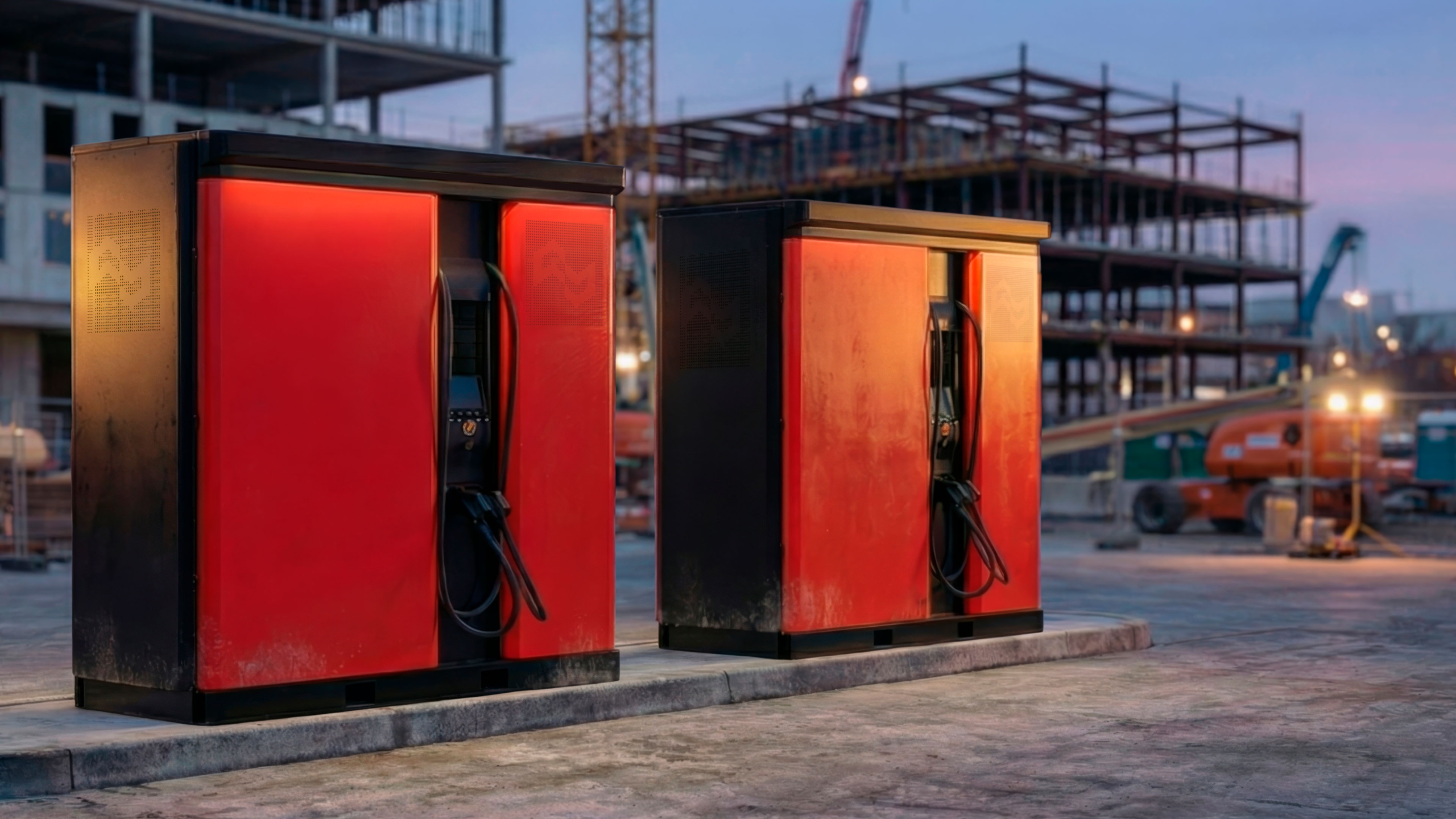
TUAL has appointed Northumberland manufacturer Tharsus to industrialise its PowerUp battery-buffered fast charger, moving the system from proof-of-concept and field-trial work towards repeatable volume production in the UK.
The manufacturing partnership centres on a high-power CCS charging system designed for commercial fleets operating at sites where the available grid connection cannot support conventional rapid charging at the required duty cycle. PowerUp combines its grid connection with integrated lithium-ion battery storage, allowing energy to be accumulated when site demand is lower and discharged when vehicles need higher charging power.
Tharsus will work with TUAL’s design and engineering teams to optimise the product for production, including the manufacturing disciplines needed to move from early builds into larger volumes. Neither company has disclosed target annual output, production investment, or a date for full-rate manufacture, leaving the immediate programme focused on industrialisation rather than a declared production ramp.
The arrangement places an important part of TUAL’s scale-up in Blyth, where Tharsus specialises in taking complex electromechanical products from prototype into manufacture. Its experience spans battery systems, high-reliability power electronics, control systems, robotics, and mobility equipment, matching the combination of energy storage, conversion hardware, software, and ruggedised packaging inside PowerUp.
Phil Clarke, founder and chief executive officer at TUAL, said: “Delivering on our uptime and performance targets requires a manufacturing partner with exceptional technical capability and operational discipline. Tharsus brings exactly that. They understand the importance of building quality into every stage of the process and have the experience to support our move from pilot to scalable production.”
Fleet charging sites can have vehicles capable of accepting high power while the depot itself remains constrained by its electrical connection, the cost and lead time of reinforcement, or the practical difficulty of installing new fixed infrastructure. TUAL’s architecture inserts energy storage between that limited supply and the vehicle, creating a buffer that can deliver periods of higher output without requiring the grid connection to match the charger’s peak power continuously.
TUAL says PowerUp can accept single- or three-phase supplies from as little as 16A. Its design is intended to be relocatable and installed without major civil works, while remote monitoring and diagnostics support maintenance and uptime. Those requirements place manufacturing controls around battery integration, power conversion, thermal behaviour, electrical protection, communications, software configuration, and repeatable end-of-line testing.
Products that perform successfully in low numbers can expose different problems as volumes rise. Cable routing, connector access, firmware loading, calibration, test time, serviceability, and supplier variation all have to be engineered around repeatable assembly rather than individual builds. Tharsus will therefore be responsible for turning the existing design into a production process capable of holding performance and quality as output increases.
The manufacturing agreement follows TUAL and PowerUp securing Made in Britain status. The protected collective mark identifies qualifying products manufactured in Great Britain or Northern Ireland, while TUAL is using the designation as part of a wider plan to establish an export-ready manufacturing model in Britain and expand into European commercial-fleet markets.
Brian Palmer, founder of Tharsus, said: “We’re proud to partner with TUAL in realising their much-needed EV technology and bringing world-class British engineering to markets across Europe. As a UK manufacturer, we were completely behind TUAL’s drive to secure their Made in Britain status.”
The charger enters production planning as investment continues across UK zero-emission commercial vehicles and their supporting supply chains. More than £1.1 billion of private investment has been announced for UK commercial vehicle manufacturing and associated supply chains since 2021, while charging hardware, grid connections, depot electrical systems, and maintenance capacity remain critical parts of the same transition.
Battery-buffered charging does not remove the underlying energy requirement. Its operating economics depend on site load profiles, utilisation, storage cycling, electricity tariffs, charger duty, and the cost of alternative grid work. It can, however, alter when power is drawn and how much connection capacity is required when a vehicle plugs in, potentially giving constrained or temporary fleet sites another route to higher-power charging.
The production programme now has to convert that architecture into equipment that can be assembled, tested, supported, and repeated at scale. TUAL has selected the manufacturing partner for that step; declared production volumes, customer deployments, and the planned European expansion will provide the next measures of how quickly PowerUp moves from field-tested hardware into sustained manufacture.