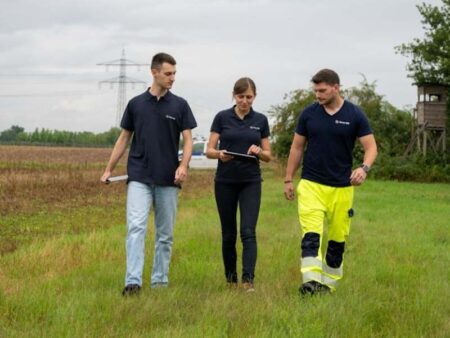

The picture shows (from left) Benjamin Hocanin, working student at NETZinspect, Dr. Sophie Crommelinck, product owner at Netze BW, Andreas Kummelt, technician at Netze BW analysing LiDAR data. Image courtesy Netze BW.
In Germany, a helicopter equipped with special sensors to capture 3D data, digitise line maintenance, make it more efficient and assess supply security, covered 3,600km of power grid lines on behalf of NetzeBW.
The helicopter flew on behalf of the DSO during an inspection of its high-voltage lines and all 266 adjacent substations using LiDAR technology in Baden-Württemberg.
LiDAR (Light Detection and Ranging) is a technology that uses laser beams to measure distances and separations to create precise 3D models of objects and their surroundings.
The special helicopter was used to survey the lines and surrounding vegetation across the entire Netze BW network area from a height of approximately 110 meters, with centimeter-level precision, says Netze BW in a release. This represents a real added value, the DSO adds, especially in mountainous and remote areas with poor visibility.
The data is used to identify where trees might grow into or collapse the power lines.
Have you read:
Netze BW tests autonomous airships for powerline inspections
AI-powered wildfire detection startup Pano AI raises another $44m in the US
Commenting in a release was Fabian Grabowski, a technician at Netze BW: “Previously, we always had to estimate – with LiDAR, we have certainty about where vegetation could pose a risk.”
According to Netze BW, a single tree incident on power lines can cost up to half a million euros, meaning that assessing when trees become a danger in front of powerlines is essential.
Said Dr. Sophie Crommelinck, product owner at Netze BW: “A before-and-after comparison shows that the application of the LiDAR method identifies around a third more vegetation risks than mere estimation.
“In the past, technicians also targeted line sections by vehicle or on foot, which took significantly more time. Need-based pruning measures can now be initiated more quickly.”
The LiDAR system, adds the DSO, also provides a growth forecast for trees near the powerlines for the next two years, taking into account the fact that the lines sag under full load and in hot weather or move in windy conditions.
A turn to digital tech
According to Netze BW, all identified ingrowth risks are now available to operating personnel in a consolidated form in the TIP app (Route Management & Innovation Platform) developed by the utility.
Authorities and partner companies can also access the application. Authorities gain access to measures in protected areas, among other things, which facilitates coordination.
Although the turn to digital technology is a necessity for these types of inspections, Netze BW says that its increasing use leads to a multitude of media data, quickly becoming confusing if there is no central platform with uniform access.
Therefore, Netze BW is preparing such a platform in a third project pillar of ‘NETZinspect 2.0.’ All images, videos, and 3D data from its technical systems will be stored on a long-term basis.
Through this platform, every company department can access all existing data for which this data is relevant—for example, grid operations, planning, project management, or grid construction. This would make frequent trips to the systems a thing of the past, as existing images can be easily accessed.
Said Katharina Gill, head of the NETZinspect 2.0 project: “TIP represents a subset of the project. Drone footage is also included, which is intended to replace visual inspection work.
“Artificial intelligence can also be used to detect foreign objects in overhead lines or to check the functionality of insulators.”
For comparison, Netze BW says that the distance covered by their helicopter, 3,600km, is the same as from Stuttgart, Germany, to Georgia.