
Image courtesy 123rf
Using France, its solar and EV fleet deployment as a case study, Parker Spielman of DejaBlue discusses how fragmented policy risks leading us to wasted energy, higher costs, and a slower path to net zero, unless we start thinking across assets.
The energy transition has been largely driven by policy and regulation. In France, as in much of Europe, subsidies have played a pivotal role in supporting initial investments in renewables and electric vehicle charging infrastructure during their nascent stages, when these technologies were not yet economically viable on their own. For instance, early incentives helped bootstrap early solar deployments, while targeted support enabled the rollout of EV charging networks to offset the chicken-and-egg dilemma of low vehicle adoption and sparse infrastructure. Without such measures, the market density needed to sustain these business models simply wouldn’t have materialized, and it would have taken much longer to reach the scale for economic feasibility as well as the investment to improve the efficiency.
Yet, as we push deeper into decarbonization, the same regulations will become a limiting factor so long as they target specific assets in isolation. Regulations treat each energy asset in isolation, ignoring how they could work together. This siloed approach risks limiting our ability to consume clean energy efficiently and effectively.
France, with its ambitious targets under the National Low-Carbon Strategy, aiming for 40% renewable electricity by 2030 and carbon neutrality by 2050, serves as a stark case study. Here, well-intentioned policies for distributed energy resources (DERs), like the Loi d’Orientation des Mobilités (LOM) and the Loi sur l’Accélération de la Production d’Énergies Renouvelables (APER), have laid the groundwork for integrated systems. These regulations push for electrification at scale and simultaneous large-scale deployment of rooftop and parking lot solar. This, coupled with grid-scale renewable energy production investments may seem to provide all of the elements to energize efforts towards net zero, but without cross-asset coordination, they’re falling short.
The lack of asset coordination results in wasted renewable energy, higher costs for consumers, and a net slower transition. An updated, holistic approach to the energy transition is required.
More on France’s energy transition:
How grid schools aim to close France’s energy transition talent gap
France’s electricity network workforce is short by 43,000 people
Solar support for grid resale rather than self-consumption
As grid-scale renewable production scales, especially solar, there is a surplus of energy produced during the middle of the day. This generally coincides with the times where there is the least demand for energy. More than 90% of days in the last four months had zero or negative spot prices for at least one hour. Most days have many hours of near zero spot prices, which provide enough surplus to supply all of the energy needed for flexible loads like EV charging.

Essentially, there is a lot of extra energy available during the middle of the day and nobody knows what to do with it yet.
Now, let’s add in the regulation piece, and we will focus on the commercial, mid-market sector, which is the most interesting to look at given the combination of attractive opportunity and regulatory impact.
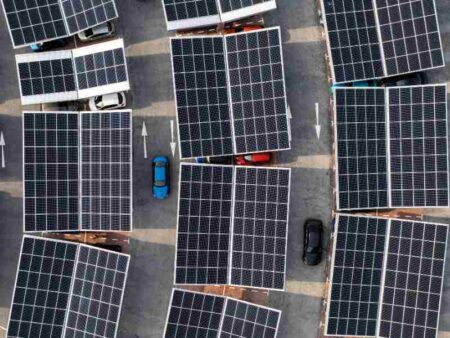
The APER law requires parking lots greater than 1,500 m² (50-60 parking spaces) to cover half of the lot with a solar shade structure (ombrière in French). Similarly, buildings with a footprint of over 500 m² need to cover half of their rooftop with solar.
To add onto this for France, which recently faced a credit downgrade, the state owned energy company, EDF, guarantees the purchase price for solar energy for a duration of 12-20 years. For installations of 100–500 kWp, those rates are currently 0.0886 €/kWh for full resell (−22.4 % compared to 2024) without an option for partial resale for energy not consumed on the site. For smaller sites with solar installations between 36-100 kWc, this value is 0.01081 €/kWh for full resell, while only 0.0761 €/kWh for exported solar on sites that also try to consume it on-premise. There is less guaranteed value for sites that consume some of their energy locally, which makes these projects harder to finance with debt.
All in all, estimates put non-industrial feed in tariffs at around 1 billion Euros per year. France cannot afford to further subsidize the construction of small-scale solar projects that will produce additional excess power that the grid already doesn’t need.
Electrification in france is resulting in huge flexible day-time load
Due to the nature of vehicle ownership being driven through corporate leasing and regulation pushing for electrification of these fleets plus the underlying infrastructure to support them, day-time EV charging represents the single highest potential use case for excess solar.
France’s LOM law set sweeping requirements to accelerate EV infrastructure and fleet electrification. Corporate fleet electrification is required with an increasing percentage of the fleet, with penalties, until fleets are fully electric in early 2032. Similarly, parking lots over 20 spaces need to equip 5% of spaces with EV chargers.
The nature of long-duration daytime charging, such as an employee parking in the morning and returning to their car after the workday, provides an ideal solution, since the charging can simply be optimized to align with the period of surplus renewable energy. Commercial EV charging also comes with the scale needed to consume a significant amount of the surplus midday renewable energy. These same locations with long-duration charging use cases, including workplaces, education facilities, hospitals, and parking structures, are affected by the same requirements to both install solar and a large number of EV chargers.
The majority of these locations end up importing grid energy during peak morning hours, then selling their excess solar back to the grid for a fraction of what they just paid. They generally have flat rate or on/off peak tariffs, and want the downside protection since two-thirds of their usage is still fixed. Besides, most of the value generated by optimizing flexible loads like charging (or heating and cooling) goes to the energy retailer anyway. Due to financing structures and feed-in-tariff incentives, many commercial solar installations fully resell their production to the grid rather than consuming it on-site. Even among the subset attempting self-consumption, few installations are equipped to align flexible loads with their surplus solar production.
Tune in to the special edition mobility-focused Energy Transitions podcast:
Episode 1: Can Spain’s transport sector keep pace with decarbonisation?
Episode 2: Fitting EVs into Spain’s power system
Episode 3: How electric mobility can unlock business opportunities for Spain’s fleets
Leveraging existing infrastructure together
The solution requires neither revolutionary technology nor massive new investment. A world where vehicles charge predominantly with solar energy, whether generated locally or fed into the grid, lies within immediate reach. The infrastructure is already being mandated and deployed. What remains is the far simpler task of making it work in concert.
This transformation hinges on three straightforward adjustments: designing electricity contracts that incentivize site owners and drivers to benefit from shifting their charging behavior; restructuring feed-in tariffs to reward on-site consumption over grid export; and ensuring that assets communicate with one another rather than operating in isolation.
Consider this: a typical office building with 100 parking spaces must install solar panels AND EV chargers, yet these systems rarely communicate with each other, and are often designed and constructed separately.
To avoid building parallel infrastructure that fails to converge, policymakers and large development projects must adopt a more holistic approach to the energy transition. Existing infrastructure can readily be equipped to enable assets to work in unison. For new developments, integrating solar and EV charging from the outset, completing construction and civil engineering in a single phase, proves both more efficient and cost-effective. At that point, designing them to operate together becomes the obvious choice.
The energy transition’s success hinges not on deploying more assets, but on enabling them to work together. Without cross-asset coordination, we’re being unrealistic in our aim to reach net zero while ushering in a future of distributed energy assets that operate as expensive neighbors rather than productive partners. The alternative is simpler, cheaper, and within immediate reach: just connect what we’re already building.
About the Author

Parker Spielman is the co-founder and CEO of DejaBlue, a company focused on making energy infrastructure smarter, cleaner, and easier to manage. His background spans over 15 years of work on large-scale optimisation problems, from ride-sharing systems at Lyft and Uber to energy and electrification infrastructure in Europe.
Do you want to join the conversation about mobility? Visit the Mobility Zone at Enlit Europe.
Step into the heart of transport innovation at the Mobility Zone. Bringing together utilities, regulators, OEMs, charge point operators, and tech innovators, this dedicated space is where the future of e-mobility is shaped.
Register now to attend Enlit Europe, taking place from 18–20 November in Bilbao.
Originally published on Enlit World.