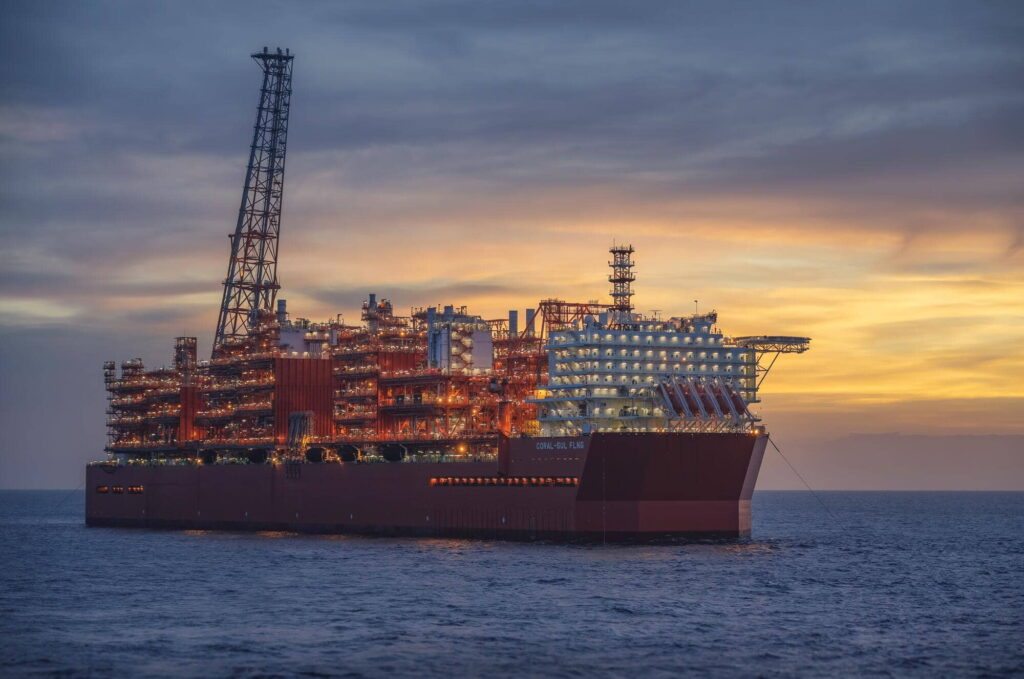
Technip Energies, working with JGC and Samsung Heavy Industries, has been awarded an engineering, procurement, construction, installation, and commissioning contract for the Coral Norte floating LNG project offshore Mozambique.
The contract was awarded by Mozambique Rovuma Venture for the Coral Norte FLNG development, which is being developed by Eni and partners CNPC, ENH, XRG, and KOGAS. Technip Energies said the latest contract, together with previously announced work, represents a major award for the company.
Coral Norte is designed to produce around 3.6 million tonnes per annum of LNG. Combined with the existing Coral Sul development, the project is expected to double the Coral hub’s production capacity to 7 million tonnes per annum, strengthening Mozambique’s position as a significant LNG producer.
The project will be delivered using a replica concept based on the earlier Coral Sul FLNG unit. That approach is intended to reduce execution risk by applying proven design, engineering, procurement, construction, and installation experience from the previous development. In offshore megaprojects, repetition can be valuable where reservoir conditions, feed gas composition, deepwater location, and operating requirements support reuse of a validated solution.
The Coral Norte final investment decision was taken in October 2025, following earlier project approvals and preliminary activities. Technip Energies, JGC, and Samsung Heavy Industries have already been involved in early work, including activity around hull and topside module preparation.
FLNG projects are among the most complex assets in process and offshore engineering. They combine gas treatment, liquefaction, storage, offloading, marine systems, power generation, safety systems, control rooms, accommodation, and export infrastructure within a floating facility. The engineering task is not only to make the process work, but to make it safe, maintainable, and operable offshore over long production periods.
Coral Norte also shows how LNG project execution is changing. Developers are placing greater emphasis on standardisation, replication, modular construction, and proven supply-chain partnerships to reduce cost and schedule risk. After years in which LNG megaprojects were associated with overruns and difficult interfaces, the ability to repeat a successful design has become commercially valuable.
The European industrial element is significant. Technip Energies is headquartered in France and remains one of Europe’s major engineering groups for energy and process infrastructure. Its role in Coral Norte places European engineering capability at the centre of a project involving African resources, Asian shipbuilding and construction capability, and global LNG markets.
Energy security continues to shape investment in gas infrastructure. Gas markets have been altered by geopolitical disruption, shifting trade flows, and pressure to balance reliability with decarbonisation. LNG has become a strategic commodity because it can move between regions more flexibly than pipeline gas, although long-term demand remains exposed to climate policy, pricing, and competition from electrification and renewables.
The process engineering demands are substantial. Gas treatment and liquefaction must be configured for offshore constraints. Equipment layouts must consider weight, footprint, access, safety zones, maintenance, and marine motion. Control and safety systems must operate across process and vessel domains, while fabrication sequences have to align with module delivery, yard capacity, commissioning, and offshore installation.
The replica strategy can reduce uncertainty, but it does not remove the need for technical discipline. Every project carries site-specific risks, contract interfaces, logistics challenges, local requirements, and execution pressures. The value of replication depends on knowing which parts of the earlier design can be reused and which must be adapted carefully.
The contract also reflects the continuing role of deepwater gas developments in the global energy system. Even as investment shifts towards low-carbon infrastructure, LNG remains part of energy-security planning and industrial feedstock strategies. Floating LNG offers a route to monetise offshore resources without building the full onshore liquefaction footprint, but the engineering threshold remains high.
Technip Energies’ Coral Norte role sits across process engineering, offshore construction, energy security, and global project delivery. The contract is a commercial win, but it is also another test of whether the industry can use standardisation and replication to make complex LNG infrastructure more predictable.