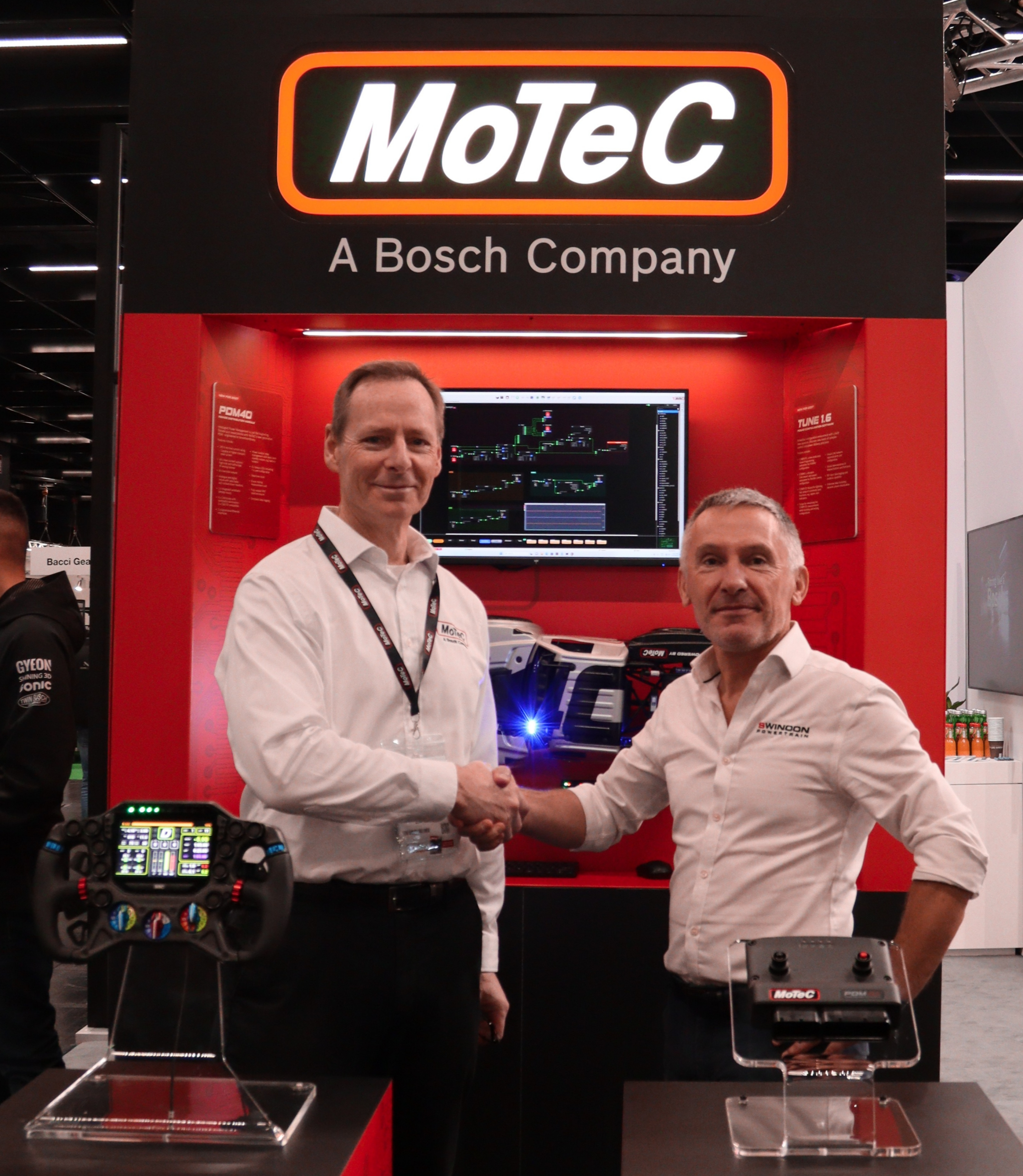
Swindon Powertrain has become an official MoTeC dealer under a new agreement extending sales and specialist engineering support for motorsport, prototype vehicles, electrified powertrains, and low-volume automotive manufacturing.
The partnership was announced at Professional Motorsport World Expo 2026 in Cologne and takes effect immediately. It formalises a relationship between the two companies that dates back to the establishment of MoTeC's European operations in the late 1980s.
Swindon Powertrain will now sell MoTeC electronic control and data acquisition products through its own webshop, supported by engineers trained to assist customers with equipment selection, integration, calibration, and operation.
The arrangement is intended to serve specialist vehicle manufacturers that require more detailed engineering assistance than a conventional component supply relationship might provide. Applications include restomods, bespoke road vehicles, prototypes, electrified conversions, and low-volume production programmes.
Swindon Powertrain was among MoTeC Europe's earliest customers and has since worked with the electronic systems manufacturer across a range of competitive motorsport projects. The current relationship includes the Supercars Toyota engine programme for Walkinshaw TWG Racing, which had recorded five race victories at the time of the announcement.
Raphaël Caillé, chief executive of Swindon Powertrain, said: “Today’s announcement builds on the trust we and MoTeC have developed through many years of close collaboration”.
The companies are extending that experience beyond established competition programmes, particularly where vehicle developers combine bespoke mechanical components with sophisticated electronic control systems.
MoTeC's product portfolio includes programmable engine control units, data acquisition systems, display loggers, and modular electronics. These systems are used to monitor vehicle operating conditions, control powertrain functions, and collect data for engineering analysis.
Engine management involves coordinating measurements from multiple sensors with the outputs that govern combustion and other mechanical operations. Depending on the installation, an electronic control unit may process engine speed, throttle position, manifold pressure, temperature, and other parameters to determine ignition and fuel delivery.
The required control strategy varies with the engine architecture and intended operating conditions. Motorsport engines, for example, may use highly specialised calibration maps and sensors to optimise performance over particular operating ranges, while road-going specialist vehicles must also accommodate different requirements for drivability and everyday use.
Integrating an engine control system therefore extends beyond installing a controller and connecting its wiring. Engineers must establish the compatibility of sensors, actuators, electrical interfaces, and communications systems, then configure the software to reflect the behaviour of the completed powertrain.
Data acquisition provides a separate set of functions. Measurements from the engine, drivetrain, suspension, and other vehicle systems can be recorded and reviewed to assess how components perform during testing or competition.
The value of those records depends on measurement accuracy and correct interpretation. A sensor must be appropriately calibrated, sampling rates must be suitable for the behaviour being investigated, and recorded information must be associated with the correct operating conditions.
Where several electronic devices communicate across a vehicle network, engineers must also ensure that messages are correctly configured and that the systems respond as intended when information is delayed or unavailable.
These requirements can be demanding in one-off vehicle builds. A specialist manufacturer may combine a modern engine, an existing vehicle electrical system, aftermarket instrumentation, and newly developed components that were not originally intended to operate together.
Restomod projects introduce similar challenges, particularly when modern powertrain electronics are integrated into older vehicle architectures. Control functions, instrumentation, and electrical protection must be designed around the actual installation rather than assuming the interfaces found in a standard production vehicle.
Electrified vehicles can involve further engineering work across propulsion control, low-voltage electronics, instrumentation, and communications with other vehicle systems. The suitability of individual MoTeC products for these applications will depend on their specifications and the requirements of the completed vehicle.
Swindon Powertrain's engineering activities extend across internal combustion engines, electric propulsion systems, wiring harnesses, component manufacture, and vehicle development. Those capabilities provide a basis for supporting control-system integration as part of a wider manufacturing or prototype programme.
The company can also provide assistance during commissioning, when engineers establish whether the assembled electronic and mechanical systems operate correctly together. This work may involve checking sensor signals, validating control outputs, and assessing performance on suitable test equipment.
Such activities are particularly relevant to low-volume producers, which may have specialist mechanical engineering capabilities but limited internal resources for developing and validating complex electronic control installations.
The new dealer agreement allows Swindon Powertrain to combine equipment sales with support informed by its existing engine development and vehicle engineering experience.
MoTeC operates an established European dealer network comprising approximately 90 authorised businesses. The company places emphasis on technical training and support, allowing dealers to work with products whose implementation may require considerable application knowledge.
Swindon Powertrain's engineering team has completed an intensive training programme covering the wider range of products now available through the partnership. The companies expect this to support customers throughout equipment selection, system configuration, and subsequent technical work.
Caillé said: “This partnership takes that relationship to the next level for customers, enabling Swindon Powertrain to support a broader range of MoTeC users with the detailed engineering expertise to extract the maximum from their systems.”
The agreement covers both established competition markets and emerging specialist vehicle programmes. MoTeC equipment is used across disciplines including rallying, endurance racing, Time Attack, and other national and international motorsport categories.
Although motorsport remains a significant application, the expansion into niche and low-volume road vehicles increases the variety of control architectures and integration requirements that participating engineers may encounter.
The companies have not disclosed financial terms, sales projections, or an associated investment in manufacturing facilities. The immediate change is Swindon Powertrain's formal dealer status, which allows it to supply MoTeC products commercially while providing the engineering support developed through the companies' longstanding collaboration.