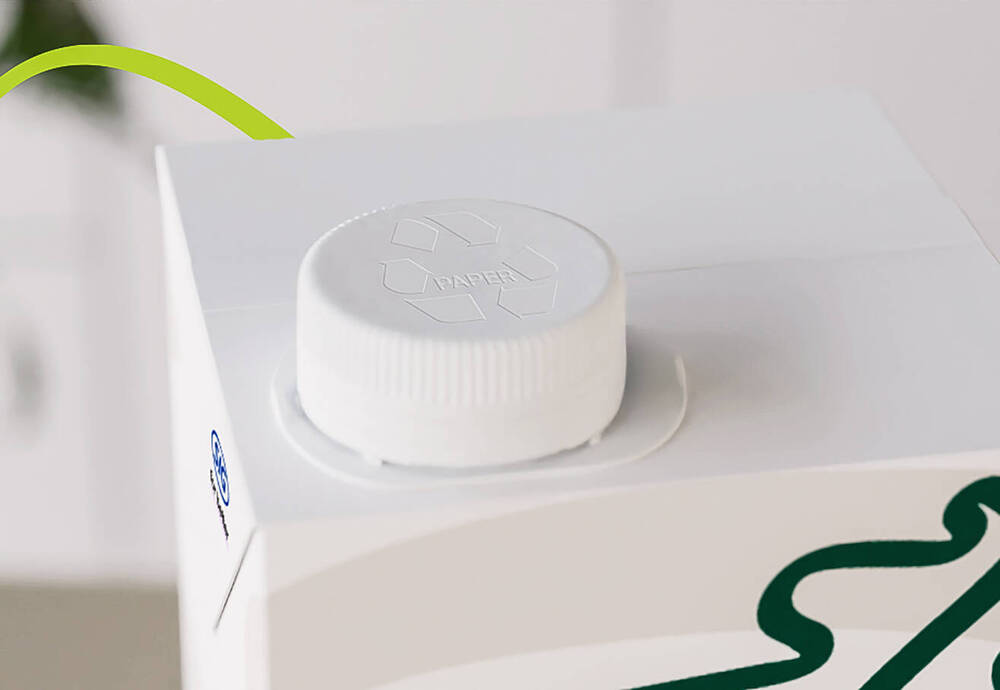

SIG and PulPac will work together to create an exclusive development programme for the development and mass manufacturing of the next generation of paper-based closures for SIG’s aseptic cartons.
This will bring SIG one step closer to its goal of increasing the aseptic cartons’ paper content to 90%, including closure, by 2030.
In its mission to create a fully regenerative food packaging system, SIG is steadily increasing the paper content of its aseptic cartons, to enhance renewability, and further reduce carbon footprints and the use of fossil-based materials. This year, SIG aims to reach an interim target of 85% paper content (excluding closures) and, by 2030, to incorporate paper-based closures to move beyond 90% paper content overall.
PulPac’s Dry Molded Fiber technology is based on forming a dry web of fibres to build cutting-edge responsible solutions instead of creating materials from a fibre slurry. This is resulting in minimised water usage in the moulding process alongside several additional benefits like lower CO2 emissions compared to plastic solutions. The technology also offers unparalleled design flexibility and is engineered for high-volume production, according to the two parties.
Gavin Steiner, chief technology officer at SIG said: “We believe in dry moulded fibre technology, paving the way for innovative and responsible alternatives to plastic closures. It is one of the most scalable fibre-based solutions on the market with great potential to boost progress in the transition from plastic to paper-based closures.”
Steiner added that the paper-based closure, both the base and the cap will be paper-based – significantly increasing the already very high proportion of paper in our aseptic cartons.
“At the same time, we aim to offer consumers the same convenience and first-class opening performance they associate with our existing closure solutions”, he added.
For aseptic carton packs, SIG uses post-application of its closures, only after the products have been filled into the packaging and the cartons have been securely sealed in the aseptic zone of the SIG filling machine.
The precise post-application of the closures using closure applicators developed and built by SIG does not interfere with the aseptic process and ensures that the products remain safely protected. This post-application process lays the foundation for a plug-and-play solution of paper-based closures, which in future will be applied to the closed packaging in the same way as plastic closures without changing the production process.
Christoph Wegener, chief markets officer at SIG noted that for packaging innovations focused on sustainability to have a significant impact, they must be compatible with the installed machinery setup.
“That is why “plug-and-play” solutions are an absolute design principle for us at SIG, which we inherently follow across our unique packaging structures without aluminium layer,” he explained. “We apply the same approach to our paper-based closures. The combination of aluminium-layer-free packaging materials and paper-based closures will be our path to 90% paper content in our full-barrier aseptic cartons. This would be a real breakthrough in the packaging industry toward a circular economy.”