SECO has expanded its Application Hub with a new suite of artificial intelligence applications aimed at enhancing industrial safety, voice security, and human–machine interaction. The Italian embedded computing specialist announced the additions this week, citing growing demand for turnkey AI deployments that can be integrated directly into operational environments.
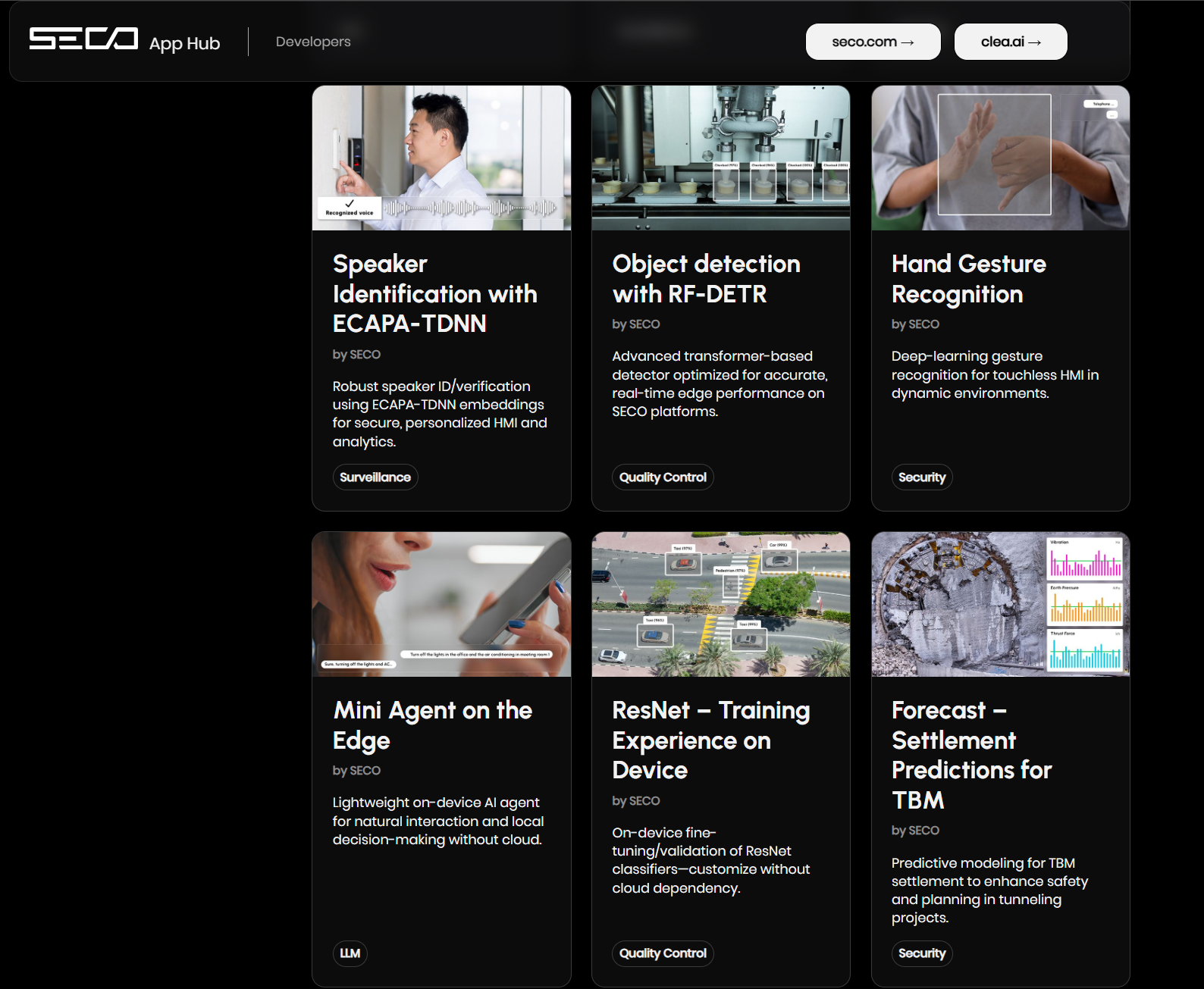
The release spans six applications. These include speaker identification using ECAPA-TDNN for secure voice-based authentication; object detection with RF-DETR for optimised real-time monitoring on SECO platforms; and hand gesture recognition using 3D CNNs, allowing more natural control of machinery and interfaces.
Other additions include a lightweight conversational agent designed to run locally on edge devices, enabling operators to query sensor data and issue commands without cloud dependency; a ResNet-based training tool, which allows developers to train and validate classification models directly on their hardware; and Forecast for TBM, a predictive analytics solution that models ground settlement during tunnel boring to improve safety and project planning.
Fausto Di Segni, Head of IoT and AI at SECO, said: “Our vision is to remove the barriers that typically slow down AI adoption at the edge. With a growing catalogue of ready-to-deploy applications, combined with the Clea Framework and the resources of our Developer Center, we help companies move AI projects smoothly into production. This approach accelerates time-to-market while ensuring alignment with the platforms and ecosystems our clients already use.”
All applications are validated across processors from Intel, Qualcomm, NXP, AMD, Rockchip, and MediaTek, and are backed by SECO’s enterprise Long-Term Support. The company’s Developer Center provides deployment guidelines, specifications, and testing procedures, while a free 90-day trial of the Clea Framework is also available to clients.
By adding these solutions to the Application Hub, SECO is positioning its edge AI portfolio directly against growing industrial demand for production-ready, interoperable software assets. The new applications are available immediately via the company’s platform.