Rolls-Royce Deutschland will lead a European programme to integrate a hybrid-electric subsystem with a gas-turbine engine, moving electrical propulsion technology towards testing as part of the company’s UltraFan 30 demonstrator work.
The ELEVATED project has been selected through the European Union’s fourth Clean Aviation call and brings together industrial, academic and research organisations from France, Germany, the Netherlands, Norway, Spain and the United Kingdom. Grant preparation must still be completed before the project funding is finalised.
Clean Aviation selected 19 projects under the call, with up to €290 million of EU support contributing to €664 million of combined public and private activity when related research and in-kind contributions are included. The portfolio spans hybrid-electric propulsion, hydrogen systems and other technologies intended to reduce emissions from future aircraft.
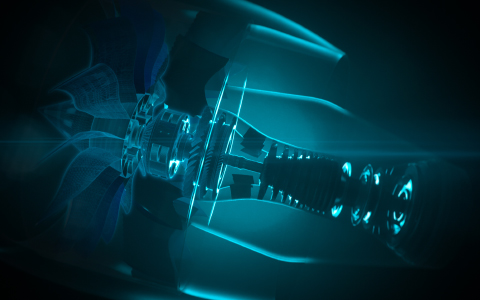
ELEVATED will install its hybrid-electric subsystem into a donor engine rather than limit development to individual electrical components. The consortium will work across electrical machines and drives, high-voltage harnesses, engine integration, powerplant integration, aircraft-level integration, control, modelling and supporting research.
The configuration is intended to establish how electrical power hardware behaves when coupled to a representative gas turbine under realistic boundary conditions. That includes the mechanical, electrical and control interactions that are difficult to reproduce when motors, drives or power electronics are tested separately.
Hybrid-electric propulsion adds equipment to an aircraft as well as potential efficiency. Electrical machines, converters, cables, insulation, cooling and protection systems all carry weight and introduce additional failure modes. Any reduction in fuel burn therefore has to outweigh the mass and conversion losses introduced by the electrical system.
Certification places further demands on the architecture. High-voltage equipment must operate reliably across temperature, vibration and altitude conditions while maintaining electrical isolation and fault protection. Control systems also have to manage the interaction between turbine and electrical hardware without creating unacceptable behaviour during normal operation or failures.
Rolls-Royce says the ELEVATED programme is expected to contribute towards an objective of at least a 20% reduction in aircraft-level carbon dioxide emissions. The project is targeting Technology Readiness Level 6, where an integrated system has been demonstrated in an environment sufficiently representative to inform later product and certification work.
Data from the programme will support modelling, technology selection, product development, certification planning and industrialisation. The output is therefore intended to extend beyond a demonstration run by establishing whether the architecture has a practical route into a future propulsion system.
ELEVATED will feed into Rolls-Royce’s UltraFan 30 programme. The narrower demonstrator is being developed around geared ducted engine technology for future short- and medium-range aircraft and combines developments in engine cores, fans, materials, manufacturing and propulsion-system efficiency.
Ground testing of UltraFan 30 is planned for 2028. Rolls-Royce says the demonstrator is intended to validate technologies relevant to future narrowbody propulsion while retaining compatibility with 100% sustainable aviation fuel.
The hybrid-electric work is running alongside the EU-supported UNIFIED programme, which is advancing turbomachinery and other elements of UltraFan 30. Rolls-Royce secured €64 million of EU funding for UNIFIED earlier in 2026, giving the company parallel development streams around the gas-turbine architecture and electrical integration.
Combining those streams creates a more demanding engineering benchmark than testing hybrid equipment against an older propulsion baseline. Improvements to fan, core and gearbox efficiency reduce the amount of energy wasted by the gas turbine, so any electrical subsystem has to demonstrate a measurable aircraft-level advantage after its own mass and losses are included.
The latest Clean Aviation call also places hybrid systems alongside competing or complementary routes. Rolls-Royce is participating in FARMAN, covering hydrogen distribution, and H-ELENA, focused on low-NOx direct hydrogen combustion, while other consortia are pursuing fuel cells and ultra-efficient conventional propulsion.
That breadth reflects the absence of a single settled architecture for future short- and medium-range aircraft. Different missions may favour different combinations of turbine efficiency, electrical power, hydrogen or sustainable liquid fuel, while infrastructure and certification will influence which technologies can move from demonstrators into service.
The ELEVATED consortium spans six European countries and covers electrical machines, drives, high-voltage harnesses, engine and powerplant integration, aircraft integration, control and modelling. Those work packages must mature together before the hybrid-electric subsystem can reach the planned donor-engine demonstration and generate representative integration data.
ELEVATED gives hybridisation a defined physical milestone inside that process. By 2028, the programme is intended to have moved beyond isolated motors and power electronics to an integrated subsystem operating with a gas turbine and producing the data required for a later engineering decision.