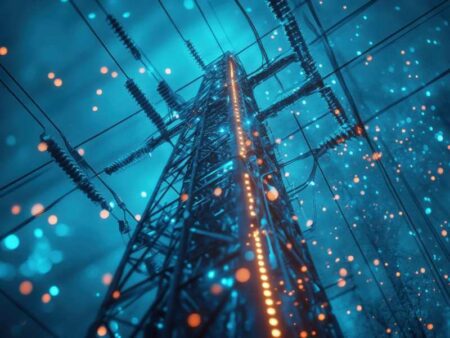

Image courtesy 123rf
Alon Kessel of Voltify explains how, following the blackout in Iberia, we need to rethink our approach to managing and balancing the power grid in real time.
This past April, a major power outage swept across the Iberian Peninsula, plunging large swaths of Spain and Portugal into darkness for nearly a full day.
But the blackout wasn’t the result of a dramatic natural disaster or sophisticated cyberattack. Instead, it was a consequence of poor grid planning and configuration, where limited infrastructural flexibility and a lack of cross-regional coordination allowed a localized issue to cascade into a broader regional failure.
The incident serves as a clear case study in the risks of relying too heavily on energy systems that are designed for stability, without adaptability in mind.
While the ongoing transition to clean, renewable energy is critical for a sustainable future, this shift has overlooked the need for reimagining infrastructure that can deliver energy to where it’s needed, when it’s needed, especially under stress.
To better prepare for a future of rising and more dynamic energy needs, we need to rethink how we manage, deliver, and balance the electric grid in real time.
The legacy grid
The grid’s core vulnerability isn’t insufficient energy generation – it’s a lack of agility. Indeed, today’s systems are under more pressure than ever before, yet they can’t dynamically reroute, balance, or protect energy flows. That’s because the grid has historically operated on a centralized model, where power generated at large fossil-fuel plants flows predictably and one-directionally to passive consumers.
However, this centralized configuration, designed for stability and simplicity, is fundamentally out of step with today’s energy landscape, which is shaped by flexible, distributed assets, bidirectional flows, and demand patterns that fluctuate by hour, day, and season.
Adding to the complexity are electric vehicles (EVs), heat pumps, smart appliances, and digital infrastructure such as data centers, all of which require fast-ramping, highly reliable power loads that legacy systems were never built to handle. Climate shifts add another layer of stress, with rising temperatures and more frequent extreme weather events threatening to damage infrastructure or push systems beyond their limits.
These concerns aren’t just distant projections. The North American Electric Reliability Corporation predicts that record load growth and intensifying heat will continue to strain grid capacity this summer and into the future, as demand outpaces our ability to deliver reliable power.
Have you read:
Europe’s grids need more resilience finds ENTSO-E’s April blackout investigation
Eurelectric proposes steps for DSOs to enhance climate change resilience
Changing the way energy is delivered
While investment in renewables is important, integrating these energy sources into the grid can actually destabilize it if not supported by the right infrastructure. Even as we generate more sustainable power, our current network simply isn’t structurally prepared to accommodate significant changes. In other words, without modern infrastructure capable of dynamically storing and transmitting renewable energy like solar or wind power, these sources might actually introduce volatility, strain transmission lines, and trigger far-reaching consequences.
Suboptimal grid systems are more than a mere inconvenience – the blackout in Spain and Portugal caused an estimated 400 million euros in economic disruption. If we fail to develop a system that can intelligently manage our electricity in real time, more countries are bound to face similar crises.
Even when the failures of centralized systems don’t reach the scale of the this recent outage, they can lead to unwanted side effects, including the loss of generated power that goes unconsumed, and is ultimately wasted.
Resilience must be engineered from the ground up
To mitigate future outages and ensure long-term reliability, the electric grid must evolve from a rigid, centralized system into a flexible, decentralized network that can sense, anticipate, and adapt to a wide range of variable factors, from unexpected weather changes to sudden demand spikes. This next-generation grid must respond automatically to disruptions while also coordinating with other sectors in real time.
To start, this means investing in, smart inverters, and grid-edge automation that can detect faults, isolate issues, and reroute power in milliseconds—often the difference between a blackout and a narrowly avoided crisis. But hardware upgrades aren’t enough. They need to work hand-in-hand with AI and software-driven systems that can respond instantly to changing grid conditions, shift supply, and reconfigure energy flows far faster and more precisely than any human-operated control room.
Although the technologies needed to build more resilient systems already exist, significant challenges still exist due to outdated operating models, misaligned regulatory incentives, and planning assumptions that continue to treat the grid as static infrastructure rather than a dynamic, adaptive network. Additionally, efforts to create distributed energy networks are often undervalued or confined to isolated pilot programs, instead of being embraced by grid operators for the resilience and flexibility they provide.
The energy system of the future
The whole energy system has to be resilient – not just its components – in order for it to function reliably. That resilience depends on tight coordination between hardware, software, markets, and human operators, all working in tandem to facilitate a system that can localize, absorb, and recover from disruptions rapidly, without compromising the wider network.
To achieve this, the grid of the future must enable:
- Visibility into real-time conditions at every layer of the grid.
- Distributed control and automation that can act locally before failures escalate.
- Flexible demand-side participation in responding to grid signals, where smart appliances or EV chargers interact with the grid, rather than simply drawing energy from it.
- AI-driven platforms that can forecast stress, simulate scenarios, and optimize grid operations in real time.
- Cooperation and coordination between governments, major commercial industries, and energy providers.
The challenges outlined here will only grow more pressing in the years ahead. Those utility providers who can shift their energy systems away from purely stability-focused models and instead combine the strengths of a “distributed energy” approach with a technologically advanced, ground-up redesign of grid infrastructure will be the best positioned to navigate the road ahead.
A practical way for utility providers and governments to assess the impact of transitioning from rigid stability to flexible distribution is to pinpoint the sectors and industries with the most to gain from a distributed energy model. Organizations that are large-scale power consumers, such as hospitals, universities, military bases, data centers, industrial parks, and even small communities, can offer an apt litmus test, as they stand to tangibly benefit from lower energy costs and improved resilience. As an example, microgrids, which can function together as a distributed energy network combining power generation and consumption capabilities, are a versatile solution for these large power consumers. Microgrids’ ability to incorporate diverse energy sources and optimize energy flow using AI and advanced forecasting models allows them to balance supply and demand effectively in real time to minimize cost and disruptions while boosting resilience.
Gird your grids
Energy systems built for yesterday’s demands are already struggling to meet today’s challenges, and the cost of inaction grows with each failure. As electrification and renewables continue to reshape the energy landscape, resilience must be treated as a core design principle, not an afterthought.
The sustainability and stability of our future depends on energy systems that are decentralized, intelligent, and self-coordinating—designed to adapt to volatility rather than be broken by it. Powering the future is not just about installing more renewable generation capabilities, it’s about fundamentally rethinking how we plan, build, and operate the infrastructure that ties it all together.
About the author:

Alon Kessel is the co-founder and CTO of Voltify, a startup working to decarbonise freight rail transportation through innovative electrification technologies. Before launching Voltify, Alon cofounded Doral and led major innovative energy developments like the combination of solar photovoltaics with orchard agriculture (agrivoltaics).