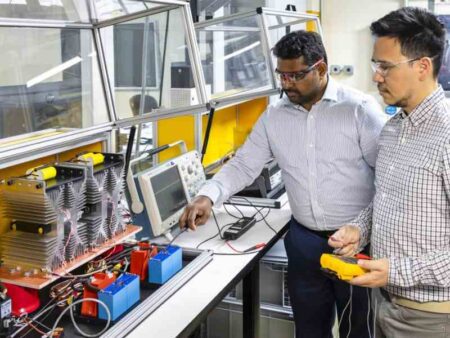

Prasad Kandula and Marcio Magri Kimpara set up testing of ORNL-developed medium-voltage circuit breakers that use affordable semiconductors to protect grid systems that use direct current. Credit: Carlos Jones/ORNL, US Dept. of Energy.
Researchers at the US Department of Energy’s Oak Ridge National Laboratory (ORNL) say they have developed medium-voltage circuit breakers capable of handling increasing levels of DC at a lower cost.
ORNL researchers are designing and scaling up the capacity of a new type of semiconductor-based circuit breaker, which they say can operate a hundred times faster than mechanical switches.
This enables wider use of DC in the electric grid as it becomes more attractive to energy system designers for its efficiency, flexibility and compatibility with modern energy sources and loads.
Explaining in a release was Prasad Kandula, who leads ORNL’s Grid Systems Hardware group: “The lack of medium-voltage circuit breakers for direct current has been an obstacle to flexibility in delivering electricity.
“Once you go to DC, that ‘zero current’ moment is gone — and without it, a mechanical switch isn’t fast enough to stop a fault before heat builds up and a fire starts.”
Have you read:
How to measure the impact of growth of data centres on energy consumption
Brazil’s Electrobras expands AI partnership for real-time fault monitoring
A turn to semiconductors
ORNL explains that DC systems rely on fast-acting power electronics, which require equally fast protection.
Semiconductors offer both speed and greater safety for DC systems, says the lab, whereas traditional mechanical breakers rely on a physical gap that is less effective in stopping DC, which is capable of sparking across a gap in an arc of explosive energy.
To avoid this, the lab says the current can instead be routed away through a semiconductor-based device, significantly reducing safety risks and wildfire risks.
However, until now, semiconductor breakers have been too expensive to either compete economically with mechanical breakers for AC, or to facilitate expanded use of DC grids. No type of commercial breaker can handle DC above 2,000 volts, and most can’t achieve half that.
This is where ORNL’s testing comes in.
Cost-effective thyristors
Kandula and his team set out to find a cost-effective solution to fill this performance gap. They focused on an older, industry-accepted semiconductor called a thyristor.
“We selected a base technology that was robust, efficient and inexpensive,” Kandula said about thyristors, which are affordable enough to make semiconductor-based switches competitive for the first time.
According to ORNL, thyristors cannot be directly “switched” off, so the team also had to design an external circuit to forcibly reduce the current.
In ORNL’s Grid Research Innovation and Development Center, or GRID-C, engineers built and tested a circuit breaker prototype to interrupt a current at 1,400 volts in less than 50 microseconds – four to six times faster than had been demonstrated with thyristors previously.
To prove the technology could be scaled up to handle higher voltages, researchers connected the breakers in a series – meaning one after another along the same electrical path.
This approach, says the lab, comes with technical challenges – the voltage must be shared evenly across all breakers, to prevent any single device from becoming overloaded and failing; creating a series of breakers must not delay the system’s rapid reaction time.
ORNL researchers designed solutions and tested them in a series of breakers operating up to an 1,800-volt testing capacity. They are already working on adding to the series for eventually scaling up to 10,000 volts, anticipating the larger energy demands of future DC grids.
The project is part of a larger ORNL initiative, announced back in February, to develop a menu of stackable medium-voltage building blocks for expanding new power applications in US transportation, manufacturing and data centres.